Exchange Ranking
 Top Exchanges
 24h Volume Ranking
 Popularity Ranking
 Exchange BTC Balance
 Proof of Reserves
 Decentralized Exchanges
 Funding Rate
 Funding Heatmap
 Liquidation Data
 Max Pain
 Long/Short Ratio
 Whale L/S Ratio
 Binance/Okex/Huobi L/S
 Bitfinex Margin L/S
 ETF Tracker
 Solana ETF
 XRP ETF
 Hong Kong ETF
 Bitcoin Treasuries
 Crypto Reversal
 Ethereum Reserves
 HyperLiquid Wallet Analysis
 Hyperliquid Whale Watch
 Large Transactions
 On-chain Movement
 Bitcoin ROI
 Stablecoin Market Cap
 Options Analysis
 News
News Articles
 Economic Calendar
 Features
 Wallet
 Contract Calculator


 Security
 Collections
 Watchlist
 Following
 USD1
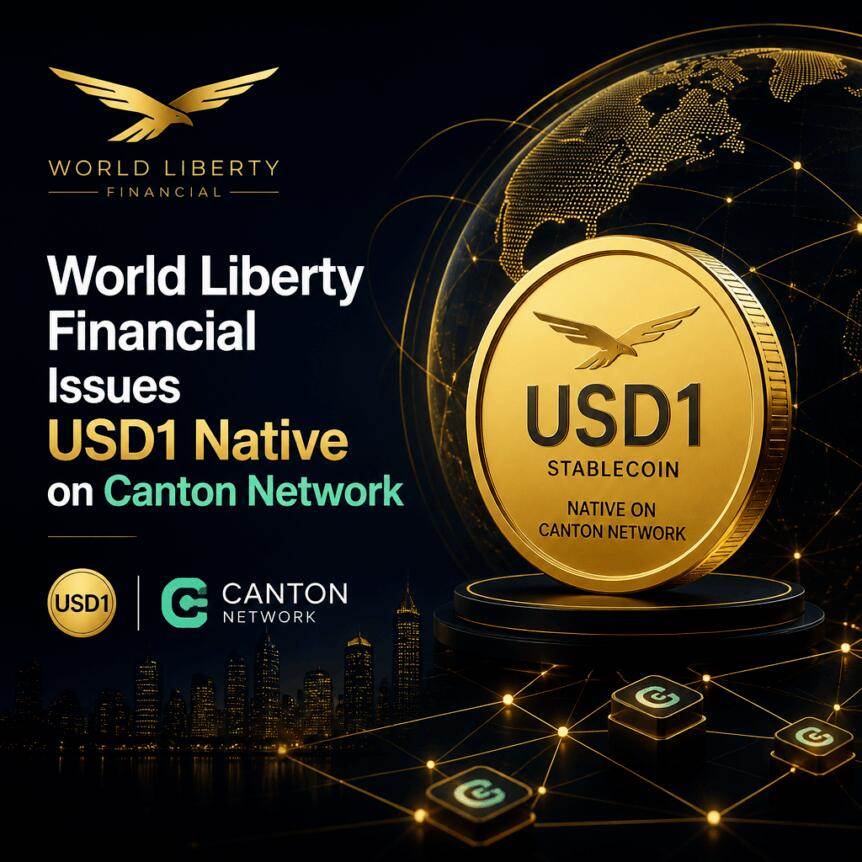
USD1 World Liberty Financial launches native USD1 stablecoin on Canton Network
World Liberty Financial has launched its native form of USD1 stablecoin on Canton Network, aiming to position the token as a "cash pillar" in transactions involving tokenized real-world assets (RWA). The move targets institutional work processes, where settlement typically needs to be carried out simultaneously with issuance, redemption and collateral rather than through separate payment channels.
In an announcement released on Tuesday, the project said institutions can use USD1 on Canton to settle activities such as derivative collateral, institutional lending, and asset issuance and redemption. The company emphasized that the native issuance was designed to allow USD1 to be cleared together with tokenized assets in the same transaction while leveraging Canton's privacy and rights control features.
Core Points
USD1 is now natively available on the Canton Network and aims to simplify the settlement process for tokenized real-world assets. This stablecoin positioning serves institutional application scenarios, including derivative collateral, loans, and asset issuance and redemption. World Liberty said the native issuance allows USD1 to be settled with tokenized assets in the same transaction, while leveraging Canton's privacy/permissions features. According to DeFiLlama data, the circulation market value of USD1 is approximately US$4.05 billion, making it the sixth largest stablecoin. USD1 is managed by BitGo Bank & Trust and conducts reserve supervision and casting/redemption processing.
Importance of native settlement to tokenized RWA
The actual value of issuing stablecoins "natively" on blockchain for institutional finance is that it reduces the friction between tokenized assets and payment settlement. Native issuance does not view cash settlement as an off-chain or external step, but rather supports the concept that stablecoin flows occur concurrently with asset transfers, issue events, or contract-based collateral changes. World Liberty's vision is that USD1 could be used for settlements involving tokenized RWAs-particularly as a cash pillar in transactions such as derivative collateral and institutional lending. This is important because many tokenization efforts depend not only on representing assets on the chain, but also on how reliably and efficiently the corresponding payment link can be executed, subject to the constraints of institutional requirements. The company also mentioned Canton's privacy and rights control features. For investors and institutions evaluating tokenized asset infrastructure, these functions are often core: They can determine what data is visible, who can interact with which components, and how to build compliance-oriented workflows within the blockchain system.
Current size and operator of USD1
According to DeFiLlama's stablecoin data, the market value of USD1 is approximately US$4.05 billion, described as the sixth-largest stablecoin by market value. In terms of issuance and operations, World Liberty stated that USD1 is issued by BitGo Bank & Trust, which manages reserves and handles the casting and redemption processes. This operational separation-with designated banking entities managing stablecoin reserves and issuance processing, while on-chain use is achieved through network integration-highlights how stablecoin business models often combine traditional financial controls with blockchain distribution. For participants on Canton, this structure may affect assumptions about redemption processes and reserve supervision, especially when stablecoin settlements are intended to be used in a regulated or institutional environment.
Canton's Institutional Focus and Internet Tokenized Asset Activities
Canton positions itself as a public, permission-free blockchain designed specifically for institutional finance, and the company says it handles large flows of tokenized assets. In an update released along with the USD1 integration, Canton claims that it processes and issues more than US$9 trillion in tokenized assets per month. It also mentioned that more than $350 billion in chain-bound U.S. Treasury bonds flow on the network every day. These numbers do not directly guarantee future use of USD1 on Canton, but they do help understand why stablecoin integration is strategic. If tokenized securities and RWA instruments have been transferred with considerable frequency, the settlement layer becomes a key bottleneck-or a competitive advantage-depending on how efficiently it can match payment times and compliance requirements. By placing USD1 in this environment, World Liberty appears to aim to integrate more deeply into institutional token flows, rather than limiting USD1 to its role as a stand-alone stablecoin in the broader DeFi market.
Integration timing: part of Canton's broader layout
The USD1 release follows another Canton expansion announcement reported last week. According to earlier reports, the American Ideal Foundation, founded by Digital Asset and former U.S. House Speaker Paul Ryan, announced plans to pilot a Canton-based system for distributing state-managed benefits in three U.S. states, expected to begin in 2027. While the USD1 program and the benefits distribution pilot are significantly different in purpose, they both point to Canton's broader ambition: to attract enterprise-level use cases and institutional participants. This order is important to observers because it suggests that the network is actively positioning its infrastructure to support multiple categories of on-chain activities-from financial settlements involving tokenized assets to non-traditional public distribution workflows.
Next steps for USD1 on Canton
With USD1 now running natively on Canton, the key question facing market participants is how long it will take for institutions to move from the testing phase to continuous on-chain clearing of tokenized asset transactions. Focusing on the evidence that USD1 is used in the specific workflows highlighted by World Liberty-particularly collateral and issuance/redemption processes-will show whether native clearing can provide measurable operational advantages in real transactions.