Exchange Ranking
 Top Exchanges
 24h Volume Ranking
 Popularity Ranking
 Exchange BTC Balance
 Proof of Reserves
 Decentralized Exchanges
 Funding Rate
 Funding Heatmap
 Liquidation Data
 Max Pain
 Long/Short Ratio
 Whale L/S Ratio
 Binance/Okex/Huobi L/S
 Bitfinex Margin L/S
 ETF Tracker
 Solana ETF
 XRP ETF
 Hong Kong ETF
 Bitcoin Treasuries
 Crypto Reversal
 Ethereum Reserves
 HyperLiquid Wallet Analysis
 Hyperliquid Whale Watch
 Large Transactions
 On-chain Movement
 Bitcoin ROI
 Stablecoin Market Cap
 Options Analysis
 News
News Articles
 Economic Calendar
 Features
 Wallet
 Contract Calculator


 Security
 Collections
 Watchlist
 Following
 EGLD
EGLD High-performance blockchain designs have long faced structural tradeoffs: when execution is directly tied to consensus, network throughput is limited by the speed at which the verifier processes transactions. As research and engineering teams progress on final confirmation and block propagation, execution itself is seen as the next bottleneck requiring redesign.
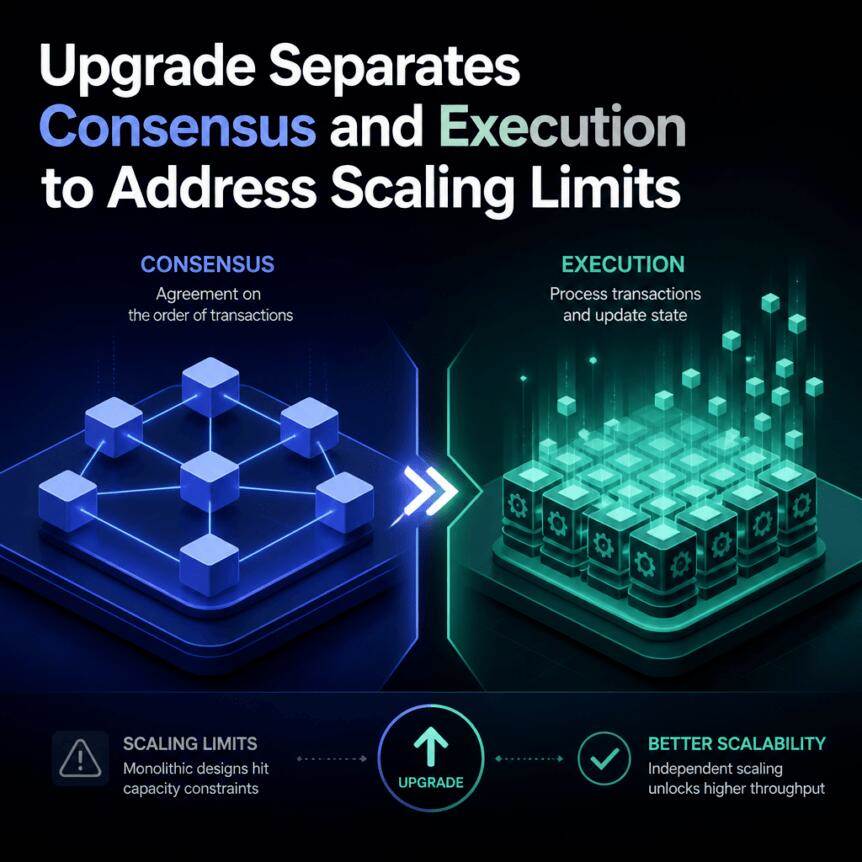
As a participant in the Cointelegraph Decentralized Guardians (CTDG) ecosystem, MultiversX is testing a solution that aims to eliminate this bottleneck. Its Supernova upgrade decouples consensus from transaction execution, allowing verifiers to vote without waiting for execution to complete-turning calculations into asynchronous pipelines. Supernova is already testing its online launch, and the main-network activation plan will be implemented later this year.
Core Points
Supernova Reordering Block Workflow: Proposer submits unexecuted transaction blocks, and verifiers immediately vote based on the validity of the agreement.
The execution results are confirmed in subsequent block headers, and the execution lag is about one block (about 600 milliseconds).
"Virtual Memory Pool Status" maintains effectiveness by tracking pending nonce, expected balance consumption, and proposed but not executed transactions.
The execution result inclusion estimator (EIE) limits the number of execution results that can be referenced by a block based on the minimum configured node security processing capabilities.
When execution is severely delayed, the automatic backpressure mechanism reduces block capacity and provides catch-up time for the system.
Why execution and consensus binding becomes an extension problem
In traditional synchronous blockchains, verifiers not only need to confirm that the block structure is correct, but also have to execute transactions before voting to verify state transitions. This ensures system certainty and consensus criticality, but it also creates a sharing bottleneck: the most computationally intensive transactions slow down the entire network. Many networks have been working for years to optimize consensus speed and block propagation, but MultiversX believes that these optimizations are not enough if execution is still on the critical path. The core architectural question Supernova solves is: Does execution have to remain within the consensus loop, or can it be processed asynchronously while ensuring safety and correctness?
Supernova's asynchronous pipeline: vote first, execute later
Supernova, now online on the testnet, has introduced a new block generation sequence. Previously, block generation followed a more serial model: the proposer selected the transaction, executed it locally, and submitted the block containing the execution results, the verifier needed to re-execute the transaction verification state transition before voting, and execution was directly in the consensus critical path. Supernova changed this order: proposers choose transactions and submit blocks without prior execution; verifiers can vote immediately after confirming that the proposal conforms to the rules of the agreement. Execution occurs asynchronously in the background, and the output results are usually referenced and notarized in the next block header-execution lags by about one block (about 600 milliseconds). The actual effect is that the network's response speed no longer depends on the speed at which the verifier executes all transactions before participating in the consensus. Instead, the consensus is advanced based on the validity of the protocol, and execution is catching up on a parallel path.
Effectiveness assurance when implementing lagging consensus
Decoupling execution from consensus presents security and effectiveness challenges: If execution is delayed, how does the network determine that transactions in the proposed block will remain valid while generating execution results? Supernova solves this issue through the state of the virtual memory pool. The pool goes beyond the latest executed chain status and tracks forward-looking execution inputs such as pending nonce, expected balance consumption, and transactions proposed but whose execution results fail to pass consensus. This provides proposers with a more accurate view of account activity, allowing them to select transactions that they expect to execute successfully when the round arrives. In order to maintain system robustness when verifier performance varies, MultiversX also introduces two operational stability guarantees:
Execution Result Included Estimator (EIE): Limit the number of execution results that can be referenced in a block, and the upper limit is linked to the security processing capabilities of the minimum configured node to reduce the risk of overloading weak nodes due to referencing too many pending results.
Automatic backpressure mechanism: When execution lags severely, reduce block capacity to allow the network to catch up rather than allowing delays to accumulate endlessly.
Supernova's Impact on Developers and Users
For builders, the key message is that "final confirmation within a shard" can arrive immediately when proof is available-MultiversX says this typically occurs in the same round of about 100-250 milliseconds, while execution conditions are more predictable. This is critical for applications that rely on fast feedback loops, such as high-frequency DeFi primitives and on-chain orderbook systems, where performance can degrade significantly when latency becomes a user experience issue. Since August 20, Supernova has generated 600-millisecond blocks on the real-time test network and development network. The broader goal of the network is to make on-chain interactions feel more immediate and transform the experience into a responsive application infrastructure rather than delaying billing. On the timeline, MultiversX stated that the main network activation is expected to take place on September 10, 2026. Although testnet performance may not fully reflect the behavior of a fully loaded mainnet, the architecture itself is designed to handle execution delays without forcing all verifiers to execute transactions first during the consensus period.
Supernova's positioning in the CTDG and Cointelegraph ecosystem
The upgrade is also part of broader infrastructure collaboration. Previous reports pointed out that Cointelegraph joined MultiversX as a verifier through the CTDG program in March 2026, deepening its operational role beyond content and community work. Cointelegraph's CTDG Developer Center is also described as an official MultiversX partner, connecting the protocol to the broader developer community. From an industry perspective, such protocol upgrades often require ecological collaboration: performance improvements only make sense if the infrastructure, tools, and participating verifiers can reliably adopt new execution and consensus mechanisms. Supernova's focus on backpressure mechanisms and minimum configuration guarantees suggests that its design is designed to make this transition smoother. As Supernova moves from the testnet to the expected mainnet date, the key points for users to pay attention to are whether execution latency remains within expected ranges under actual loads, and how EIE and backpressure mechanisms prevent verifiers from falling behind without excessively limiting throughput. The criterion for success is not only faster final confirmation, but also whether execution remains reliable when consensus and execution run at different paces.