Exchange Ranking
 Top Exchanges
 24h Volume Ranking
 Popularity Ranking
 Exchange BTC Balance
 Proof of Reserves
 Decentralized Exchanges
 Funding Rate
 Funding Heatmap
 Liquidation Data
 Max Pain
 Long/Short Ratio
 Whale L/S Ratio
 Binance/Okex/Huobi L/S
 Bitfinex Margin L/S
 ETF Tracker
 Solana ETF
 XRP ETF
 Hong Kong ETF
 Bitcoin Treasuries
 Crypto Reversal
 Ethereum Reserves
 HyperLiquid Wallet Analysis
 Hyperliquid Whale Watch
 Large Transactions
 On-chain Movement
 Bitcoin ROI
 Stablecoin Market Cap
 Options Analysis
 News
News Articles
 Economic Calendar
 Features
 Wallet
 Contract Calculator


 Security
 Collections
 Watchlist
 Following
 EGLD
EGLD Architectural bottlenecks and asynchronous execution solutions for high-performance blockchains
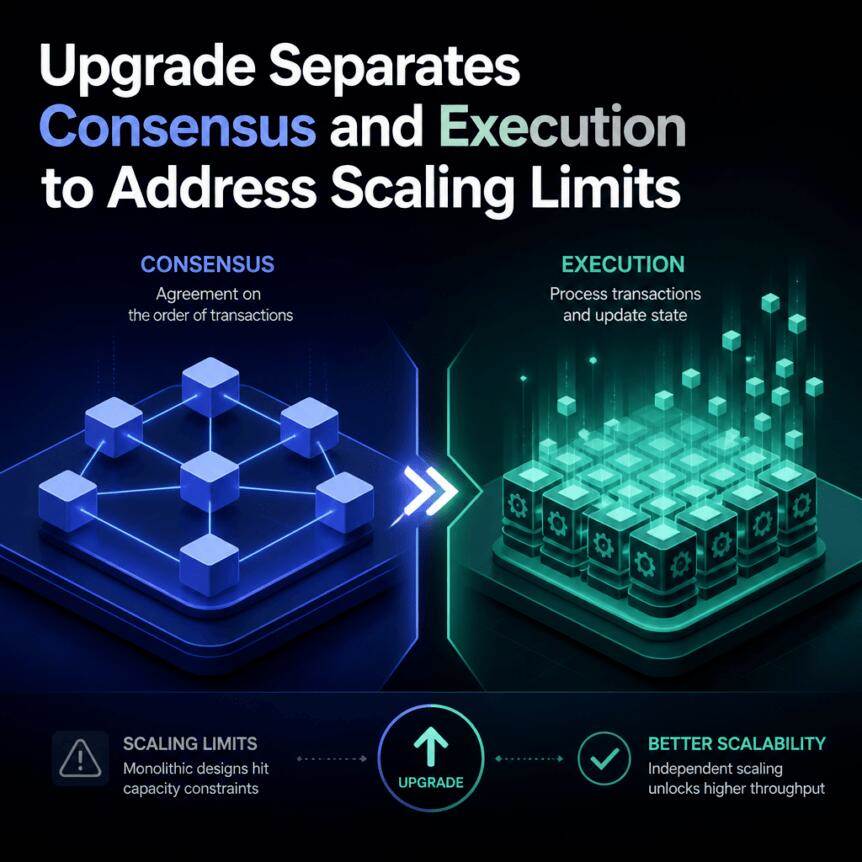
High-performance blockchains often face the same architectural limitations: the execution process lies directly on the consensus path. In traditional synchronization models, the verifier must first execute transactions within the block to confirm whether the final state transition is valid. Although this design ensures network certainty, it also turns computing into a sharing bottleneck. Whether it is more complex smart contract logic, cross-system coordination, or heavier status updates, the more complex the transaction, the more dependent network speed depends on how quickly the validator processes those transactions. The slowest execution link along this path may eventually become a constraint on the rhythm of the entire system.
Many networks have spent years optimizing finality, network efficiency and block propagation. Today, execution has become the next architectural constraint. The new design is no longer just focused on getting verifiers to reach consensus faster, but starts thinking: Does execution have to stay inside the consensus cycle?
Moving to the Asynchronous Computing Pipeline
MultiversX eliminates this constraint with Supernova (now online testnet), decoupling consensus from execution, allowing the network to reach block consensus before processing transactions. Prior to Supernova, block production followed a sequential model: proposers selected transactions, executed them locally, and then submitted the block containing the execution results. Verifiers must re-execute the same transaction before voting, which puts execution directly on the consensus critical path.
Supernova changed the order: the proposer selects the transaction and submits the block, but does not need to execute it in advance. After verifying that the proposal conforms to the protocol rules, the verifier votes immediately, and execution occurs asynchronously in the background. The execution result is usually referenced and notarized in the next block header, so execution is about one block behind the consensus, about 600 milliseconds.
Decoupling execution from consensus immediately raises an effectiveness issue: the network must determine whether the proposed transaction is likely to remain valid before execution catches up. Supernova solves this problem through virtual memory pool status. The memory pool not only focuses on the latest executed chain status, but also tracks pending nonce, expected balance consumption, and transactions that have been proposed but the execution results have not yet passed consensus. Proposers can gain a forward-looking view of account activity and select transactions that will still be successfully executed when their turn arrives.
MultiversX has also added two security mechanisms around the new pipeline. Execution results include the Estimator (EIE) limits the number of execution results that can be referenced in a block based on the ability of the lowest specification node to safely process. At the same time, if execution lags too far behind, the automatic backpressure mechanism will reduce the block capacity and allow the system catch-up time.
Collaborative development in decentralized ecosystems
This upgrade is also part of broader ecological cooperation. A media organization joined the network as a verifier through related projects in March 2026, extending the partnership to the infrastructure participation level. MultiversX is also an official partner of a developer center that connects the protocol to the broader community of developers and blockchain users. The partnership has reached real depth: the MultiversX Foundation has delegated rights to the verifier, and the developer center team has built a dedicated verifier dashboard on MultiversX.
From a builder's perspective, finality within a shard is achieved when the proof is available, usually within the same round, about 100 - 250 milliseconds, while execution conditions are more predictable. These conditions are most important for applications that rely on tight feedback loops, such as high-frequency DeFi primitives, on-chain order books, and other systems that start to crash when delays affect the user experience.
Since August 20, Supernova has generated 600-millisecond blocks on the real-time test network and development network, with its broader goal of making on-chain interactions feel instant. Mainnetwork activation is expected to take place on September 10, 2026. This shift reflects a broader trend: blockchain is moving towards something more like a responsive application infrastructure than a deferred settlement engine.