Exchange Ranking
 Top Exchanges
 24h Volume Ranking
 Popularity Ranking
 Exchange BTC Balance
 Proof of Reserves
 Decentralized Exchanges
 Funding Rate
 Funding Heatmap
 Liquidation Data
 Max Pain
 Long/Short Ratio
 Whale L/S Ratio
 Binance/Okex/Huobi L/S
 Bitfinex Margin L/S
 ETF Tracker
 Solana ETF
 XRP ETF
 Hong Kong ETF
 Bitcoin Treasuries
 Crypto Reversal
 Ethereum Reserves
 HyperLiquid Wallet Analysis
 Hyperliquid Whale Watch
 Large Transactions
 On-chain Movement
 Bitcoin ROI
 Stablecoin Market Cap
 Options Analysis
 News
News Articles
 Economic Calendar
 Features
 Wallet
 Contract Calculator


 Security
 Collections
 Watchlist
 Following
 BTC
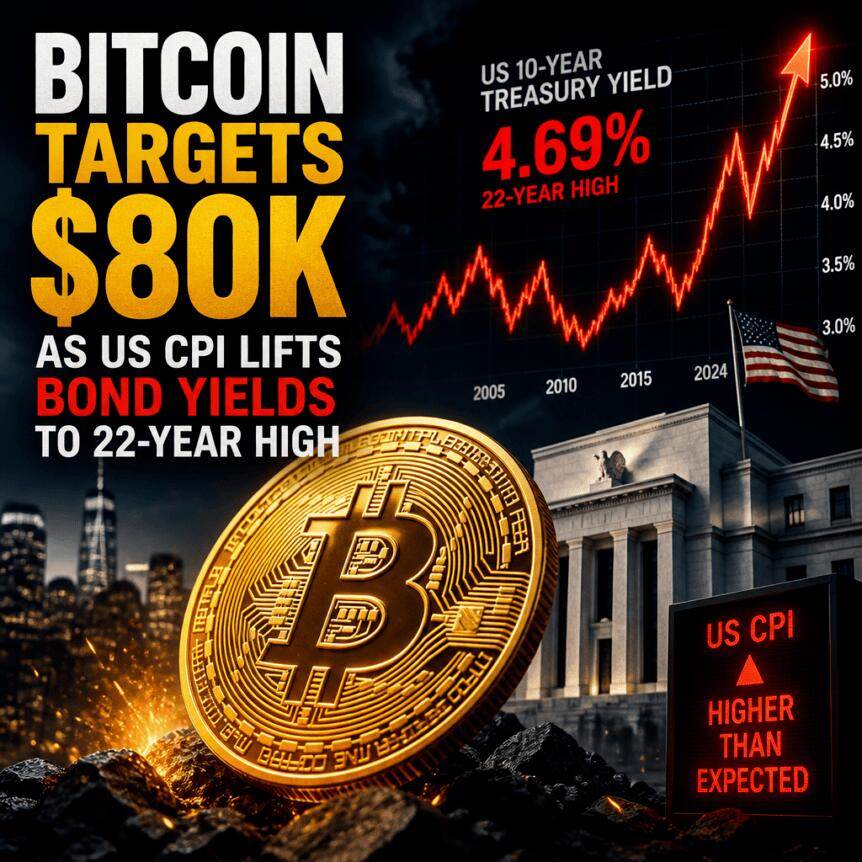
BTC Bitcoin rebounds to near $79,000, inflation data alleviates pressure on risky assets
On Friday, as core U.S. inflation data largely met market expectations, Bitcoin (BTC) rebounded to a level of about $79,000, which helped ease upward pressure on risky assets earlier in the trading session. However, this Relief Rally is unfolding against the backdrop of sharp fluctuations in U.S. bond yields. Market participants said this environment could make it difficult for Bitcoin to maintain gains.
The U.S. Consumer Price Index (CPI) showed core prices rose 0.3% month-on-month in August, slightly above traders 'expectations of 0.2%, while the broader inflation narrative remained closely tied to the Federal Reserve's interest rate expectations. According to data from CME Group's FedWatch tool, the implied probability of a 25 basis point rate hike at the September 16 meeting rose to 85% on Friday, up from about 60% a week ago.
Key Points
- Bitcoin surged more than 3%, as the core CPI increased by 0.1 percentage points month-on-month.
- CME FedWatch tool data shows that the probability of a 25 basis point rate hike in September rose to 85% after the data was released.
- Bond market reactions were volatile: The yield on the 30-year Treasury bond soared to its highest level since June 2004, before falling back.
- Trading firm QCP warned that higher yields and tightening expectations could become headwinds for Bitcoin until Treasury liquidity support takes effect.
Bitcoin rebound after "nervous" digestion of CPI data
TradingView data showed that the BTC/USD market experienced new intra-day fluctuations after the release of CPI data, which showed a year-on-year inflation rate of 3.4%. After briefly falling to around US$76,000 after the data was released, BTC/USD quickly reversed and closed up more than 3% on the day.
This trend is in sync with the overall improvement in the U.S. stock market, although initially weak. As of press time, the S & P 500 index was up about 1%, and the Nasdaq Composite Index was up about 1.1%. In contrast to the previous week, Bitcoin came under pressure after the producer price index (PPI) exceeded expectations, the CPI reading was widely seen as "in line with expectations," easing previous shocks.
Although the stock market has stabilized, the interest rate market has become more erratic. In response to the CPI release, the 30-year Treasury yield fluctuated sharply-first soaring to heights not seen since June 2004, and then falling back to about 5.309%. "This is a tight market," trading resource platform The Kobeissi Letter concluded in a post on Platform X.
Core CPI details strengthen policy focus
Inflation data highlights that energy costs continue to drag on monthly price movements. The U.S. Bureau of Labor Statistics (BLS) reported that gasoline prices rose 3.9% in August, accounting for more than one-third of the total monthly increase in CPI for "all items." BLS also noted that the energy index rose 2.1% for the month.
These components are critical to the speed with which traders form a deflationary narrative. Combined with overall data, BLS said that core CPI rose 0.3% month-on-month in August, about 0.1 percentage points higher than expected, which put the Fed's next move firmly in the spotlight.
As a result, traders are more proactive in adjusting interest rate expectations. CME's FedWatch tool shows that the probability of a 25 basis point rate hike at the September 16 meeting has increased significantly, reaching 85% on Friday. This is a significant shift from the implied probability of about 60% a week ago.
Impact of Federal Reserve divergence signals on cryptocurrencies
U.S. policy uncertainty continues to shape real-time trading conditions for cryptocurrencies. The article pointed out that Fed officials have not fully agreed on the appropriate path for the future. In particular, Governor Christopher Waller said he would prefer to keep interest rates within the current range of 3.50%-3.75%, if upcoming inflation data showed at least "some signs of de-inflation."
Reuters previously reported Waller's view that another 25 basis points rate hike at the next meeting will not be enough to push CPI down to the 2% target, emphasizing the limitations of incremental actions when inflation momentum is uncertain. For Bitcoin, this debate is crucial because markets tend to become more sensitive to real yields and broader "risk-free" benchmarks when inflation readings cannot clearly verify cooling trends. In other words, even if the CPI data is not catastrophic, core data that is "slightly above expectations" could still reprice the interest rate path in a way that limits risk-taking.
QCP warns that yields could weaken Bitcoin momentum
In addition to immediate reactions, QCP Capital pointed out in its latest analysis that the type of yield strength that is developing this year could pose a particularly serious challenge for Bitcoin. The company believes the rise in U.S. yields is increasingly driven by expectations of tighter policies and shared risk premiums between stocks and bonds, rather than by stronger growth.
In the QCP's view, this is important because it creates a particularly unfavorable combination for BTC: higher "competitive" yields without the nominal growth drivers that typically accompany traditional tightening cycles. The company describes this mix as "the worst combination for Bitcoin" because it undermines the narrative that helped Bitcoin rise to $82,000 from $63,000 in the second half of August-when market participants were focusing on "Treasury liquidity puts" that provide structural support.
QCP also stated that Bitcoin may benefit from the same broader development, but this could only happen after repurchase operations have time to inject substantial liquidity into the market. Such statements suggest that Friday's rally may reflect more traders 'reaction to CPI data that did not further deteriorate expectations than a lasting shift in macro trends.
It is worth noting that the analysis cited the U.S. Treasury's previous decision to strengthen debt repurchase intervention measures, which was discussed in previous market reports. If these operations translate into continued liquidity, it may mitigate the impact of high yields over time; if not, high interest rate expectations and yield fluctuations may continue to limit Bitcoin's upside.
Interpreting CPI through the lens of the Fed's response function, the next data point-especially additional inflation data and any signs of continued de-inflation-is likely to determine whether Bitcoin's rebound holds or recedes, as bond yields may put pressure back on. Readers should pay close attention to how liquidity expectations related to the Treasury evolve and CME's FedWatch tool's expectations for the probability of a September rate hike, as this combination may determine whether Bitcoin's volatility translates into a trend or a flash in the pan.