Exchange Ranking
 Top Exchanges
 24h Volume Ranking
 Popularity Ranking
 Exchange BTC Balance
 Proof of Reserves
 Decentralized Exchanges
 Funding Rate
 Funding Heatmap
 Liquidation Data
 Max Pain
 Long/Short Ratio
 Whale L/S Ratio
 Binance/Okex/Huobi L/S
 Bitfinex Margin L/S
 ETF Tracker
 Solana ETF
 XRP ETF
 Hong Kong ETF
 Bitcoin Treasuries
 Crypto Reversal
 Ethereum Reserves
 HyperLiquid Wallet Analysis
 Hyperliquid Whale Watch
 Large Transactions
 On-chain Movement
 Bitcoin ROI
 Stablecoin Market Cap
 Options Analysis
 News
News Articles
 Economic Calendar
 Features
 Wallet
 Contract Calculator


 Security
 Collections
 Watchlist
 Following
 HYPE
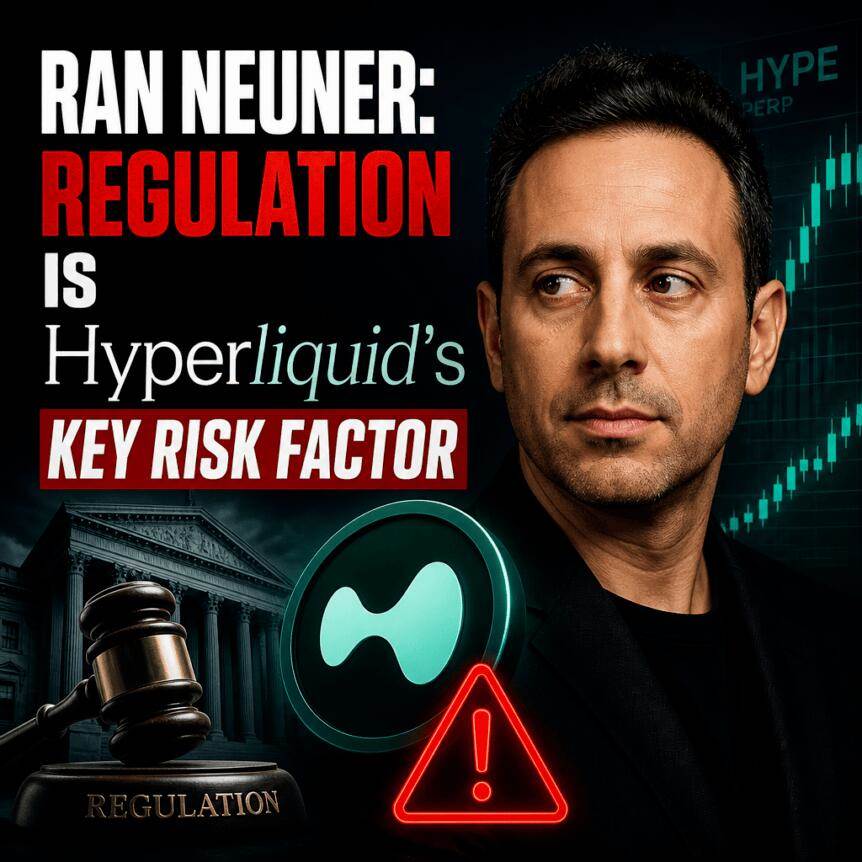
HYPE Regulation becomes Hyperliquid's biggest risk, Neuner: Decentralized exchanges may become the next target
Crypto Banter founder Ran Neuner pointed out that regulation has become the core risk facing Hyperliquid. He warned that the government was very likely to extend current rules for centralized exchanges to decentralized trading platforms.
Neuner made the above remarks on Cointelegraph's Chain Reaction podcast. He believes that while the regulatory framework for centralized trading venues is taking shape, the treatment of decentralized exchanges (DEX) remains unclear-a gap that could have a substantial impact on the operation of platforms such as Hyperliquid in different jurisdictions.
Core Points
- Ran Neuner said that regulators have begun to pay attention to centralized exchanges, and decentralized exchanges may become the next regulatory focus.
- Uncertainty surrounding how decentralized transactions are regulated is seen as Hyperliquid's biggest vulnerability.
- Neuner also believes that Hyperliquid's network effects and liquidity advantages are difficult to replicate, limiting competitive threats.
- U.S. officials have hinted that Hyperliquid has a "fully compliant and legal" market access path, but no specific process details have been released.
Regulatory uncertainty is a major risk
When discussing Hyperliquid's long-term prospects, Neuner placed regulation at the top of its risk list. He pointed out that authorities have begun to establish rules for centralized companies in the crypto industry, such as the MiCA licensing system implemented in Europe.
Neuner said the next phase could involve the regulation of decentralized exchanges. "Governments are just starting to regulate centralized exchanges... I think after that, they will move to decentralized exchanges." He said in the "Chain Reaction" podcast.
The key issue for investors and users is not whether regulation exists, but how regulation will apply to decentralized trading models. Neuner's concerns reveal a practical problem: Even if a platform is technically "decentralized," regulators may still seek ways to define responsibilities, compliance expectations, or market access restrictions. Until these boundaries become clearer, platforms that rely on open access and unauthorized execution will face asymmetric competition-market competition can advance rapidly, but compliance frameworks often lag behind.
Network effects may weaken competitive pressures
Although Neuner highlighted regulatory uncertainty, he was more optimistic about Hyperliquid's ability to withstand competitive pressures. His arguments focus on network effects-particularly the difficulty of replicating a system where user activity and mobility reinforce each other.
Neuner compares this challenge to the broader technology market: "You can't replicate a network." He explained that even if competitors tried to build alternatives, most were unable to succeed in attracting enough participants to regain the momentum of the original platform.
This logic is particularly important for trading platforms. Neuner described that liquidity tends to be concentrated where activity is strongest because users prefer deep markets that support smoother entry and exit. "When something has network properties, users naturally flock to the busiest or best nodes." he said.
Hyperliquid operates a Layer-1 blockchain, known for its decentralized perpetual contract trading, and currently leads the industry in terms of transaction volume. DeFiLlama data cited in the discussion showed that Hyperliquid's decentralized perpetual contract exchange trading volume was approximately US$223 billion in the past 30 days.
U.S. market access: Signals exist, but operational details are missing
Neuner raised regulatory concerns as U.S. officials publicly raised the idea that Hyperliquid could eventually enter the market in a compliant manner. In August, President Donald Trump said Commodity Futures Trading Commission Chairman Michael Selig was working to get Hyperliquid to enter U.S. markets in a "fully compliant and legal manner." Within the next 24 hours, the HYPE token price soared by about 20%, when it was trading at about $70. [TAG
However, as of the August announcement, neither the CFTC nor Hyperliquid had issued formal proposals on what "compliant and legal" access means in practice. Details such as whether an application has been submitted, the specific structure required by regulators or when compliant products will be launched are lacking.
This lack of clarity remains the focus of market participants. Even if officials send positive signals, implementation timetables and precise compliance mechanisms can determine whether access is truly available to U.S. participants-or just theoretical.
HYPE continues to attract attention, market pricing future
Despite Neuner's regulatory issues, HYPE remains a focus on its strong year-to-date performance. According to reports, the token traded at about $82 on Friday, a year-to-date increase of more than 220%.
CoinGecko data cited in the article also puts HYPE's market value at approximately $18.2 billion, with a fully diluted valuation of approximately $78.4 billion.
These numbers highlight the tensions common in the crypto market: Even if the regulatory framework itself is still defined, emotions can fluctuate rapidly based on political and regulatory signals. For traders, this means that volatility is likely to remain high during the submission of any new statement or document; for long-term holders, it increases the importance of monitoring how the compliance path evolves beyond the headlines.
Looking ahead, the most important question is whether regulators will spell out clear standards for decentralized exchanges-and whether Hyperliquid can translate the U.S.'s "compliance access" signal into specific, enforceable requirements. Until then, the platform's competitive advantage based on liquidity may help, but the regulatory trajectory is likely to determine how widely its services expand.