Exchange Ranking
 Top Exchanges
 24h Volume Ranking
 Popularity Ranking
 Exchange BTC Balance
 Proof of Reserves
 Decentralized Exchanges
 Funding Rate
 Funding Heatmap
 Liquidation Data
 Max Pain
 Long/Short Ratio
 Whale L/S Ratio
 Binance/Okex/Huobi L/S
 Bitfinex Margin L/S
 ETF Tracker
 Solana ETF
 XRP ETF
 Hong Kong ETF
 Bitcoin Treasuries
 Crypto Reversal
 Ethereum Reserves
 HyperLiquid Wallet Analysis
 Hyperliquid Whale Watch
 Large Transactions
 On-chain Movement
 Bitcoin ROI
 Stablecoin Market Cap
 Options Analysis
 News
 Articles
 Economic Calendar
 Features
 Wallet
 Contract Calculator


 Security
 Collections
 Watchlist
 Following
 BTC
Encountered with counterfeit websites while searching for Ledger hardware wallet software through search engines: What security researchers report
Currently, any user trying to find Ledger hardware wallet software through a search engine may be redirected to a counterfeit website. On Saturday, security researcher Cyber Scrilla reported on a fake Ledger website and its accompanying application. The site ranks high in Google Natural search results and requires visitors to enter their 24 mnemonic words. These 24 words are the only key to accessing the entire asset balance. Once someone enters these words, they lose control of their wallet, even if no one has actually touched the physical device.
For German holders, this is not just a checklist for suspicious emails, it is also a must-develop habit: wallet software should be accessed through bookmarks or manually entered addresses, and should never be accessed through the search box. This article explains the details that have been reported, how counterfeit websites reach the top of search results, and what to do if mnemonic terms have been entered.
Coinfomania reported that the site attracted more than a million visits in the past month and attributed the data to Google. This figure needs to be viewed with caution. Other reports on the same day followed the same order of magnitude, but clearly expressed it as a statement and did not provide their own measurement basis. Therefore, what is reliable is the direction rather than the specific number: the fake website affects not dozens of people, but on the order of the population of Germany's medium-sized cities. The report did not mention the affected domain names, making it difficult for readers to check.
Equally important in assessing this matter is "what didn't happen." There is currently no indication that Ledger hardware is defective, nor is there any evidence that the company lost the key. It is the path to the manufacturer that is under attack, not the product itself.
Recovery Phrases: Why 24 words are the real attack point
Recovery Phrases (often called seed phrases) are a list of usually 24 words from which all the private keys of the wallet can be calculated. This list of words does not look like a password that can be reset. Whoever controls it controls the balance.
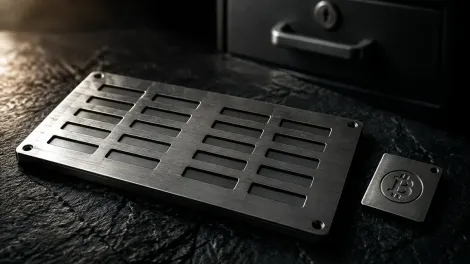
This leads to the iron rule behind every hardware wallet: never leave the device and the piece of paper. No manufacturer, support department, verification page or update requires it. The security of a hardware wallet stems from the fact that the key never leaves the device; an input box in the browser breaks down this protection in an instant. Mnemonic words should remain offline, recorded on paper or engraved on metal, and stored in a place only known to the owner.
BTC-Echo quoted forensic analyst Albert Quehenberger as saying: "Once the recovery phrase is handed over, the wallet must be considered damaged." This is a technical consequence, not a prudent formula. As long as an attacker knows these words, he can rebuild his wallet on any device without having to overcome other obstacles.
Search for poisoning and malicious advertising: How counterfeit goods reach the top of the results list
The fraudulent website at the top of search results is not an accident, nor is it a sign that the search engine has been hacked. There are two mechanisms working together, and the cost is lower than many people think.
The first is paid for placement. Whoever orders an ad on the brand name will appear on the first non-paid result. Security company Zscaler discovered malicious Google ads posing as Ledger in September and directed users to fake verification pages;Coinfomania pointed out this in its report. Although advertisements are reviewed, the review takes time, and a few hours of running time is often enough.
The second is natural placement, which also explains the situation in this case. A copy of the real website inherits its structure, text and terms. If enough links from other websites are added, search engines will consider the copy as a suitable answer to the brand query. Experts call this phenomenon "search poisoning": the results list is still technically correct, but the wrong address comes first.
The insights drawn therefrom distinguish this case from the ordinary wave of phishing. Until recently, search engines were regarded as a safe approach, while unidentified email was regarded as a dangerous source. This order no longer holds true. Anyone who wants to check which devices and software truly meet their needs can find models with different storage and operating modes in a hardware wallet comparison.
Once the phrase is typed, the door opens: the attacker no longer needs any equipment.
The fictional deadline of October 15: How Ledger Mail is built
In addition to phishing websites, there is also phishing email in operation. BTC-Echo described a message sent on behalf of Ledger warning of a security breach and requiring manual security updates by October 15, 2026. The deadline does not exist; it is a lever to exert pressure.
This pattern is well known in fraud research and has a dual effect in this case because a real incident is indeed happening. The real news background makes fake emails appear credible. In addition, according to BTC-Echo, attackers disguised as helpers after so-called "security incidents" and made forged support requests, demanding credentials or approving transactions.
Almost every such email has three characteristics: a date that creates a sense of urgency, an action required to be performed in the browser, and a request that goes beyond a normal login. If a date is missing, all that remains is to ask for something you would never normally enter.
Ledger hacking incident through dealer CryptoBilis: What is known and unknown
The background of the counterfeiting website working so effectively is another incident. Starting October 9, Ledger is investigating incidents in which fund balances reported by customers who purchased equipment through Southeast Asian distributor CryptoBilis were cleared. According to BTC-Echo, citing on-chain analyst Specter, more than $86 million is said to have flowed out through multiple blockchains.
To be honest, BTC-Echo cannot confirm this total on its own: the portfolio cited by Arkham Intelligence cannot be found under the given name. Ledger's public statement about the reasons also remains missing. Information collected by cryptoticker.io on October 9, 2026 about tampering with devices and dealers who stopped using them has been listed in our Ledger incident report.
For owners of the German region, this part of the content is still within control. CryptoBilis is only sold in Southeast Asia and not in Germany. According to BTC-Echo, Ledger recommends not setting up equipment purchased from the dealer in the past 90 days; for equipment already set up, assets should be transferred to new equipment that uses new mnemonics. Users who purchase equipment from manufacturers or German professional retail channels are not affected by this recommendation.
What to do now if you have entered a recovery phrase?
The entered phrase cannot be repaired. Such a string of words cannot be changed, blocked or withdrawn, and the time pressure is real: automated tools often clear the affected addresses within minutes.
The first step is to create a new wallet with the newly generated phrase using a device that has never been exposed to a phishing website. Then start moving assets, starting with the largest position. Resetting old equipment does not help because the phrase has been leaked. Continuing to monitor old wallets doesn't help: attackers with words don't need a second attempt.
If you just click on the website without making any input, there is no loss. At this point, just delete files downloaded from such sources and check the authorizations granted. Phrases that have never been typed anywhere are still valid.
The device itself is not affected: What is attacked is the way you find its software.
Bookmarks replace search boxes: How to securely access Ledger Live and other wallet software
In the face of search poisoning, vigilance help is limited. An effective way is to change the order of operations. Manually enter the address of the manufacturer's website once, check it carefully and save it as a bookmark. After that, every access started with that bookmark, and the search function completely exited this use.
When first saved, the spelling of the domain name is worth checking carefully. Interchangeable characters, extra syllables, or different suffixes are common techniques. Once you save the address, you don't have to read it again every time; this is where its advantage lies.
The same goes for software wallets, and damage there tends to be faster because the keybook is stored on the computer or mobile phone. The way you get the software determines who ultimately holds the key. The second principle provides additional protection: programs should get them from sources saved in bookmarks and never from search results.
硬件钱包还是交易所:事故后你的硬币应存放何处
同一周内的两起事件容易让人产生短路思维,即将所有资产推回交易所。这种计算只有在风险被清晰对比时才成立,因为它们是不同的,而不仅仅是更大或更小。
在自我托管中,风险在于你自己:丢失的短语、输入的种子、来源可疑的设备。这种风险是可以管理的,但完全由你承担。在交易所中,风险在于提供商:破产、提现暂停、服务提供商的事故。这种风险不可管理,但有监管义务的对手方需承担责任。
在实践中,许多持有者按目的分离资金。用于移动或交易的金额留在受欧洲监督的提供商处;闲置的金额存入自我托管。欧盟在MiCA法规下授权哪些提供商以及如何保管客户资产,可在受监管加密货币交易所的调查中找到。MiCA授权说明了监督和义务,但与收益无关。
我们的评估:搜索渠道是弱点,而非设备
从新闻室的角度来看,此案改变了自我托管最重要的建议。证据并列呈现:Coinfomania数据显示数百万访客访问了自然搜索结果顶部的仿冒网站,加上Zscaler在9月记录的导致伪造验证页面的广告。两者都击中了那些除了搜索品牌名称外未做错任何事的人。
Reasons for opposing over-amplifying the case include: visitor data has not been independently verified, domain names have not been publicly named, and it is unclear how many visitors have actually entered their phrases. Damage caused by counterfeit websites has not yet been established to be comparable to dealer incidents. Still, the recommendation remains the same because it costs zero: Set bookmarks and stop using the search box for this purpose. Crypto balances may be lost in full, and in the self-custody model, no institution can replace them.
Ledger phishing: October 15 is not the real deadline
The deadline in the email is fictitious, the incident at the dealer has not been resolved, and the phishing website may reappear at the new address. The following three steps will put your self-hosting in a state where it can survive this storm:
Fixed access path
Manually enter the address of the manufacturer's website, check it and save it as a bookmark. Whether the current device meets your own needs can be checked by comparing hardware wallets.
Organize software sources
Get wallet programs only from saved sources and remove installation packages from search results. See software wallet comparison for differences in key storage.
Split positions by purpose
Keep the transaction amount with the supervised provider and the reserve is self-custodial. See regulated cryptocurrency exchanges for information on institutions authorized by the European Union.
(As of October 10, 2026. This article does not constitute investment advice. Price and fee structures are subject to change; please check terms with your provider before purchasing.)