Exchange Ranking
 Top Exchanges
 24h Volume Ranking
 Popularity Ranking
 Exchange BTC Balance
 Proof of Reserves
 Decentralized Exchanges
 Funding Rate
 Funding Heatmap
 Liquidation Data
 Max Pain
 Long/Short Ratio
 Whale L/S Ratio
 Binance/Okex/Huobi L/S
 Bitfinex Margin L/S
 ETF Tracker
 Solana ETF
 XRP ETF
 Hong Kong ETF
 Bitcoin Treasuries
 Crypto Reversal
 Ethereum Reserves
 HyperLiquid Wallet Analysis
 Hyperliquid Whale Watch
 Large Transactions
 On-chain Movement
 Bitcoin ROI
 Stablecoin Market Cap
 Options Analysis
 News
News Articles
 Economic Calendar
 Features
 Wallet
 Contract Calculator


 Security
 Collections
 Watchlist
 Following
 XRP
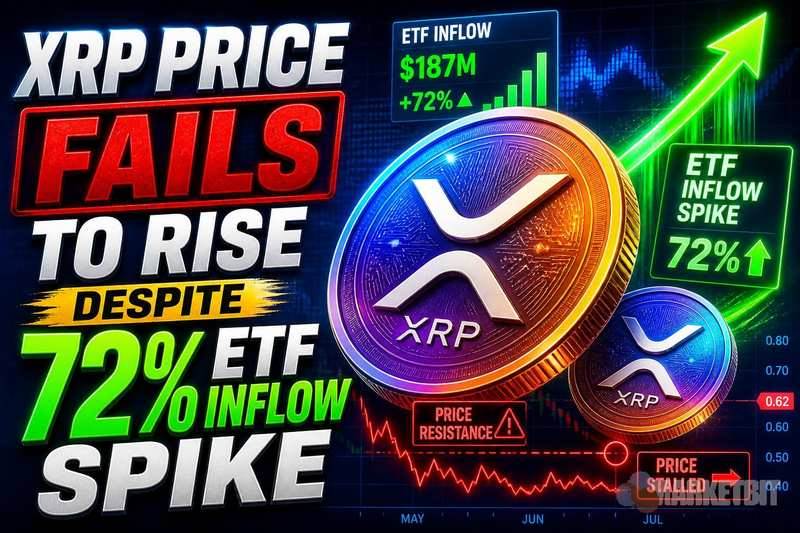
XRP XRP ETF capital inflows surged by 72%, but spot prices did not rise simultaneously.
According to reports, XRP ETF capital inflows surged by 72% month-on-month, but this change was not equally reflected in XRP prices. There is a clear gap between the momentum of capital flows and the reaction of the spot market.
Why a 72% surge in ETF inflows has not driven XRP spot prices
ETF inflows measure the amount of net capital that goes into exchange-traded products that hold or track an asset. Typically, rising inflows are seen as a demand or emotional signal. Following this logic, a 72% increase in reported capital inflows to XRP products should have supported higher prices. However, actual data shows that the surge in capital inflows diverges from the trend of spot prices: the reported acceleration in capital did not translate into a corresponding increase in XRP prices.
Why XRP prices have not responded to the surge in capital inflows
Fund inflows are not the same signal as tradable spot momentum. One eye-catching increase in capital inflows reflects capital allocation within ETF products, which does not always immediately translate into spot buying pressure on XRP. In addition, upper resistance levels and profit-taking near previous price levels are reasonable explanations for the sluggish market response-but should not be over-attributed. Previously, XRP held on to the US$1 support level after clearing leveraged positions. This background forms the basis for the current XRP price and support dynamics. The broader market environment may also absorb inflow signals from a single asset, resulting in a disconnect between the intensity of inflows and the direction of prices in the short term.
What should XRP traders focus on next?
The key confirmation signal is whether the acceleration in capital inflows can be sustained or whether it will quickly reverse after a surge. If the inflow intensity continues, the logic of the delayed catalyst still holds; if a reversal occurs, the signal will be disabled. At the price level, what needs to be paid attention to is whether the price can break through the upper resistance zone or will be suppressed back to the previous support area. At the same time, transaction volume and network activity serve as auxiliary judgment basis. Increased participation-such as the growth trend in the number of active XRP addresses-can be used to measure whether demand is expanding. The core question remains the divergence itself: whether stronger ETF inflows will ultimately drive XRP prices higher, or whether the gap between fund flows and spot performance will persist.