Exchange Ranking
 Top Exchanges
 24h Volume Ranking
 Popularity Ranking
 Exchange BTC Balance
 Proof of Reserves
 Decentralized Exchanges
 Funding Rate
 Funding Heatmap
 Liquidation Data
 Max Pain
 Long/Short Ratio
 Whale L/S Ratio
 Binance/Okex/Huobi L/S
 Bitfinex Margin L/S
 ETF Tracker
 Solana ETF
 XRP ETF
 Hong Kong ETF
 Bitcoin Treasuries
 Crypto Reversal
 Ethereum Reserves
 HyperLiquid Wallet Analysis
 Hyperliquid Whale Watch
 Large Transactions
 On-chain Movement
 Bitcoin ROI
 Stablecoin Market Cap
 Options Analysis
 News
News Articles
 Economic Calendar
 Features
 Wallet
 Contract Calculator


 Security
 Collections
 Watchlist
 Following
 HYPE
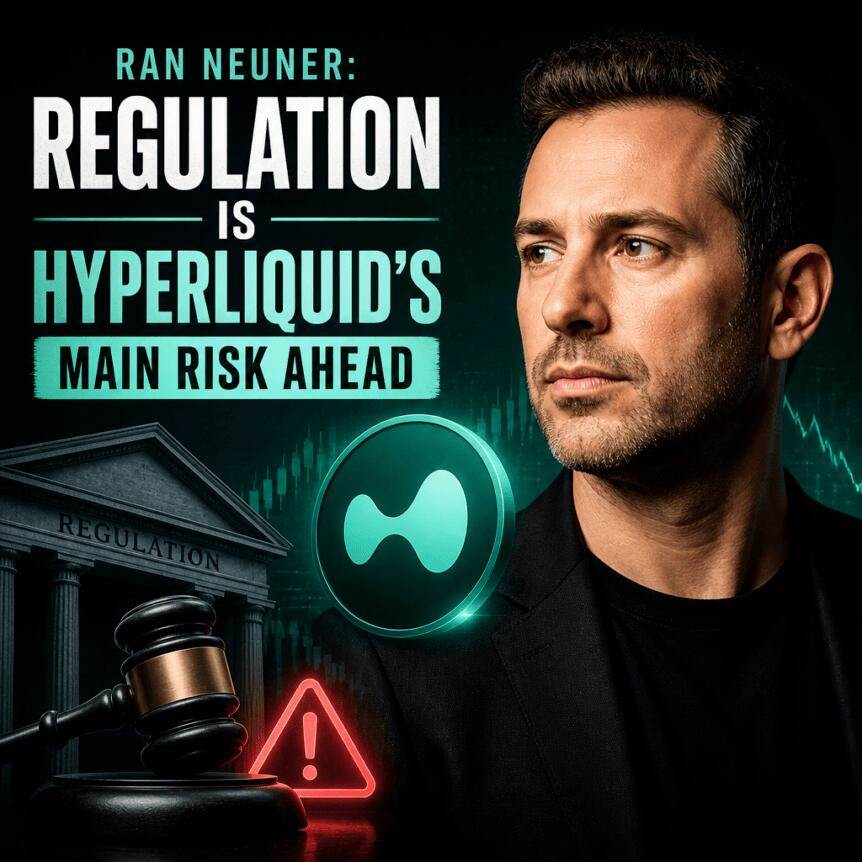
HYPE Regulation becomes the biggest risk faced by Hyperliquid
According to Crypto Banter founder Ran Neuner, as the underlying Layer-1 network, one of the world's largest decentralized perpetual contract trading venues, Hyperliquid is facing increasingly prominent regulatory risks. In an interview with Cointelegraph's "Chain Reaction" podcast, he pointed out that once the current centralized regulatory framework is established, government agencies 'attention is likely to shift from centralized exchanges to decentralized platforms.
Data shows that Hyperliquid has occupied a deep position in derivatives liquidity. Neuner cited DeFiLlama data showing that in the past 30 days, the network ranked first in perpetual contract DEX transactions, totaling approximately US$223 billion. Still, Neuner said that if regulators decide to impose similar compliance requirements on decentralized platforms, this high level of activity may not fully protect them from shocks.
Summary of Core Views
- Ran Neuner called regulatory uncertainty the biggest risk faced by Hyperliquid and warned that decentralized exchanges may face more stringent scrutiny as centralized rules are implemented.
- Neuner believes that Hyperliquid's network effects create lasting advantages that are difficult for competitors to replicate through simple copying functions.
- He pointed out that traders naturally tend to move to more liquid platforms, thus strengthening the status of decentralized trading platforms as the "best node."
- U.S. officials have said Hyperliquid may seek a "fully compliant and legal" route to the U.S. market, but the details are unclear.
Why decentralization will be a key goal of regulation
In the podcast, Neuner focuses on a fundamental issue: the lack of centralized intermediaries on decentralized exchanges (DEX) that regulators have begun to license and supervise. He believes that this difference will not prevent regulatory intervention, but may determine how the next wave of regulatory policies is shaped.
"The biggest problem is that we don't know how regulators will treat decentralized exchanges."
Neuner mentioned the current legislative status surrounding centralized exchanges and cited licensing frameworks such as MiCA. His view is that once centralized platforms are included in a clear regulatory system, regulators may extend pressure on decentralized platforms to similar areas.
For Hyperliquid, the core concern is not whether the platform is technically decentralized, but how regulators define the activities that occur on it-especially when a platform serves as a trading market and users rely on it for execution and liquidity.
Network effects and liquidity may mitigate competitive threats
Although Neuner highlighted regulation as a key weakness, he is more optimistic about Hyperliquid's competitive persistence. His arguments focus on network effects, including both the underlying blockchain ecosystem and exchange-level trading behavior.
Neuner compares this dynamic to consumer platforms: Even if thousands of competitors try to replicate successful models, only a few gain a substantial user base. "You can't replicate network effects," he said, adding that when users and counterparties have gathered around a dominant platform, competition will be a tough climb.
He extended this view to traders 'decisions. According to Neuner, the depth of liquidity affects users 'choice of trading venues, as deeper liquidity can simplify the entry and exit of positions, reduce friction and improve execution efficiency. As a result, users often migrate to the "busiest or best nodes", which can continuously consolidate their leadership status.
This is critical for Hyperliquid because the derivatives market is particularly sensitive to liquidity and execution quality. If traders continue to prioritize more liquid platforms, the platform's most competitive advantages may become self-reinforcing, even if competitors provide alternative interfaces or parallel functions.
The signal to enter the U.S. market is clear, but the compliance blueprint remains unclear
In addition to Neuner's concerns, U.S. officials have previously suggested that Hyperliquid could take a more compliant path. In August this year, media reported that U.S. President Trump said that Commodity Futures Trading Commission (CFTC) Chairman Michael Selig was working to introduce Hyperliquid into the United States in a "fully compliant and legal manner."
At the time, the price of the token fluctuated violently around the remarks, with HYPE rising about 20% during the 24-hour period cited, and trading at about $70. However, as of the August announcement, neither the CFTC nor Hyperliquid had announced a formal proposal, the specific working methods for outlining U.S. market access, whether an application has been submitted, and when any compliance services will be launched.
This uncertainty remains important for market participants because regulation, market access and product design are closely interconnected. If regulators require specific structures-such as licenses, restricted interfaces, or other compliance mechanisms-the operational impact for a decentralized derivatives platform can be huge. Neuner's comments incorporate this broader uncertainty: Until regulators clarify how they handle decentralized transactions, platforms may be forced to operate with insufficient visibility into their long-term compliance endpoints.
HYPE's market performance reflects the pricing of future options value
HYPE continued to maintain strong momentum in the market reaction after the signal was released in August. As of Friday, HYPE was trading at about $82, a year-to-date increase of more than 220%, according to CoinGecko data. The report also mentioned a market value of approximately US$18.2 billion and a fully diluted valuation of approximately US$78.4 billion.
The data highlight how quickly traders can reposition when regulatory access in major jurisdictions is seen as possible-although details are still missing. For investors, the key question is whether any future U.S. -based framework will translate into specific operational changes, or whether market expectations exceed the final requirements of regulators.
Faced with the upside potential of liquidity-driven network effects and the downside risks of regulatory uncertainty, the next stage to focus is clear: any official regulatory guidance clarifying the treatment of decentralized exchanges, and any public disclosure explaining how "fully compliant" U.S. market access will work for the platform in practice.