Exchange Ranking
 Top Exchanges
 24h Volume Ranking
 Popularity Ranking
 Exchange BTC Balance
 Proof of Reserves
 Decentralized Exchanges
 Funding Rate
 Funding Heatmap
 Liquidation Data
 Max Pain
 Long/Short Ratio
 Whale L/S Ratio
 Binance/Okex/Huobi L/S
 Bitfinex Margin L/S
 ETF Tracker
 Solana ETF
 XRP ETF
 Hong Kong ETF
 Bitcoin Treasuries
 Crypto Reversal
 Ethereum Reserves
 HyperLiquid Wallet Analysis
 Hyperliquid Whale Watch
 Large Transactions
 On-chain Movement
 Bitcoin ROI
 Stablecoin Market Cap
 Options Analysis
 News
 Articles
 Economic Calendar
 Features
 Wallet
 Contract Calculator


 Security
 Collections
 Watchlist
 Following
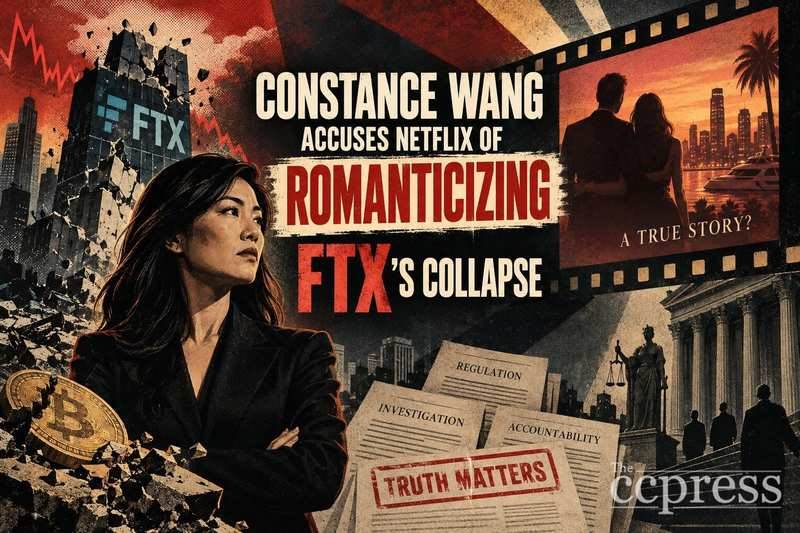
Former FTX COO Constance Wang accuses Netflix of romanticizing the FTX crash into a "love story"
Former FTX COO Constance Wang has publicly accused Netflix of portraying FTX's catastrophic collapse as a "love story," criticizing the streaming giant for romanticizing the most devastating fraud in cryptocurrency history. Her criticism touches on the core question of how entertainment media handles real financial crimes: Is the dramatic presentation to serve the public or conceal responsibility?
According to CoinGape, Wang, who served as chief operating officer during the FTX collapse, directly criticized Netflix's narrative of the exchange's collapse. "You should be ashamed of yourself," she wrote, condemning Netflix's production choices. As a key figure within FTX, Wang's response carries weight. She is not a marginal role, but an executive who has been close to the core of the company's operations. At its peak, the exchange handled billions of dollars in daily trading volume before experiencing a dramatic collapse.
Why calling it a "love story" is an accusation rather than a description
Wang's statement is essentially a critical view of the media. When a financial fraud case is repackaged as a romantic narrative, the editorial perspective shifts from accountability to dramatic conflict. Victims and their losses take a back seat, while personal personalities and relationships take the lead. This concern is not only related to aesthetics, but also related to practical impact. History has shown that romanticizing portrayal of financial crimes often arouses sympathy for the perpetrators, or at least obscuring the public's understanding of the truth of the incident. Wang used the word "love story" to indicate that she believed Netflix placed emotional narrative above fact-clearing.
This distinction is crucial to public understanding of the FTX crash. The case involved significant economic losses to a large number of real users and had a ripple effect on the broader cryptocurrency industry, affecting direct customer groups far beyond FTX, affecting many exchanges, lending platforms and investors.
What signals does Netflix's frame choices send?
The streaming platform routinely adapted financial scandals into content works, and its tone choices have shaped the perception of complex events by millions of viewers. Stories told as "love stories" invite viewers to empathize with the protagonist; stories told as "fraud cases" invite viewers to examine decision-making mistakes and the victims 'experiences.
Wang's status as a former FTX executive makes his criticism particularly sharp. She is not an external observer who questions the narrative, but a witness within the institution depicted. She accused Netflix of fundamentally wrongly framing the narrative, which at least directly challenges the documentary's credibility as a historical record.
Since the collapse of FTX, regulatory pressure on crypto companies has intensified, with enforcement actions even affecting the largest existing exchanges. In this context, how the public remembers FTX is not a trivial issue. Whether Netflix will respond to Wang's criticism or change the way audiences receive documentaries remains an unsolved mystery left by her remarks. But she made one point clear: at least one witness did not agree with the story being told.