Exchange Ranking
 Top Exchanges
 24h Volume Ranking
 Popularity Ranking
 Exchange BTC Balance
 Proof of Reserves
 Decentralized Exchanges
 Funding Rate
 Funding Heatmap
 Liquidation Data
 Max Pain
 Long/Short Ratio
 Whale L/S Ratio
 Binance/Okex/Huobi L/S
 Bitfinex Margin L/S
 ETF Tracker
 Solana ETF
 XRP ETF
 Hong Kong ETF
 Bitcoin Treasuries
 Crypto Reversal
 Ethereum Reserves
 HyperLiquid Wallet Analysis
 Hyperliquid Whale Watch
 Large Transactions
 On-chain Movement
 Bitcoin ROI
 Stablecoin Market Cap
 Options Analysis
 News
 Articles
 Economic Calendar
 Features
 Wallet
 Contract Calculator


 Security
 Collections
 Watchlist
 Following
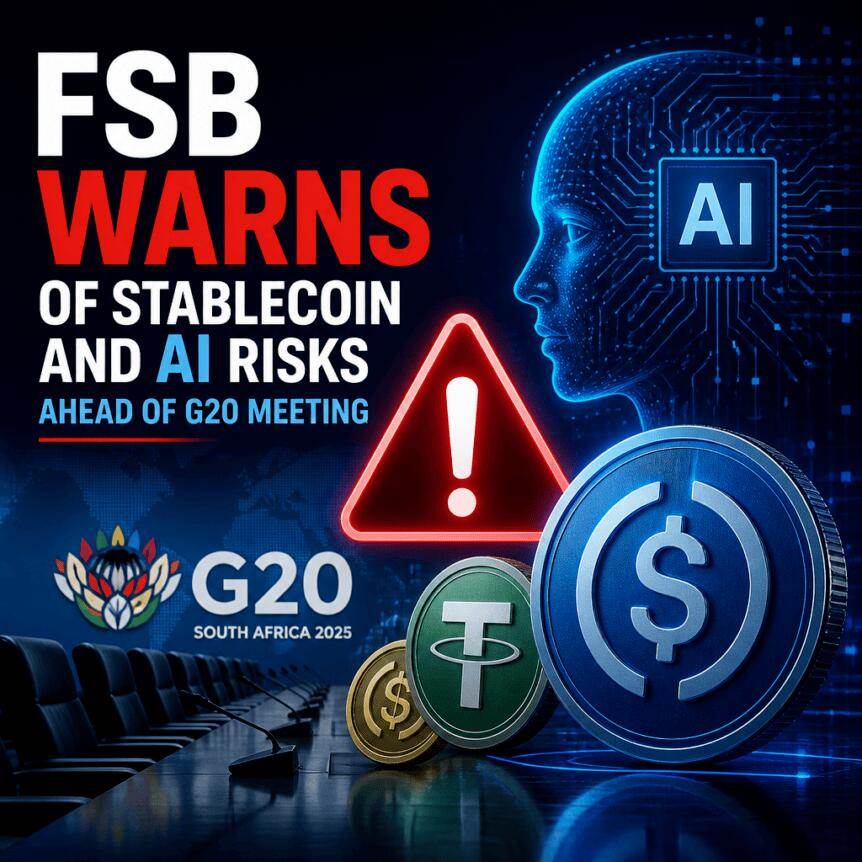
Financial Stability Board warns: stablecoins and artificial intelligence may pose new risks to global financial stability
The Financial Stability Board (FSB) issued a warning that artificial intelligence (AI) and stablecoins are posing emerging risks to global financial stability. The agency urged the G20 to strengthen cross-border regulation and develop new safeguards for the responsible use of AI in the financial industry.
In a letter released on Monday, FSB Chairman Andrew Bailey said the current international mechanism for the regulation and crisis management of stablecoins was still "immature or undeveloped." The letter was sent ahead of Thursday's meeting of G20 finance ministers and central bank governors.
Core Points
- The FSB pointed out that the cross-border stablecoin supervision and crisis response framework is not yet fully mature.
- FSB's analysis emphasizes that the pressure on redemption of stablecoins may spread to traditional markets through reserve asset clearing and bank deposit withdrawals.
- Regarding AI, the FSB emphasizes that financial institutions should make governance, cybersecurity and third-party risk management priorities.
- Bailey's letter connects the need for responsible use of AI to broader issues of resilience in market infrastructure and critical institutions.
- Progress on stablecoin rules across countries has been uneven, with the FSB previously found that only some jurisdictions have finalized the framework.
Why stablecoin regulation remains a cross-border problem
Bailey's warning focused on the real gap between domestic regulation and the actual cross-border stablecoin mechanism. According to the FSB's 2025 review report, of the 28 jurisdictions surveyed, only 11 jurisdictions had completed the formulation of a regulatory framework for stablecoins at that time.
This imbalance in the regulatory landscape is important because stablecoins can flow quickly between markets. If payment pressure builds up in various regions at the same time and regulatory rules are inconsistent, the body responsible for coordinating responses (whether liquidity support, monitoring, or crisis communication) becomes blurred.
In his letter, Bailey asked G20 member states to support the FSB's just-finalized practical guidelines for the responsible use of AI in financial services, while also pointing to repeated concerns related to stablecoins raised by regulators. Previous reports have shown that European Central Bank President Christine Lagarde warned in 2025 that there are redemption risks involving stablecoins issued inside and outside the EU.
How stablecoin "runs" are transmitted to traditional markets
In a supporting report, the FSB believes that stablecoin runs may not be limited to within the crypto market. The regulator pointed to a ripple effect: Forced sales of reserve assets and bank deposit withdrawals could spread stress to more traditional parts of the financial system.
The FSB also highlighted the risks associated with multi-issuer stablecoins. In this structure, even if the relevant reserves are held in different jurisdictions, redemption requirements may be concentrated on specific issuers-creating operational and regulatory friction when speed is most needed.
For investors and market participants, the key issue is not only whether stablecoins can maintain their pegged prices, but also whether liquidity provision and reserve management can be rapid and effective during periods of intensified redemption activity. The FSB's statement suggests that regulators increasingly view stablecoin arrangements as part of broader liquidity and settlement dynamics rather than as isolated products.
FSB Guidance on AI: Governance, Cybersecurity and Third-Party Risks
In addition to stablecoins, the FSB finalized AI Practice Guide for the financial industry focuses on organizational governance, AI system development and deployment, cybersecurity and third-party service risks.
Bailey warns that increasingly complex cyber threats driven by AI could undermine the resilience of critical financial institutions and market infrastructure. There are concerns that AI could reduce the cost of complex attacks or speed up the targeting and utilization process, putting pressure on the controls financial institutions rely on to protect systems and maintain business continuity.
Attention to these topics is not limited to the FSB. Previous reports pointed out that European Central Bank presidents warned in July that advances in AI could amplify market fluctuations and cyber threats. In June, the FSB consulted on good practices for responsible adoption of AI before submitting final guidelines to the G20 Dialogue.
While stablecoins are usually discussed from the perspective of payment practicality and crypto adoption, the FSB's approach connects the discussion to the level of institutional resilience. This shift is critical to how companies choose to deploy AI in-house: Compliance will not only be measured by model performance, but will also depend on whether governance and risk control systems are strong enough to cope with operational failure and confrontational pressures.
Follow-up observations under the advancement of the G20 agenda
The next immediate steps are political and regulatory: the G20 will review the FSB's recommendations as stablecoin regulation continues to evolve unevenly around the world and AI adoption within financial institutions accelerates. All parties should pay attention to whether cross-border stablecoin supervision and crisis management practices have received clearer international commitments, and how the finalized AI guidance translates into specific expectations for banking and market infrastructure in terms of governance, cybersecurity capabilities, and third-party risk management.