Exchange Ranking
 Top Exchanges
 24h Volume Ranking
 Popularity Ranking
 Exchange BTC Balance
 Proof of Reserves
 Decentralized Exchanges
 Funding Rate
 Funding Heatmap
 Liquidation Data
 Max Pain
 Long/Short Ratio
 Whale L/S Ratio
 Binance/Okex/Huobi L/S
 Bitfinex Margin L/S
 ETF Tracker
 Solana ETF
 XRP ETF
 Hong Kong ETF
 Bitcoin Treasuries
 Crypto Reversal
 Ethereum Reserves
 HyperLiquid Wallet Analysis
 Hyperliquid Whale Watch
 Large Transactions
 On-chain Movement
 Bitcoin ROI
 Stablecoin Market Cap
 Options Analysis
 News
News Articles
 Economic Calendar
 Features
 Wallet
 Contract Calculator


 Security
 Collections
 Watchlist
 Following
The U.S. Securities and Exchange Commission (SEC) has just submitted a reform plan for cryptocurrency custody rules to the White House. The plan aims to clarify how financial participants can legally hold crypto assets on behalf of customers while complying with regulations.
Brief overview
The SEC submitted to the White House on August 25 a reform plan for cryptocurrency custody rules for investment advisers and funds. The reform is part of a pro-cryptocurrency shift promoted by Paul Atkins since 2025, with landmark moves including the withdrawal of multiple lawsuits. The Hyperliquid Policy Center asked the SEC and the Commodity Futures Trading Commission (CFTC) to coordinate regulatory rules for perpetual contracts.
SEC seeks to update cryptocurrency custody rules
The SEC reform led by Paul Atkins is called the Custody Rules Amendment, which aims to update relevant provisions in the Investment Advisers Act and the Investment Company Act of 1940. Documents filed with the White House Office of Information and Regulatory Affairs (OIRA) clearly state that the committee plans to:
modernize the custody rules for client and fund assets, including crypto assets.
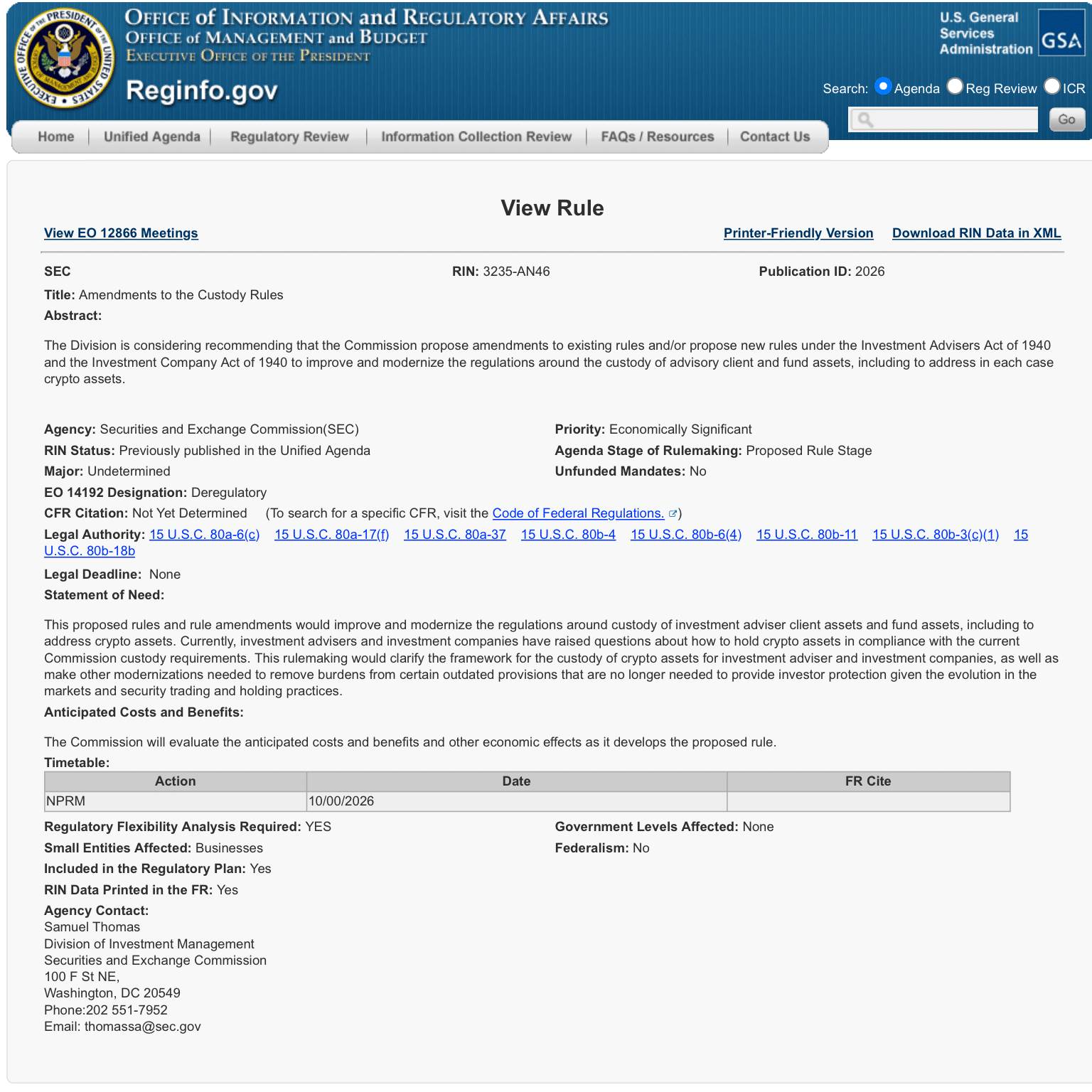
SEC reform of cryptocurrency custody. Investment advisers and fund management companies have previously faced traditional custody rules designed for traditional financial securities that do not apply to digital assets. As a result, many institutional participants prefer to wait and see rather than take compliance risks. The SEC's goal is to eliminate this ambiguity and discard certain outdated provisions without sacrificing the protection of crypto investors.
(Hide promotional links here)
Hyperliquid opposes regulators
While the SEC is dealing with crypto asset custody, another regulatory issue is also shaking the industry: perpetual contracts. The Hyperliquid Policy Center (HPC) decided to take a tough stance. In a joint letter to the SEC and CFTC, the HPC asked both regulators to develop a unified regulatory framework for these non-expiration derivative products. The core argument is that perpetual contracts should be classified based on their economic structure, not based on the underlying assets they track.
This issue is by no means empty talk, as Hyperliquid's HIP-3 market has generated more than US$480 billion in trading volume within ten months of its establishment, with approximately US$4 billion in open interest. Without clear classification standards, jurisdiction disputes between regulatory agencies will eventually inevitably resort to courts. Therefore, a unified regulatory framework will allow platforms to compete in execution quality and liquidity. The timing is no coincidence, as Donald Trump recently mentioned the CFTC's work aimed at allowing Hyperliquid to operate fully compliant and legally in the United States.
Two major issues, one core goal
Remove the uncertainty that hinders the popularization of cryptocurrencies in the United States. The trusteeship reform proposal submitted by the SEC to the White House is the most tangible evidence. Regulators are no longer just punishing, but are finally beginning to build regulatory frameworks. However, it remains to be seen whether the text will not be significantly changed when it passes the OIRA review.