Exchange Ranking
 Top Exchanges
 24h Volume Ranking
 Popularity Ranking
 Exchange BTC Balance
 Proof of Reserves
 Decentralized Exchanges
 Funding Rate
 Funding Heatmap
 Liquidation Data
 Max Pain
 Long/Short Ratio
 Whale L/S Ratio
 Binance/Okex/Huobi L/S
 Bitfinex Margin L/S
 ETF Tracker
 Solana ETF
 XRP ETF
 Hong Kong ETF
 Bitcoin Treasuries
 Crypto Reversal
 Ethereum Reserves
 HyperLiquid Wallet Analysis
 Hyperliquid Whale Watch
 Large Transactions
 On-chain Movement
 Bitcoin ROI
 Stablecoin Market Cap
 Options Analysis
 News
 Articles
 Economic Calendar
 Features
 Wallet
 Contract Calculator


 Security
 Collections
 Watchlist
 Following
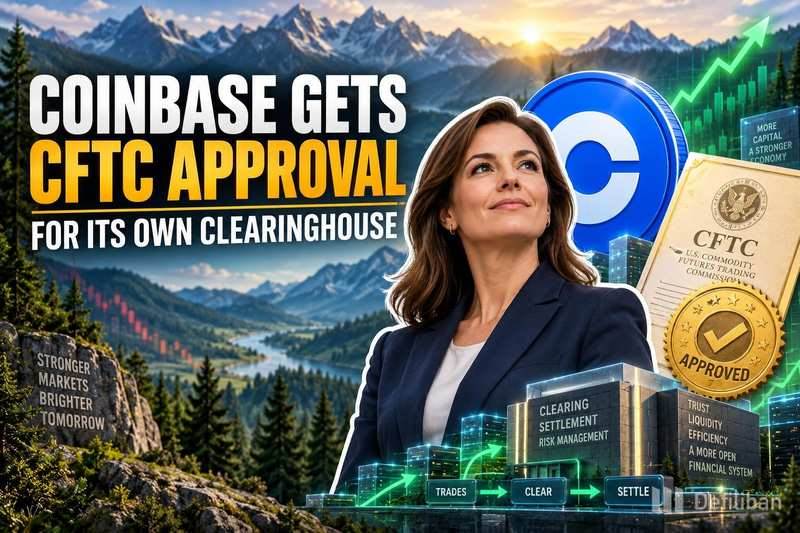
On September 28, 2026, Coinbase completed the structural layout of the U.S. derivatives market
On September 28, 2026, as the U.S. Commodity Futures Trading Commission (CFTC) officially registered Coinbase Clearing LLC as a Derivatives Clearing Organization (DCO), Coinbase completed its structural layout in the U.S. derivatives market. The approval gave the exchange a "post-transaction" level of control previously handled by a third-party clearing house.
This approval means the addition of a regulated clearing house to the regulatory stack that already includes U.S. brokerage operations and Coinbase Derivatives, LLC (its designated contract market). This marks a key step in vertical integration for Coinbase.
What does Coinbase CFTC approval clearing house add to its market structure?
In every derivatives transaction, a clearing house is located between the buyer and seller, becoming the counterparty of both parties, and ensuring settlement if either party defaults. If there is no own clearing entity, the exchange must route this functionality to a separate DCO, which means sharing data, financial benefits, and operational control with third parties.
According to CFTC documents, Coinbase Clearing LLC has been registered as a derivatives clearing organization since September 28, 2026, and the registration has been authorized by a committee order. The current scope of registration is limited to fully collateralized products: including futures, futures options and swaps.
Notable structural constraints: The requirement for full mortgage is an important structural constraint. This means that Coinbase Clearing is currently unable to process margin products that allow leverage ratios to exceed 1:1 mortgage ratios. This scope reflects the CFTC's treatment of crypto-native DCO and limits current target markets to cash-settled and fully backed instruments.
How do brokerage, exchange and clearing functions work together?
Coinbase's U.S. derivatives footprint now covers three regulated levels:
- Broker level: is responsible for customer access and order routing.
- Exchange level: The CFTC's DCM register shows that Coinbase Derivatives, LLC was designated as a contract market on November 23, 2020 and has been clearing through third-party DCO Nodal Clear.
- Clearing Layer: Coinbase Clearing LLC replaces its previous external dependence and becomes a dedicated clearing entity.
Having these three tiers is operationally important, especially in terms of margin efficiency, real-time risk management and data access. Vertically integrated exchanges can more closely align net positions across products, reduce margin calls delays, and retain the economics of clearing fees internally rather than paying fees to third-party DCOs on a per-contract basis.
The CFTC's DCO application for Coinbase Clearing LLC includes an annex titled "Summary of Proposed Liquidation Activities" that outlines the scope of the proposed liquidation business. The committee order directly cited the document and authorized the scope of business from the date of registration.
Allowed types of clearing
1. Fully collateralized futures
2. Futures options
3. Swap contracts
Why is this approval critical to the U.S. crypto derivatives infrastructure?
Coinbase has become one of the few crypto-native entities operating CFTC registered DCOs. Historically, most crypto derivatives trading volume in the United States has been cleared through traditional DCO or stayed in the offshore market. A dedicated clearing entity changes the competitive landscape for institutional market participants who need CFTC supervision on counterparties to clearing transactions.
The regulatory background for Coinbase's derivatives ambitions has changed substantially. The company's positioning in relation to the CFTC is not without friction: CME Group has tried to challenge CFTC approval, which covers Coinbase and Kalshi perpetual futures, a controversy that reflects growing competition between established institutions and emerging entrants in the regulated crypto-derivatives space.
The scope limit of full mortgages also shapes competitive positioning. At the clearing level, Coinbase Clearing is currently unable to immediately compete with CME's margin futures infrastructure. This limit may be changed through future regulatory applications, but current registrations are limited to what is explicitly allowed by a commission order.
For participants associated with decentralized finance (DeFi), the most direct downstream impact is counterparty risk. A CFTC registered DCO provides a regulated, capital-backed guaranteed fund structure that is not available in offshore or on-chain clearing alternatives. Whether this structure will attract institutional funds away from decentralized perpetual contract platforms depends on whether the product scope expands beyond fully collateralized instruments and how Coinbase prices its clearing services relative to existing options.
At the time of registration, the Fear and Greed Index was at a level of 74 (Greed), reflecting a broadly constructive market environment for such regulatory expansion. Structurally, the key is whether Coinbase Clearing applies to expand its licensed product range and whether the combination of DCM and DCO can generate enough transaction volume to justify the capital and compliance costs of operating a clearing house independently.