Exchange Ranking
 Top Exchanges
 24h Volume Ranking
 Popularity Ranking
 Exchange BTC Balance
 Proof of Reserves
 Decentralized Exchanges
 Funding Rate
 Funding Heatmap
 Liquidation Data
 Max Pain
 Long/Short Ratio
 Whale L/S Ratio
 Binance/Okex/Huobi L/S
 Bitfinex Margin L/S
 ETF Tracker
 Solana ETF
 XRP ETF
 Hong Kong ETF
 Bitcoin Treasuries
 Crypto Reversal
 Ethereum Reserves
 HyperLiquid Wallet Analysis
 Hyperliquid Whale Watch
 Large Transactions
 On-chain Movement
 Bitcoin ROI
 Stablecoin Market Cap
 Options Analysis
 News
 Articles
 Economic Calendar
 Features
 Wallet
 Contract Calculator


 Security
 Collections
 Watchlist
 Following
 BTC
 DOGE
 ETH
 HYPE
 LINK
 SOL
 TRX
 XMR
 XRP
 ZEC
加密货币暴跌原因探究:今天到底发生了什么?
2026年10月8日星期四,加密市场陷入深度下跌,前13大资产几乎无一幸免。比特币现报80,986美元,24小时内下跌2.9%,7日内下跌3.7%,较年初起点已回落7.5%。比特币总市值已滑落至1.62万亿美元。
山寨币遭受了更沉重的打击。以太坊在单日下跌5.3%、周跌幅高达9.3%后,现报2,432美元,年内亏损达18%。XRP当日下跌6.2%,年内跌幅为27%。Solana报价108美元,Dogecoin报价0.083美元,Chainlink单-session内损失7.9%。即使是今年表现突出的隐私币Zcash,也在24小时内回撤15.6%,周跌幅达18.6%,尽管自一月以来仍上涨119%。
市场上唯一的绿色来自稳定币对,USDT和USDC如预期般持平。这种比特币跌幅小于其他资产的模式,是典型的“避险”轮动特征,而非比特币特有的问题。那么,此次加密货币暴跌的原因究竟是什么?答案并非只有一个,而是三个因素叠加所致。您可以在CryptoTicker加密货币价格页面实时追踪所有价格。
暴跌原因#1:美联储是否刚刚扼杀了降息梦想?
最大的加密暴跌原因位于华盛顿,而非交易屏幕之上。美联储于9月16日将目标利率区间上调25个基点至3.75%至4.00%,而该次会议纪要于10月7日(星期三)公布。传递的信息并非风险资产所愿闻:大多数参与者预计,根据 incoming 数据,年底前再次加息是合适的。
这一句话重构了全年的预期。市场曾数月将9月的举动视为一次性事件,但纪要暗示这可能是一个紧缩周期的开始。HashKey Group研究员Tim Sun警告称,若10月再次加息,投资者会将9月视为开场戏而非短暂波动。
高利率通过两个渠道冲击加密市场。首先,国债收益率上升,无风险的4%+回报使得像比特币这样波动且零收益的资产相比之下吸引力下降。其次,美元走强,历史上比特币与美元走势呈负相关。加上由美伊紧张局势升级推动的高油价,这加剧了通胀预期并强化了紧缩政策的理由,构成了宏观鸡尾酒,将您屏幕上的每只资产推入红色区域。
接下来的关键节点已经圈出:10月14日的美国CPI数据发布,以及10月27日至28日的FOMC会议。在这些数据出炉之前,市场交易的不仅是加息本身,更是对其的恐惧。
暴跌原因#2:半亿美元杠杆如何在20分钟内蒸发?
Macro news explains the direction, and leverage explains the speed. Bitcoin was trapped between $83,000 and $87,000 in the first week of October, repeatedly blocked at the top. Each rejection piled up more leveraged long positions below the market, and traders continued to bet on the never-coming "October bull market."
On Friday, October 3, a rejection at $87,000 resulted in a $433 million position being liquidated. Then in the early morning of Wednesday, October 7, Bitcoin fell from US$85,341 to US$83,790 in about 20 minutes. A decline of approximately US$1,765 took away more than US$400 million in long positions in a single hour. During the full 24 hours, CoinGlass statistics showed that approximately US$546 million of positions were cleared in the market, 88% of which were long positions, and more than 100,000 traders were cleared.
This is what analysts call a "leverage purge." Dan Khus of LVRG Research described it as crowded long bets being mechanically forced to unwind rather than a real change in trend. Important details from Bitfinex showed that although long positions were liquidated, open interest remained stable, meaning new short positions were opened at the same rate. The market has not only deleveraging, but has also turned into a net short position.
Timing adds a psychological dimension. Friday, October 10, marks the first anniversary of the largest liquidation day in crypto history, and traders still remember it. Before Wednesday's decline, the liquidation heat chart had marked a dense long leverage cluster near $82,600. Thursday's drop to $80,986 directly penetrated the area, which is an important reason why the second wave of declines was so severe.
Reason for the collapse #3: Why are ETFs and the U.S. government selling?
The third reason for the crypto collapse involves the other party to the transaction. For most of 2026, spot Bitcoin ETFs have been the structural buyer that absorbs every correction. In late September, they had a net inflow of nearly US$1 billion in a single day. Now, this buying force has been reversed.
According to SoValue, the U.S. spot Bitcoin ETF recorded a net outflow of approximately $487 million on October 7, the largest single-day withdrawals in several weeks. ARK21 Shares and Fidelity led the wave of redemptions, while BlackRock's IBIT is the only major fund still attracting money. The Ethereum ETF was also losing blood, with approximately $161 million flowing out on the same day. When institutional buyers backed away at the same time as leveraged bulls were liquidated, no one came to catch the falling blade.
In addition, an unpopular signal on the chain appeared. Arkham data shows that more than 11,000 BTC items, worth approximately $900 million at current prices, were transferred to Coinbase Prime in two days from addresses associated with the U.S. government. Although moving to an exchange does not automatically mean selling, markets have learned to view government wallet activity as a selling risk and have responded accordingly.
None of these three causes alone will cause a crash. The hawkish Fed cooperation system has no leverage, which is just a slow torture; the leverage purge cooperation ETFs are still buying, which is just a 20-minute tap and a quick recovery. It was this combination that turned the correction into a full-blown sell-off on Thursday.
Reason for the collapse of altcoins: Why did Ethereum and XRP fall twice as much as Bitcoin?
Looking at the 24-hour column of the market table, a pattern appears on the paper. Bitcoin fell 2.9%, Ethereum fell 5.3%, XRP fell 6.2%, Solana fell 7.0%, Dogecoin fell 7.0%, and Chainlink fell 7.9%. Almost all major altcoins fell about twice as much as Bitcoin, and in weekly and annual data, the gap was even wider.
There are three mechanical reasons for this. Altcoins have thin order books, so the same amount of dollars sold will lead to greater price fluctuations. The altcoin perpetual contract market carries higher proportional retail leverage, making the clearing chain reaction more disruptive. Moreover, in the safe-haven rotation, capital not only leaves the crypto market; it also integrates within the crypto market, flowing from small tokens to Bitcoin and stablecoins. Bitcoin's dominance rose during the crash precisely because it was seen as the lowest-risk crypto asset.
Ethereum carries additional burdens. ETH fell 18% during the year, while Bitcoin fell only 7.5%, and ETH ETF outflows on Wednesday were larger than Bitcoin. XRP fell 27% during the year, had struggled at the $1.50 mark for several weeks, and failed again before this fall. For anyone looking for the specific reason for the collapse of altcoins, it's simple: Altcoins have never established an institutional support base like Bitcoin, so when that base breaks, they fall faster. Please track the shift in dominance on the CryptoTicker chart page.
Which coins will fight the crypto slump in 2026?
市场上的并非所有东西都是输家。前13大资产中有四个名字年内仍为绿色,这告诉你市场的信心实际存在于何处。
Hyperliquid是 standout,年内涨幅高达+228%,尽管单日下跌5.9%。HYPE是主导链上永续合约交易所的原生代币,讽刺的是,杠杆清洗对其业务有利:更多的清算意味着更多的费用。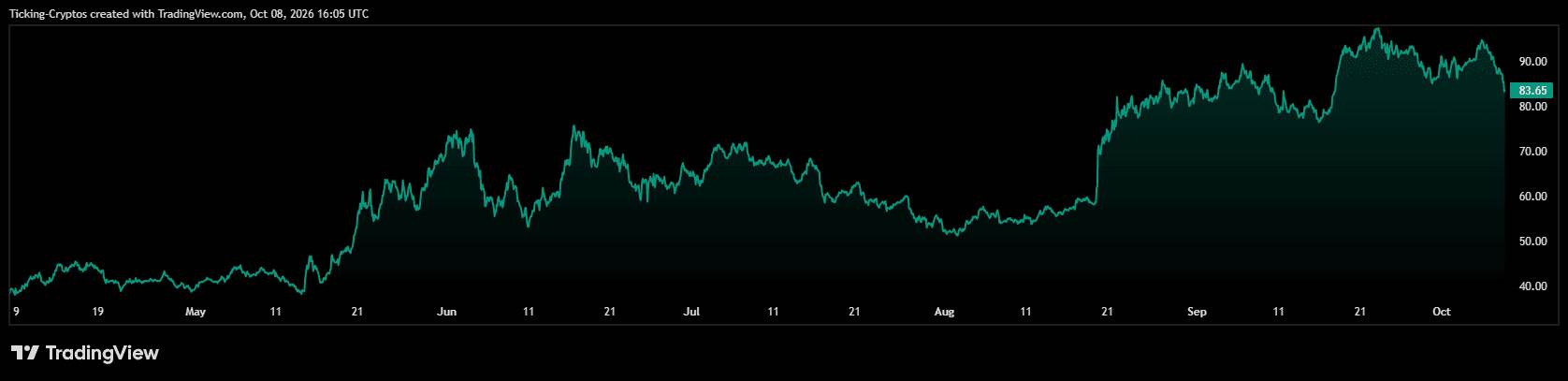
HYPE的USD图表
Zcash因隐私币复兴而在2026年上涨119%,尽管它也是这里波动性最大的名称,周跌幅达18.6%,提醒人们涨得最猛也跌得最狠。
另一个隐私巨头Monero上涨22%,周跌幅仅为2.2%,是表中非稳定币中跌幅最小的。
TRON以+17%的年涨幅完成列表,单日仅下跌0.7%。TRX受益于稳定币结算量,无论市场涨跌,这使其在崩盘中表现得像防御性资产。
共同线索很清晰。站稳脚跟的硬币是具有真实、可衡量收入或与比特币价格无关的强大叙事的硬币。跌幅最惨烈的硬币是其主要故事为“比特币的贝塔系数”的硬币。下次有人问起你手中特定资产的暴跌原因时,这一点值得铭记。