
 Exchange Ranking
 Top Exchanges
 24h Volume Ranking
 Popularity Ranking
 Exchange BTC Balance
 Proof of Reserves
 Decentralized Exchanges
 Funding Rate
 Funding Heatmap
 Liquidation Data
 Max Pain
 Long/Short Ratio
 Whale L/S Ratio
 Binance/Okex/Huobi L/S
 Bitfinex Margin L/S
 ETF Tracker
 Solana ETF
 XRP ETF
 Hong Kong ETF
 Bitcoin Treasuries
 Crypto Reversal
 Ethereum Reserves
 HyperLiquid Wallet Analysis
 Hyperliquid Whale Watch
 Large Transactions
 On-chain Movement
 Bitcoin ROI
 Stablecoin Market Cap
 Options Analysis
 News
News Articles
 Economic Calendar
 Features
 Wallet
 Contract Calculator


 Security
 Collections
 Watchlist
 Following
 BTC
BTC  ETH
ETH  SOL
SOL Hyperliquid is a better choice for traders who need an order book, more comprehensive order control, and a measurable trade path. Jupiter Perps is more suitable for Solana users who are familiar with wallet paths and accept oracle pricing execution supported by the JLP pool.
This difference is not simply a chain-to-chain confrontation. Hyperliquid prices transactions based on demonstrated liquidity and market-maker-buyer behavior, while Jupiter prices transactions based on oracle, fixed position fees, pool imbalances, and hourly borrowing costs. This structural difference determines which platform is cheaper for specific positions.
 Direct structural comparison of Hyperliquid and Jupiter Perps
(Table title: Decision factors| Hyperliquid | Jupiter Perps |Advantages)
Execution model: on-chain central limit order book| Oracle pricing perpetual contracts for JLP pools| Strategy-specific
Order control: market price, limit, stop loss, proportion and TWAP-style workflow| Position admission and trigger control, no public order book queue| Hyperliquid
Evidence of price impact: spread, visible depth, and average transaction price| Linear and price influence components related to pool imbalances| Depends on test size
Basic position fee: Real-time market maker/buyer rate| In the reviewed rate table, open positions 0.06% and close positions 0.06%| For active market makers, Hyperliquid may win out
Cost of holding positions: Exchange of funds rates between parties| Hourly borrowing costs related to pool utilization| Depends on direction and duration
Counterparty structure: Traders and market makers in the order book| JLP pools provide counterparty liquidity| Different risk boundaries
Wallet path: Deposit into Hyperliquid environment| Solana Wallet and Jupiter Path| Jupiter is better for existing Solana users
Best application scenarios: active traders, passive orders and broader execution controls| Supported Solana Native Directional Positions| User-specific
This is not another general ranking. While broader sustainable DEX guidelines help generate candidate lists, this comparison addresses only one narrow choice: visible orderbook execution and Solana pool path.
Hyperliquid gives traders greater control over how orders enter the market. Jupiter provides traders with an easier path from Solana Wallet to the sustainable markets it supports. Convenience becomes an advantage only if the final execution cost and recovery path are acceptable.
Price Formation: Order Book Transactions and Oracle Prices and JLP Impact
The Hyperliquid trading interface displays buy, sell, pending orders and recent transactions. Market orders are executed based on the account's buyer rate and penetrate the available stalls. Limit orders may receive lower rates or rebates, but may also not be traded or are only selected when the market moves in the opposite direction of the quote.
This structure makes the transaction results reproducible. Traders can record the spread, average transaction price, transaction volume and price impact under the selected nominal amount before filing. The results can then be compared to relevant analysis without having to regard total agreement volume as executable depth.
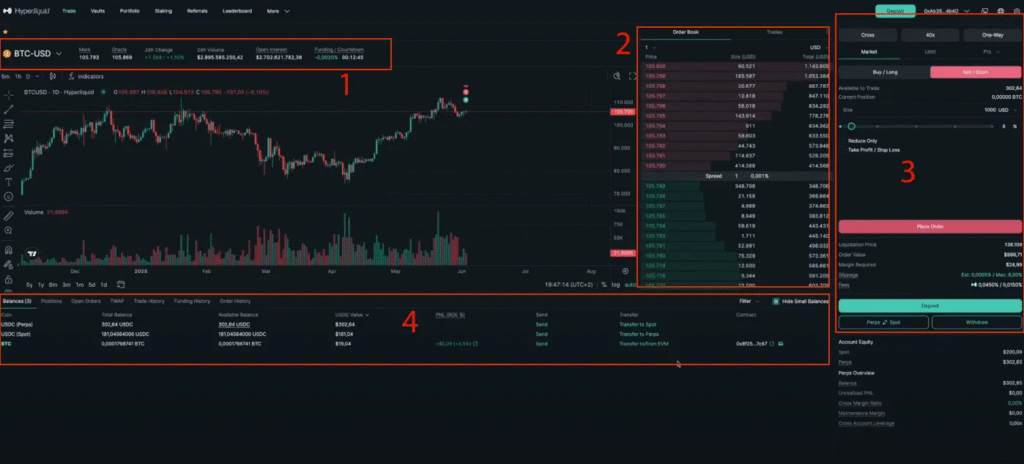 The Hyperliquid perpetual interface displays charts, order books and position controls to measure spreads and average transaction prices. Source: Hyperliquid trading interface
Jupiter Perps products do not expose the same queues. Its entry price starts at the oracle reference price, and then it is agreed to apply a 0.06% opening fee and a price impact adjustment. The impact model includes both a transaction size component and an imbalance component, so the final result may be better or worse depending on direction and JLP conditions.
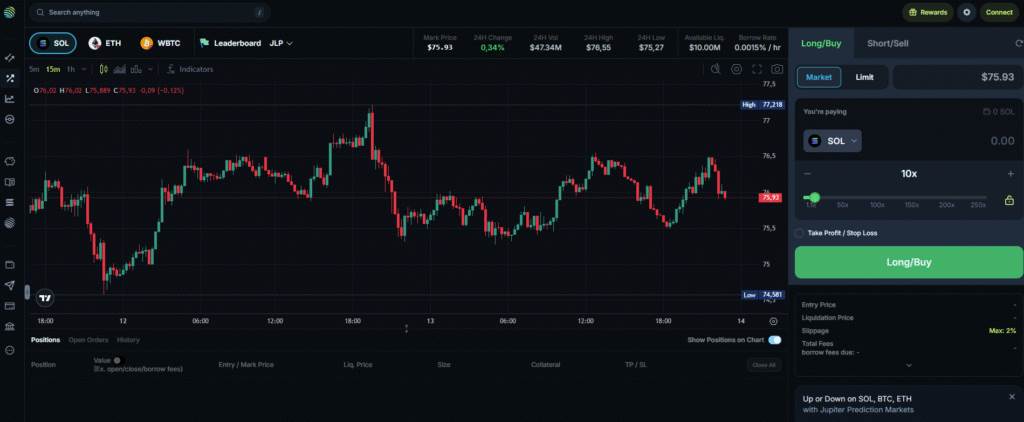 Jupiter Perps interface displays Solana wallet path and position control, and JLP supports trading for oracle pricing. Source: Jupiter Perps
Jupiter does not have an order book sweep does not mean zero-cost execution. Traders need to record the quote entry price, impact fees, collateral deductions and final position size. These fields also need to be captured when exiting, as positions that initially improved pool balance may be closed under different conditions.
Why Jupiter's 0.06% rate doesn't solve the comparison problem
In the rate table reviewed, Jupiter charged 0.06% when opening a position and another 0.06% when closing a position. Therefore, the base position fee is calculated based on the actual nominal amount of entry and exit, rather than the sample account size. Then add in the price impact, hourly borrowing costs and Solana path fees, and deals that improve pool balance may receive favorable impact adjustments.
Hyperliquid starts with a real-time market maker or buyer rate for your account. Traders then add the difference between the decision price and the average orderbook transaction price, cumulative capital fees, and deposit and withdrawal fees. Passive trading reduces explicit costs, but introduces waiting and non-selling risks; buyer orders replace this uncertainty with immediately measurable spreads and impacts.
(Form)
Position Events| Hyperliquid evidence| Jupiter Perps Evidence
Open Position: Rate Level, Order Type, Decision Price and Average Deal Price| NOtional amount of opening x 0.06%, quote impact and collateral deduction
Holding period: each fund settlement| Hourly Borrowing Costs Cumulative
Closing: Closing Fees, Spreads and Average Transaction Prices| Closing notional amount x 0.06%, closing impact and collateral returned
Failure or partial execution: open quantity and order status remaining| Rejected deals, changed quotes, or path status
This event-based comparison is better for the product than a fixed dollar example. Hyperliquid wins when Hyperliquid's order control produces a better average transaction price after taking into account fees and capital fees. Jupiter won when Jupiter's Solana path convenience and pool pricing execution left more collateral after each position event settled.
Market access and order control are independent advantages
Hyperliquid supports orderbook workflows in a broader trading environment. Its public interface allows market prices, price limits, stop losses and more structured execution. Traders who split entry, place passive orders, or arrange TWAP can express the plan directly without having to convert it into a pool-priced position.
Jupiter's advantage lies in its familiarity with the path. Users already operating in the Jupiter ecosystem can stay in the familiar Solana Wallet context and access supported sustainable markets without having to learn a separate orderbook interface. But that doesn't mean Jupiter is a better altcoin platform. Contract availability, collateral and size limits must match expected transactions.
A Solana trader mentioned in a first-hand Jupiter Perps discussion that early versions focused on BTC, ETH and SOL. This comment was accessed on August 11, 2026 and should not be regarded as a current market list. But it does point to the right verification point: Jupiter's path convenience is valuable only if the required contracts are actually available and the pool capacity is sufficient.
(Table)
Implementation requirements| Hyperliquid | Jupiter Perps
Hanging limit orders: Native order book use cases| No equivalent public queue
Split large admission: limit price, proportion, or TWAP workflow| Admission to several individually priced pools
Verification of precise depth: visible by price level| Inference through quotes, restrictions and impacts
Using existing Solana wallets: Additional environment and deposit path are required| Native product advantages
Trading only in major currencies: Strong order control| Simple paths may be competitive
Seeking broad contract options: a stronger primary comparison| Confirm the current product list
Holding costs: Funding fees and hourly pool borrowing
Hyperliquid's holding costs are mainly dominated by funding fees. A useful measure is the cumulative funding fee during the target position period, rather than the latest display range. Traders can combine this debit or credit with execution fees and spreads to calculate the complete position result.
Jupiter applies a loan fee that is accumulated on an hourly basis and responds to JLP utilization. This rate represents the cost of using the liquidity provided by the pool. As utilization increases, hot directions can become more expensive, even if opening fees remain fixed at 0.06%.
This difference changes the preferred holding cycle. Hyperliquid is easier to model strategies that are already built around sustainable capital fees. Jupiter may remain competitive for short-term positions with a favorable impact, but long-term positions require a separate borrowing forecast. Capital fee analysis should not be directly copied into Jupiter's cost model because loans and capital fees are non-interchangeable labels.
Counterparty and Liquidation Risk
Hyperliquid handles normal transactions through its order book, handles forced liquidations through its clearing system, and provides a backup mechanism when ordinary execution is insufficient. Traders control signature wallets, but still face risks to protocol status, chain operations, market depth and clearing path.
Jupiter Perps uses JLP as a pool-side counterparty. Traders 'profits and losses, borrowing, price impact and pool capacity are thus correlated. The JLP earnings interface represents an independent investment decision that is different from opening a perpetual position. A profitable trading experience does not prove that JLP provides attractive risk-adjusted returns.
(Table)
Risk Boundary| Hyperliquid |Jupiter Perps
Evidence of market price: Order book and agreement marked prices| Oracle reference price plus impact model
Liquidity sources: market makers and pending orders| JLP Assets and Utilization
Forced Liquidation Sensitivity: Order Book Depth and Margin Maintenance| Oracle prices, collateral, impact and pool conditions
Additional risk: Chain and backup mechanism behavior| Solana status, JLP capacity and account path
User protection: lower leverage, segregated collateral and wallet separation| Lower leverage, appropriate collateral and path monitoring
Jupiter is not safer simply because the quote avoids visible orderbook sweeps. Hyperliquid is not safer simply because the trader signs it from the wallet. Oracle use case studies illustrate why Oracle, collateral and clearing mechanisms need to be reviewed together.
Wallet recovery is more different than interface
Hyperliquid requires users to understand the deposit assets, target environment, wallet keys and withdrawal paths. Failed or delayed operations should be checked against wallet history and the platform's public status. The headquarters website and public statistical data interface provide background information, but the account's own transaction records are still the basis for recovery.
Jupiter added Solana transaction confirmation and token account behavior in this process. Its familiar interface reduces navigation friction for existing Solana users, but traders still need enough SOL for trading, the correct collateral accounts, and verified withdrawal addresses. A clean UI does not eliminate the risks of chain congestion, transaction rejection, or wallet intrusion.
Long-term assets should be independent of any trading path. Dedicated wallets limit the value exposed to signatures, open positions and agreed rights. Relevant analysis of automated trading agents also strengthens the same boundaries of software-controlled wallets.
The best platform depends on expected transactions
(Table)
Expected workflow| preferred| Reason
Passive limit admission: Hyperliquid| Pending Order and Queue Control
TWAP or Proportional Execution: Hyperliquid| Clearer order tool
Existing Solana users trade supported markets: Jupiter Perps| Shorter wallet and ecosystem paths
Short-term trading and favorable pool impact: Compare the two| Jupiter's fixed rates may still be better or worse than actual order book transaction prices
Multi-day positions with high JLP utilization: Preferred Hyperliquid| Jupiter's borrowing costs may be compounded on an hourly basis
Need to check the depth of execution before submission: Hyperliquid| Public order book evidence
Conclusion
Hyperliquid is suitable for traders who require refined order control, depth of visibility, and cost models based on market maker-buyer fees, spreads, and funding fees. Jupiter Perps is suitable for existing Solana users when the required market is supported and the full oracle pricing results (including 0.06% opening and closing fees, impact and borrowing costs) are lower.
These two products should not be ranked based on interface speed. Hyperliquid should be judged based on the average transaction price and cumulative funding fees. Jupiter should judge the quote based on entry price, price impact, JLP utilization, hourly borrowing costs and collateral returned after closing the position. The only viable winner for the selected trade is the one with lower life cycle costs.
Frequently Asked Questions
Is Hyperliquid cheaper than Jupiter Perps?
For passive or low-impact orderbook execution, it may be cheaper. Jupiter starts with a 0.06% opening fee and a 0.06% closing fee, while its price impact and borrowing costs may improve or worsen total costs.
Does Jupiter Perps have order book slips?
Jupiter does not use the same public order book queue, but its price impact mechanism still changes the final execution result. Oracle pricing does not guarantee zero-cost transactions.
Which platform is more suitable for altcoin perpetual contracts?
When broader contract selection and order control are important, Hyperliquid is the stronger primary comparison target. Jupiter is available only when the required market, collateral and pool capacity are available.
Does Solana wallet make Jupiter Perps more secure?
No. It just makes routing more familiar to Solana users. Protocol, oracle, pooling, clearing, transaction and key management risks remain.
























