
 Exchange Ranking
 Top Exchanges
 24h Volume Ranking
 Popularity Ranking
 Exchange BTC Balance
 Proof of Reserves
 Decentralized Exchanges
 Funding Rate
 Funding Heatmap
 Liquidation Data
 Max Pain
 Long/Short Ratio
 Whale L/S Ratio
 Binance/Okex/Huobi L/S
 Bitfinex Margin L/S
 ETF Tracker
 Solana ETF
 XRP ETF
 Hong Kong ETF
 Bitcoin Treasuries
 Crypto Reversal
 Ethereum Reserves
 HyperLiquid Wallet Analysis
 Hyperliquid Whale Watch
 Large Transactions
 On-chain Movement
 Bitcoin ROI
 Stablecoin Market Cap
 Options Analysis
 News
News Articles
 Economic Calendar
 Features
 Wallet
 Contract Calculator


 Security
 Collections
 Watchlist
 Following
 AAVE
AAVE  ATOM
ATOM  BTC
BTC  KAS
KAS  ONDO
ONDO  SOL
SOL  XMR
XMR  XRP
XRP  ZEC
ZEC Bitcoin has just experienced its strongest week of 2026. Bitcoin climbed from about $62,800 to more than $77,000, a weekly gain of about 22%, after the U.S. Treasury doubled the size of its bond repurchase operations and the Transparency Act regained momentum to boost risk appetite. In the process, approximately $2.7 billion in short positions were liquidated. 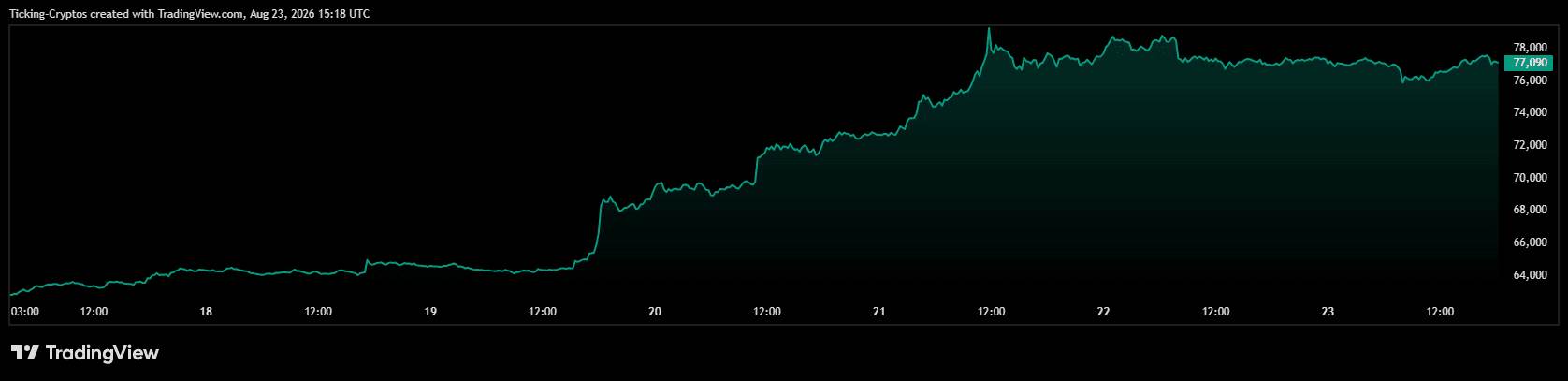
BTC price (US dollar)
However, there has been no widespread rise in altcoins. CoinMarketCap's altcoin seasonal index currently stands at 33 out of 100, down from 51 a week ago. Below 25 is Bitcoin season, and above 75 is altcoin season. We are in an awkward middle ground-with a few currencies rising strongly, while others holding still.
This gap is the opportunity. Zcash rose 75% in seven days. XRP rose 52%. Aave rose 63%. At the same time, dozens of mature projects outside the top 10 recorded only single-digit gains or narrowly outperformed inflation. Joshua Lim, head of derivatives at FalconX, said this week that traders had begun rotating funds into currencies that had not previously risen, describing it as a "catch-up transaction."
The following are five altcoins that match this characteristic. None of them entered the top ten by market value. In the past week, past month, or both, they have underperformed Bitcoin. Moreover, each has a clear reason why it may be repriced, rather than just staying low.
Why are so many altcoins still lagging behind Bitcoin?
In the current cycle, institutional funds flow into Bitcoin through ETFs, which cannot be structurally rotated into altcoins like retail profits in 2017 and 2021. The U.S. spot Bitcoin ETF has a net inflow of approximately US$1.92 billion for five consecutive trading days this month, and its total assets have reached approximately US$100 billion. These funds are locked in products that can only be held in Bitcoin by law. There is no way a BlackRock fund would decide to buy Solana during a week when Bitcoin was performing strongly.
Bitcoin's market share is still close to 58%. In previous cycles, when market share fell below this level, it triggered a cascade of funds down the risk curve. This time, the cascade of funds is slow, selective, and narratives driven. Currencies with "stories" are bought, and currencies without stories remain where they are, no matter how excellent the underlying technology is.
The practical result is that lagging currencies can be divided into two distinct groups. Some currencies are cheap because the market has not yet rotated them; others are cheap because the market, on closer inspection, believes they are not worth the price. Distinguishing the two is the whole job.
How were these five altcoins selected?
Each currency is not in the top ten by market capitalisation, its weekly increase is lower than Bitcoin's 23%, and each has a specific catalyst that may narrow the gap. Three conditions were used in the screening process:
Ranked 11th or lower by market cap on CoinGecko (excluding stablecoins); performed significantly worse than Bitcoin in a 7-day, 30-day, or two time period; and having a real reason for re-pricing-i.e. delivered upgrades, structural supply changes, regulatory shifts, or measurable business growth, rather than just a chart that looks oversold.
Meme coins, exchange tokens and projects without independent development activities are excluded. The following is sorted by market value rather than determinism.
Why is Monero Coin (XMR) currently the largest market lagging currency?
Monero has gained only 3.7% in the past week, while its closest competitor Zcash has gained more than 75%, marking the largest gap in performance between the two privacy coin leaders in months. Monero traded at approximately US$422 and had a market value of nearly US$7.9 billion, ranking 18th. In the past 30 days, it has risen by about 20%, roughly the same as Bitcoin, so this is more like a week of short-term disconnect than a long-term downturn. This difference is important.
Privacy Track was one of the strongest performing sectors in 2026. Monero cooled after hitting an all-time high near $798 in January. The track's funding often rotates between XMR and ZEC due to governance news, whale flows and regulatory headlines. When Zcash's entire Electric Coin Company team resigned in January, money flowed directly into Monero. This week, the flow of funds was in the opposite direction and strong.
The bullish logic is that there is a possibility of mean regression in clearly favored tracks. The bearish logic is more severe than any other currency on this list: Monero faces real access issues. During 2025, about 73 exchanges have removed XMR, Kraken has suspended its services to European Economic Area customers, and the EU's anti-money laundering regulations plan to prohibit licensed service providers from processing private coins and will gradually implement the escrow ban by 2027. If you are in Europe, check the availability on your platform before assuming you can buy it.
Can Gram finally turn Telegram's user base into demand?
Although Telegram has directly taken over network operations, Gram has only gained 4.6% in 30 days, making the gap between its company's news stream and price trend the largest on this list. Gram is a token formerly known as Toncoin. Its trading price is approximately US$1.51 and its market value is approximately US$4.2 billion, ranking 23rd. The name change will take effect on June 15, 2026, after a community vote was passed with a support rate of 81.22%. There have been no changes in technology. Balances, contracts and addresses were not affected, and the blockchain itself is still known as the "open network."
What really changes is control. On May 4, Telegram took over the verifier set from the TON Foundation, becoming the network's largest verifier. Pavel Durov described the rebranding as the fourth step in what he called "Make TON Great Again," and steps five to seven have yet to be announced. Network improvements are said to include a 10-fold increase in throughput and a six-fold reduction in costs. The core argument is straightforward: An instant messaging app with approximately 900 million monthly active users is now directly dominating the chain, and there are three unannounced roadmap steps. The counterargument is that this argument has been around for many years but has not yet translated into continued demand for tokens, and that Coinbase terminated GRAM perpetual futures in June, reducing leverage access for U.S. traders.
Is Ondo (ONDO) the cheapest way to hold tokenized transactions?
Ondo's business growth this year has exceeded almost any project in the crypto space, while its tokens have only risen 2.5% in the past 30 days. ONDO is trading at approximately US$0.377 and has a market value of nearly US$1.85 billion, ranking 48th. The disconnect between company business and token prices is very obvious.
Ondo's total locked value has exceeded US$4 billion, has more than 70% market share in tokenized stocks, and owns more than US$2.5 billion in tokenized U.S. Treasury products through OUSG and USDY. Its broker-dealer subsidiary, Oasis Pro Markets, has received approval from the U.S. Securities and Exchange Commission and the Financial Industry Regulatory Authority to provide tokenized shares to U.S. investors. The SEC investigation launched in 2023 has been closed and no enforcement action has been taken. Its perpetual contract exchange has reached nominal trading volume of approximately US$9 billion in seven weeks. Partners include MasterCard, Fidelity, PayPal, Ripple and JPMorgan's Kinexys.
The total real-world assets on the chain have exceeded US$36 billion in 2026. The American Depository, Trust and Clearing Corporation launched a tokenization production test in July, with more than 50 companies participating. So why is the token price flat? There are two reasons to understand before buying. First, ONDO is a governance token that currently does not generate revenue directly from agreement fees, so business growth does not automatically flow to the holder. Secondly, token unlocking will last until January 2029. Founder Nathan Allman also passed away unexpectedly in May 2026, and Ian De Bode took over as CEO. The destruction of 100 million tokens was approved in July, which helped marginally but did not solve the issue of value capture.
How is Kaspa (KAS) different from all other backward proof-of-work coins?
Kaspa's supply is expected to be close to zero by the end of 2026, with about 95% of the total supply already dug up, which eliminates the selling pressure of miners that has suppressed prices throughout the year.
KAS trades at approximately US$0.029 and has a market value of approximately US$807 million, ranking 82nd. Its price is down more than 80% from its all-time high of about $0.20, rising only 8.5% in the past week and 4.8% in the past month. However, the development progress does not match the chart performance. The Toccata hard fork was activated on June 30, 2026, transforming Kaspa from a fast payment chain to a programmable foundation layer, adding contracts, native KRC-20 token support and zero-knowledge verification opcodes to Layer 1. Kasplex offers an EVM-compatible Layer 2 that uses bridged KAS for fuel costs. Rusty Kaspa v1.1.0 was released in March. The network has processed more than 600 million transactions.
The supply-side argument is the interesting part. With approximately 95% of the maximum supply of 28.7 billion KAS in circulation and new issuance gradually approaching zero, its price is much more sensitive to demand than competitors with heavy unlocking plans. The risks are equally obvious. Building infrastructure does not mean attracting developers, and Kaspa has spent a year proving that upgrades alone will not drive prices up. The upgrade of the DAGKnight consensus is the next milestone. Miners also need transaction fees to replace block rewards, and this requires practical applications that have not yet arrived.
Is Cosmos (ATOM) a deep value investment opportunity or a value trap?
ATOM's price is down about 96% from its all-time high, making it the most contrarian name on this list and one most likely to be a disappointment. ATOM trades at approximately US$1.60 and has a market value of approximately US$847 million, ranking 77th. Its weekly gain was 8.1%, compared with 23% for Bitcoin.
The reasons for bullishness are: Cosmos Stack is widely used, IBC connects more than 200 networks, the 2026 roadmap targets 5000 transactions per second and 500 milliseconds block time, in addition to the IBC v2 light client for Solana and a universal solution for the EVM chain. Cosmos Labs has also launched a formal effort to redesign ATOM token economics around an income model rather than an inflation model, responding directly to the criticism that has plagued the token for years. The pledge rate recently hit a record high of more than 61%.
The reason for bearish sentiment is that the redesign is still in the research stage and not an approved agreement change. Chains built using the Cosmos SDK can use the technology without paying any fees to Cosmos Hub or owning ATOM, which is why the token price has dropped while the software has been successful. Noble, the key stablecoin application chain, has exited the ecosystem. dYdX, Celestia and Injective all benefit from Cosmos, but have not brought cumulative value to ATOM holders. Consider including it only if you accept that it is a bet on governance execution rather than technology itself. Technology has never been the problem.
Which of these five altcoins is the riskiest?
All five currencies are riskier than Bitcoin, and buying lagging currencies is a mixed success strategy.
| currency| ranking| price| 7 days| 30 days| main risks|
| :--- | :--- | :--- | :--- | :--- | :--- |
| Monero Coin (XMR)| 18 | $422.30 | +3.7% | +20.4% |EU Regulation and Exchange Access Issues|
| Gram (GRAM) | 23 | $1.51 | +13.5% | +4.6% |Telegram's positive narrative has not been successfully transformed before|
| Ondo (ONDO) | 48 | $0.377 | +16.1% | +2.5% |Tokens do not capture agreement revenue|
| Kaspa (KAS) | 82 | $0.029 | +8.5% | +4.8% |Upgrade has been delivered, but developers have not yet arrived|
| Cosmos (ATOM) | 77 | $1.60 | +8.1% | +15.8% |Value accumulation issues remain unresolved|
Data as of August 23, 2026, source from CoinGecko.
There is a specific trap worth pointing out in investing in backward currencies. A currency is lagging behind either because the market has not yet noticed it, or it may be because the market has factored in something that you haven't considered. ATOM has looked like a cheap option for three consecutive years. Kaspa has been undergoing major upgrades throughout the year, but prices have never responded. Before the results are announced, a step ahead and a misjudgment look exactly the same.
Historical data shows that August is also a month with low liquidity, which tends to amplify two-way price fluctuations. Moreover, with the altcoin seasonal index at 33 and still declining, the rotation assumed in this article has not yet been confirmed by data. This is an opinion, not a fact.
























