Exchange Ranking
 Top Exchanges
 24h Volume Ranking
 Popularity Ranking
 Exchange BTC Balance
 Proof of Reserves
 Decentralized Exchanges
 Funding Rate
 Funding Heatmap
 Liquidation Data
 Max Pain
 Long/Short Ratio
 Whale L/S Ratio
 Binance/Okex/Huobi L/S
 Bitfinex Margin L/S
 ETF Tracker
 Solana ETF
 XRP ETF
 Hong Kong ETF
 Bitcoin Treasuries
 Crypto Reversal
 Ethereum Reserves
 HyperLiquid Wallet Analysis
 Hyperliquid Whale Watch
 Large Transactions
 On-chain Movement
 Bitcoin ROI
 Stablecoin Market Cap
 Options Analysis
 News
News Articles
 Economic Calendar
 Features
 Wallet
 Contract Calculator


 Security
 Collections
 Watchlist
 Following
 XRP
XRP XRP is under pressure in 2026:21Shares reveals its four investment pillars
Despite some developments that are generally seen as beneficial to major cryptocurrencies, XRP will remain under pressure for most of 2026. However, asset manager 21Shares believes that focusing solely on short-term price movements will miss out on the broader investment logic that has formed around XRP.
In a new analysis, 21Shares points out that every digital asset requires a "reason to exist" and a "reason to add value." For XRP, the asset manager believes this logic is based on four pillars: regulatory clarity, institutional access, measurable effectiveness, and fixed supply. Of these four pillars, only the first point is considered to have been fully resolved, and the remaining three are still developing, which is where the potential opportunities and risks that 21Shares sees lie.
Regulatory clarity: Established pillars
The first pillar is also the easiest to assess. The U.S. Securities and Exchange Commission (SEC) filed a lawsuit against Ripple in December 2020, plunging XRP's regulatory treatment in the United States into years of uncertainty. This chapter effectively ended in August 2025, when the SEC and Ripple withdrew their respective appeals. The SEC confirmed that the district court's final decision remains in effect, including a $125 million civil penalty and injunction related to Ripple's institutional sales.
There is an important nuance here: The settlement does not establish that all possible sales or distributions involving XRP are exempt from securities laws. The court's original decision distinguished between different types of transactions. Secondary market and programmatic XRP sales are not considered securities transactions, while Ripple's direct institutional sales remain subject to securities law requirements. Still, the end of the appeal eliminated a major source of uncertainty that had plagued XRP for years.
This is particularly important for the next part of 21Shares 'argument: institutional investors.
Institutional access: Probably the most important pillar of XRP
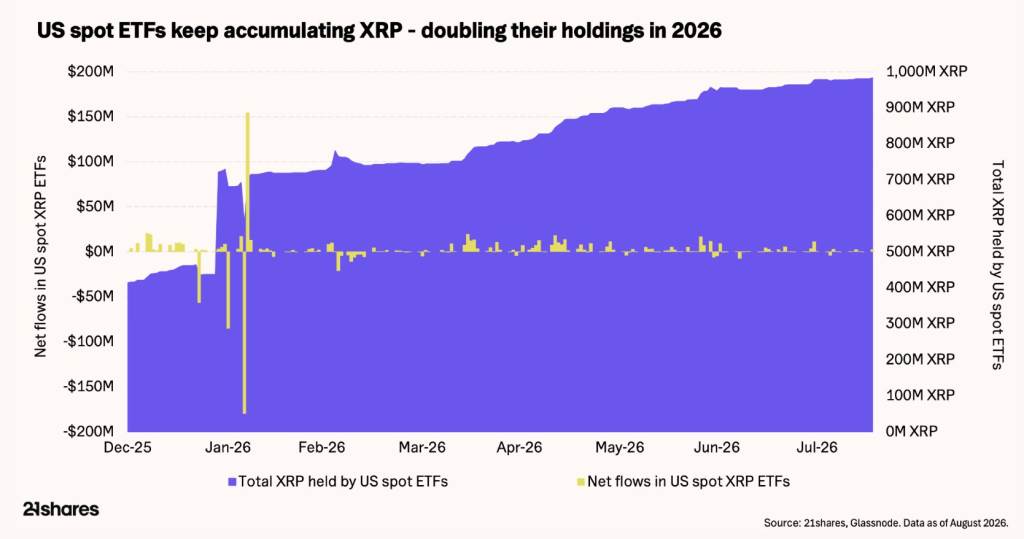
21Shares pointed out that the launch of the U.S. spot XRP ETF proves that market access has undergone substantial changes. According to the asset management company, seven U.S. spot XRP ETFs started launching in November 2025 and raised approximately US$1.3 billion in product funding in the first month. These products also recorded 55 consecutive days of net capital inflows.
 Source: X/@21shares
The chart shared by 21Shares adds another interesting detail. It showed that the total amount of XRPs held by U.S. spot ETFs climbed from just over 400 million in December 2025 to approximately 1 billion in the summer of 2026. In other words, total XRP holdings in these products nearly doubled during this period.
This does not mean that institutional needs are moving in only one direction. 21Shares specifically cited Goldman Sachs as an example and pointed out that according to its analysis, Goldman Sachs disclosed US$153.8 million in XRP positions in the fourth quarter of 2025, but cleared all positions before filing in the first quarter of 2026. Other investors absorbed this supply, and cumulative ETF flows remained positive in the first half.
This distinction is important because institutional participation is not automatically equated to permanent institutional accumulation. Certain positions may represent trading, hedging, market-making, or other strategies rather than long-term beliefs. Still, ETFs solve an important issue: Investors who do not want to manage wallets, private keys or crypto exchanges can gain XRP exposure through regulated investment products.
XRP community member and software engineer Vincent Van Code believes this may be the most important of the four pillars. He compared the cryptocurrency itself to a power drill. Buying a power drill gives someone a tool, but it doesn't give them the expertise, infrastructure and other equipment they need to build cabinets. His point is that organizations often want a finished solution rather than another technology that needs to be integrated on its own.
He believes this is where Ripple's institutional infrastructure gives XRP an advantage. Here we need to distinguish between Ripple and XRP. Ripple is a private company that builds products and services for financial institutions, and XRP is the native asset of the XRP ledger. Ripple's success does not automatically translate into proportional demand for XRP. But Van Code's broader view is worth considering: institutional adoption also depends on compliance, custody, liquidity, and integrated infrastructure, not just the underlying blockchain technology.
21Shares states that the utility of XRP can now measure
The third pillar goes beyond investment products and into the activity of the XRP ledger itself. 21Shares estimates that in the past 12 months, XRPL has processed nearly half a trillion dollars of on-chain value. It also points to the expansion of stablecoins and tokenized real-world assets online.
RLUSD is an example. According to another recent 21Shares analysis, as of June 30, 2026, Ripple's total supply of dollar-pegged stablecoins was approximately $1.56 billion, with approximately 52% of that supply located on XRPL.
Tokenization is another component of this argument. 21Shares valued tokenized assets on XRPL at approximately $4 billion, noting that infrastructure such as Multi-Purpose Tokens, Credentials, Permitted Domains, and Permitted DEX are designed to simplify the issuance and trading processes for institutions.
It can be said that this is where the XRP investment case has become more complex. The increase in XRPL activity is clearly positive for the network, but increased network usage does not automatically produce the same level of growth in XRP demand. Institutions can issue tokenized assets on XRPL or use RLUSD to trade without having to hold large XRP positions. Although XRP is used to pay for network fees and reserves, these requirements by themselves do not guarantee that trillions of dollars in settlement activity will be proportionately translated into XRP's market value.
21Shares directly admitted the problem. Its analysis shows that the link between network adoption and XRP value accumulation is still being verified. Its separate first-half report went further and pointed out that one of the missing links was the use of XRP itself as collateral or margin by institutions. This may end up becoming one of the most important issues facing XRP investors.
XRP's fixed supply completion investment case
The fourth pillar is XRP's supply structure. Unlike cryptocurrencies that have continuous mining or validator issuance, XRP's maximum supply of 100 billion coins was created at the time of its birth. In addition, transactions destroy a very small amount of XRP through a handling fee. 21Shares said that more than 14 million XRPs have been destroyed so far. As a result, the asset has no traditional inflation plan to continue to create new XRPs.
But there is still an important supply consideration: Ripple holds a large number of XRPs associated with escrow accounts. These escrow releases follow predetermined mechanisms, but the released XRPs may still increase the amount of circulating supply, depending on the proportion of the escrow account that Ripple ultimately returns to the escrow account versus the proportion allocated or sold. Therefore,"fixed supply" should not be interpreted as "fixed circulation supply".
This distinction becomes important when assessing whether ETF accumulation can significantly tighten the supply of available XRPs. In fact, 21Shares estimates that in the first half of 2026, U.S. spot XRP exchange-traded products absorbed only 14.8% of the increase in circulating supply, although in May, the absorption rate exceeded half of new supply.
21 Core summary of Shares XRP's argument
These four pillars establish a fairly clear framework. Regulatory uncertainty has been significantly reduced; regulated investment products have made XRPs easier to hold; XRPL activity around stablecoins and tokenized assets is becoming measurable; and XRPs have strict maximum supply caps.
But the biggest unanswered question connects all four pillars: Can growing institutions and XRPL adoption create enough direct demand for XRP itself? This makes these four pillars useful not only as a case for bullish XRP, but also as a framework for measuring whether the argument is actually valid.