Exchange Ranking
 Top Exchanges
 24h Volume Ranking
 Popularity Ranking
 Exchange BTC Balance
 Proof of Reserves
 Decentralized Exchanges
 Funding Rate
 Funding Heatmap
 Liquidation Data
 Max Pain
 Long/Short Ratio
 Whale L/S Ratio
 Binance/Okex/Huobi L/S
 Bitfinex Margin L/S
 ETF Tracker
 Solana ETF
 XRP ETF
 Hong Kong ETF
 Bitcoin Treasuries
 Crypto Reversal
 Ethereum Reserves
 HyperLiquid Wallet Analysis
 Hyperliquid Whale Watch
 Large Transactions
 On-chain Movement
 Bitcoin ROI
 Stablecoin Market Cap
 Options Analysis
 News
News Articles
 Economic Calendar
 Features
 Wallet
 Contract Calculator


 Security
 Collections
 Watchlist
 Following
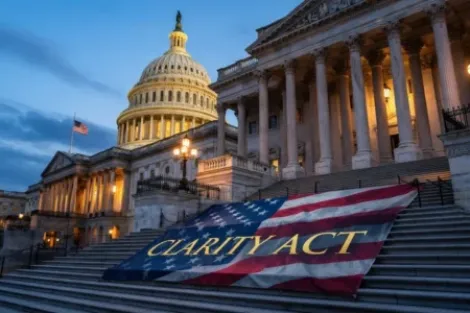
Loomis pressured Democrats after adding 114 Democratic amendments to the CLARITY bill.
The September 15 vote will test whether the Senate has 60 votes in support.
Senator Loomis said that before the September 15 vote, the revised CLARITY bill had included more than 110 Democratic amendments.
In July 2025, the House passed the bill by a vote of 294 to 134, including support from 78 Democrats across the party. In May 2026, the Senate Banking Committee advanced its version by a vote of 15 to 9, but Senate approval still requires 60 votes.
The bill aims to separate the regulatory powers of the Securities and Exchange Commission (SEC) and the Commodity Futures Trading Commission (CFTC) and add registration, disclosure and customer asset protection provisions.
On Saturday, Loomis put further pressure on Senate Democrats, pointing out that now that they have won more than 100 changes they have requested, Democrats should support the CLARITY Act. In a September 12 post, she said Democrats would take responsibility if the legislation failed.
If the CLARITY Act fails, Democrats will be responsible for what follows: More than 100 Democrat-led changes have been lost, consumers have no federal-level protections, disclosure rules are lacking, bad actors will not be removed, and the American people will continue to be trapped in an unregulated system that has caused huge losses...
-Senator Cynthia Loomis (@SenLummis)
The core of her argument lies in negotiations completed before the key procedural vote on September 15. The vote could determine whether Congress can advance comprehensive cryptocurrency market structure legislation before the November midterm elections. Backers still need bipartisan support because the Senate needs 60 votes to advance legislation.
Loomis pressured Democrats after adding 114 Democratic amendments to the CLARITY bill
After consultations during the August recess, Loomis released the revised legislative text on September 10. She said the 630-page draft incorporated more than 114 Democratic provisions.
This record forms the core of her political argument. Democrats helped rewrite most of the proposal, but unresolved disputes remain over consumer protection, ethics and financial regulation.
The revised CLARITY Act includes provisions for agreements that claim decentralization but retain centralized control. Regulators will determine when these companies need to comply with specific federal compliance requirements.
These requirements may include the obligations of the Commodity Futures Trading Commission and provisions of the Bank Secrecy Act. The revision also narrows the scope of certain decentralized finance (DeFi) provisions to spot and cash digital commodity transactions.
In addition, the legislation clarifies the powers of credit unions with regard to digital assets. More broadly, the proposal would more clearly divide cryptocurrency regulatory responsibilities between the Securities and Exchange Commission (SEC) and the Commodity Futures Trading Commission (CFTC).
The bill will also establish a registration system for digital asset intermediaries. These entities will face disclosure requirements, standards for isolation of customer assets and safeguards to resolve conflicts of interest.
The legislation has previously shown bipartisan support in the House. At the time, the House passed the bill in July 2025 by a vote of 294 to 134, with 78 Democrats voting in favor. The Senate Banking Committee subsequently advanced its version by a 15 - 9 vote in May 2026. However, these early votes did not produce a publicly confirmed Senate coalition with 60 votes.
The September 15 vote will test whether the Senate has 60 votes in support
Despite the revisions, Democratic lawmakers are seeking stronger protections. Their concerns include illegal financing, consumer protection, loopholes in securities laws, financial stability, and conflicts of interest in the president's cryptocurrency.
Banking groups have also expressed concerns about stablecoin rewards and potential loss of deposits. As a result, a procedural vote on September 15 still depends on bipartisan support.
Senator Loomis believes that Congressional legislation provides more lasting market rules than regulation alone through federal agencies. However, she warned that consumers would receive "zero federal protection" if the CLARITY Act failed, a statement that went beyond the current regulatory status.
The Commodity Futures Trading Commission (CFTC) now has the authority to prosecute fraud and manipulation involving spot digital commodity markets. Still, it lacks comprehensive regulatory authority to cover these markets.
The Securities and Exchange Commission (SEC) has also issued a 2026 interpretation on crypto assets and proposed disclosure requirements for certain cryptocurrency-related investment contracts. These measures provide limited federal regulation, but do not establish the comprehensive legal spot market structure envisioned by the legislation.
This difference explains the importance of Tuesday's vote. If 60 votes cannot be obtained, current efforts will be shelved as Congress's schedule becomes increasingly tight. However, success will not immediately turn legislation into law.
Instead, it would allow the measure to move into further Senate debate and amendment stages. For Senator Loomis, the procedural hurdle now supports a simple political argument: Democrats were involved in the revision and the next vote will test whether they truly support the bill.