Exchange Ranking
 Top Exchanges
 24h Volume Ranking
 Popularity Ranking
 Exchange BTC Balance
 Proof of Reserves
 Decentralized Exchanges
 Funding Rate
 Funding Heatmap
 Liquidation Data
 Max Pain
 Long/Short Ratio
 Whale L/S Ratio
 Binance/Okex/Huobi L/S
 Bitfinex Margin L/S
 ETF Tracker
 Solana ETF
 XRP ETF
 Hong Kong ETF
 Bitcoin Treasuries
 Crypto Reversal
 Ethereum Reserves
 HyperLiquid Wallet Analysis
 Hyperliquid Whale Watch
 Large Transactions
 On-chain Movement
 Bitcoin ROI
 Stablecoin Market Cap
 Options Analysis
 News
 Articles
 Economic Calendar
 Features
 Wallet
 Contract Calculator


 Security
 Collections
 Watchlist
 Following
 BTC
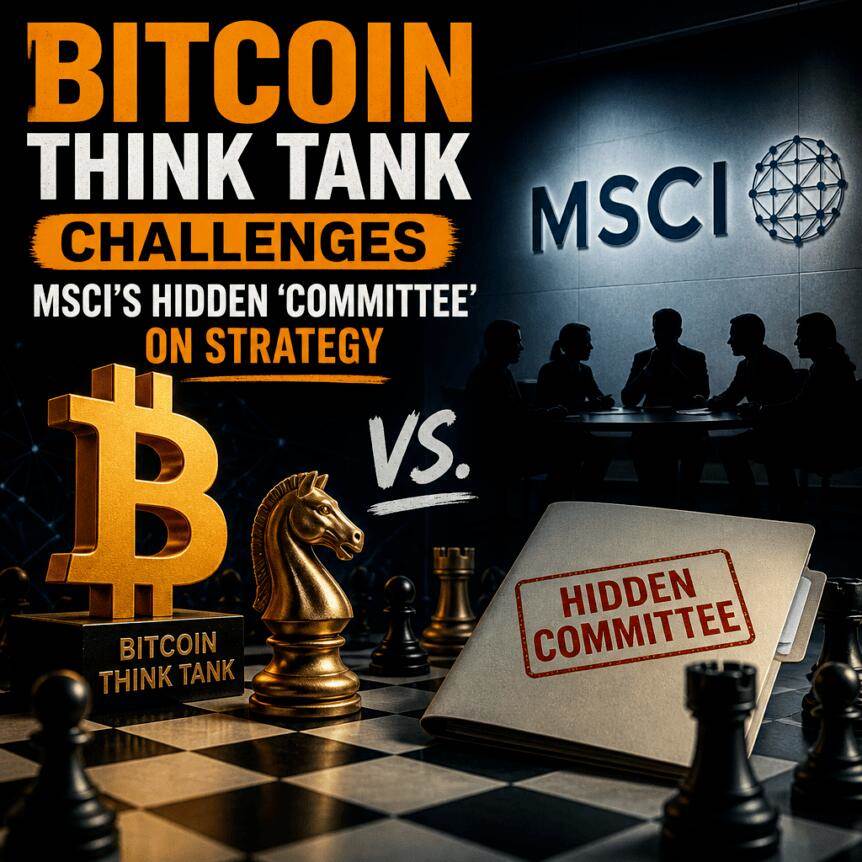
Bitcoin Policy Institute's latest consultation challenges MSCI to tighten stock selection standards
The Bitcoin Policy Institute (BPI) is questioning how Morgan Stanley Capital International (MSCI) is framing its consultation on tightening eligibility rules for inclusion of its equity benchmark index. Previously, the agency found that internal materials were related to a previously shelved digital asset "treasury" proposal.
In its research paper "Wall Street's Hidden Committee," the BPI noted that metadata associated with MSCI consulting materials suggests that broader rules may still be targeted at companies like Strategy and Metaplan that adopt a treasury model for cryptoassets. At the same time, MSCI said its goal is to distinguish between operating companies and those that rely mainly on accumulating assets rather than generating revenue from operating activities to maintain the economy.
Key Points
- The BPI claims that metadata suggests that MSCI's broader "non-operating company" proposal may retain some of the earlier specific advice on cryptocurrencies.
- MSCI's own simulations cited in the consultation suggest that Strategy, Metaplan and uranium investment firm Yellow Cake could be eliminated under the proposed methodology.
- MSCI's new approach will screen "substantial operating assets" before executing five additional financial tests. The BPI warned that there is a lack of standardized definitions of "operating assets" under major accounting standards.
- If the MSCI changes take effect, funds tracking the MSCI index may be forced to sell shares in companies deemed ineligible.
From proposals for cryptocurrencies to broader non-operational testing
MSCI's latest advisory builds on a story line that began earlier this year. The index provider initially proposed excluding Digital Asset Treasury from certain global indices in 2025. However, after receiving objections, MSCI shelved the plan in January and said it would review "non-operating companies" more broadly.
On August 3, MSCI resubmitted a broader eligibility proposal aimed at identifying companies whose value comes primarily from holding or accumulating assets rather than from operating income streams.
Under this update framework, MSCI will first check whether a company has "substantial operating assets." If not, the methodology will then use five additional financial tests to determine whether the company is eligible for inclusion in the relevant MSCI Global Investable Markets Index.
BPI's challenge: The "invisible" material behind the MSCI language
The BPI's criticism focuses on what it calls the disconnect between MSCI's broad wording and the documentation behind its consultation.
In the paper, the BPI noted that metadata showed that presentations used to support MSCI consulting were stored in an internal folder specifically for Digital Asset Treasury. The BPI believes it is "worth asking" whether MSCI's broad wording substantially continues the intent of earlier digital asset treasury efforts.
Although MSCI's consultation was expressed as a general test for non-operating companies, the BPI's focus was that even if MSCI said it had shelved narrower plans, the reasons may not be completely divorced from the cryptocurrency-focused exclusion criteria.
What MSCI simulation results mean for Strategy and Metaplan
For investors, the stakes are not theoretical. In its advisory materials, MSCI included its own simulation results that demonstrated how the proposed rules could be applied to specific companies. Based on these results-cited in the BPI paper-Strategy, Metaplan and uranium investment company Yellow Cake may be eliminated under this methodology.
MSCI's simulation and advisory documents are described in a document titled "Consultation on the Eligibility of Non-Operating Companies for Inclusion in the MSCI Global Investable Markets Index."
Such changes are important because index-linked funds often track constituents and weighting rules closely. If index providers remove certain companies, passive and rules-based active funds may face selling pressure to meet benchmark eligibility requirements.
Earlier reports pointed out that analysts have quantified the potential impact on Strategy. In 2025, JPMorgan analysts estimate that Strategy could face an outflow of approximately $2.8 billion if it is excluded from the MSCI benchmark. Although MSCI's updated advisory is now more generally stated, company-level simulations still point to Strategy and Metaplan as potential victims.
Why "operating assets" may be the core issue-and subsequent developments
BPI believes that MSCI's method introduces a large number of judgment factors in early screening. In the paper, the BPI pointed out that "operating assets" are not a standardized balance sheet category under U.S. Generally Accepted Accounting Principles (US GAAP) or International Financial Reporting Standards (IFRS). The BPI said the lack of this common definition gave MSCI broad discretion in classifying assets such as cash, investments, construction projects and strategic holdings.
The BPI also believes that the problem may not be limited to cryptocurrencies. Capital-intensive industries-such as mining companies or satellite network operators-can hold large amounts of assets for long periods of time and may rely on external financing before revenue increases. In BPI's view, vague definitions of operating assets can lead to over-expansion and capture companies that are not truly non-operating in an economic sense.
MSCI said its non-operational testing aims to isolate companies whose value comes mainly from accumulating assets rather than revenue-producing operations. The consultation also includes a public comment window: MSCI accepts feedback until September 30 and says it expects to release results on or before October 16.
If MSCI finalizes changes, the provider expects any resulting index methodology updates to be implemented as part of its November 2026 index review.
Investors focusing on crypto assets and highly asset-intensive stocks should pay close attention to the October 16 decision-making timeline-not only to see whether Strategy and Metaplane are ultimately eliminated, but also how MSCI defines "substantial operating assets" in final, reproducible criteria.