Exchange Ranking
 Top Exchanges
 24h Volume Ranking
 Popularity Ranking
 Exchange BTC Balance
 Proof of Reserves
 Decentralized Exchanges
 Funding Rate
 Funding Heatmap
 Liquidation Data
 Max Pain
 Long/Short Ratio
 Whale L/S Ratio
 Binance/Okex/Huobi L/S
 Bitfinex Margin L/S
 ETF Tracker
 Solana ETF
 XRP ETF
 Hong Kong ETF
 Bitcoin Treasuries
 Crypto Reversal
 Ethereum Reserves
 HyperLiquid Wallet Analysis
 Hyperliquid Whale Watch
 Large Transactions
 On-chain Movement
 Bitcoin ROI
 Stablecoin Market Cap
 Options Analysis
 News
News Articles
 Economic Calendar
 Features
 Wallet
 Contract Calculator


 Security
 Collections
 Watchlist
 Following
 BTC
BTC  ZEC
ZEC Zcash mining revenue analysis: Single-machine and energy efficiency returns surpass Bitcoin
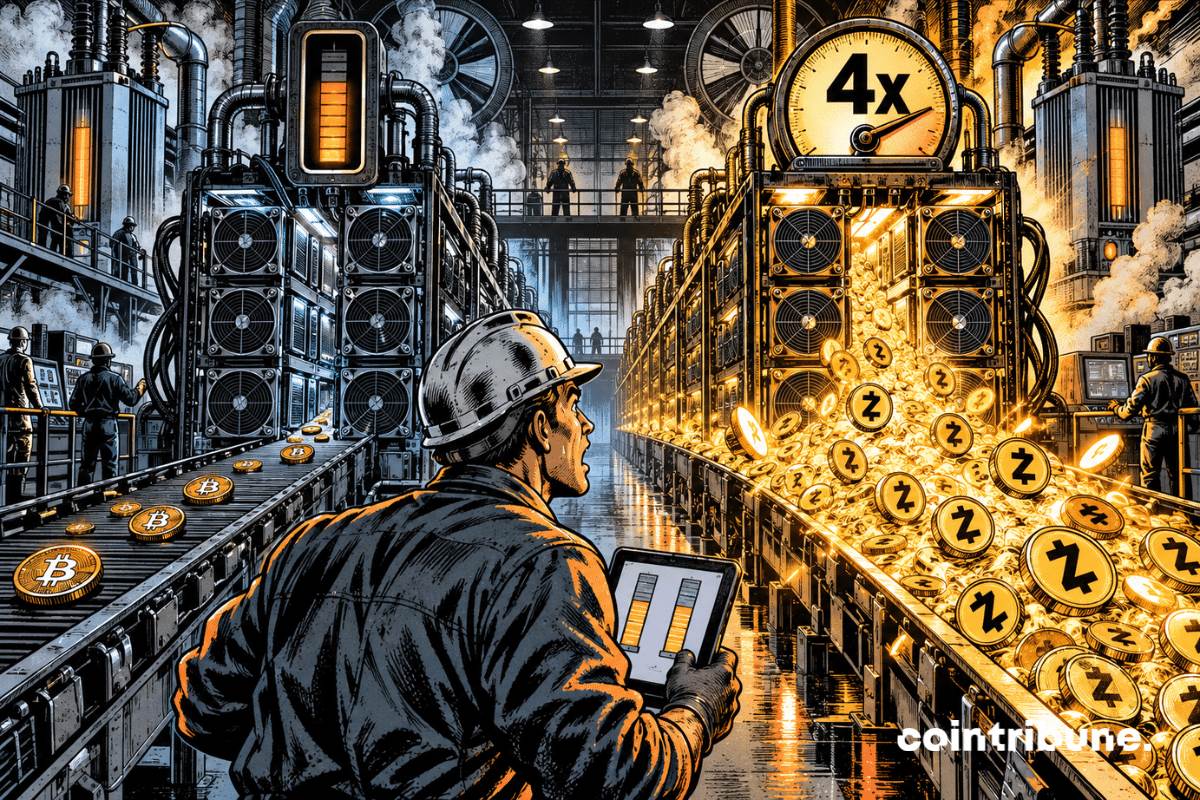
Although Zcash's total reward pool is small, its mining revenue is about twice that of Bitcoin's single device, and the revenue per megawatt hour (MWh) energy consumption is as high as four times. This year, as the rise in ZEC prices has increased mining profitability, Zcash's computing power has increased by more than 2.5 times. In comparison, Bitcoin miners earn approximately $35 million a day, while Zcash miners earn approximately $2 million a day, a figure that highlights the significant difference between total rewards and point-of-operation returns on the network.
Zcash mining has an advantage in terms of profitability
Both networks use a Proof-of-Work (PoW) mechanism to ensure the security of the blockchain. Dedicated computers complete block verification by solving computational difficulties, generating hashes, and comparing the results to network targets. However, Grayscale's research found that Zcash mining provides higher returns for individual miners.
Research estimates show that Zcash's daily return per mining device is about twice that of Bitcoin. In addition, Zcash also generates about four times higher rewards per megawatt hour (MWh). At the same time, equipment used for Zcash and Bitcoin mining cannot be used interchangeably.
Grayscale also compares Zcash mining with other computing uses. According to research, Zcash's current return per megawatt hour is higher than some artificial intelligence and high-performance computing cloud services.
Zcash mining activity grows 2.5 times
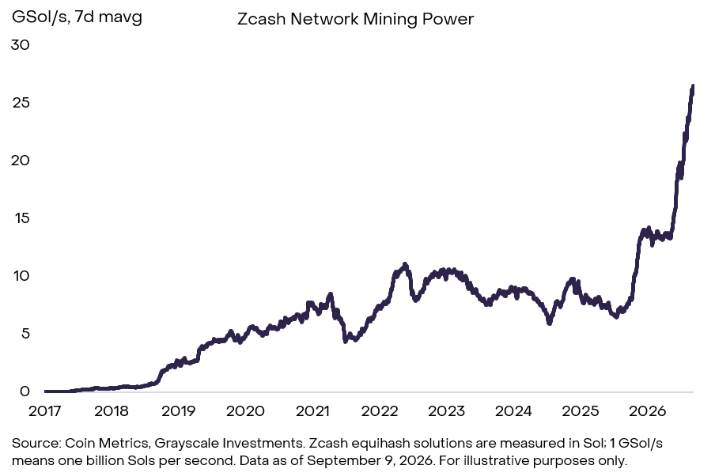
The increase in mining profitability is consistent with the sharp increase in Zcash mining activity. Grayscale pointed out that Zcash's power has increased more than 2.5 times this year. Research attributed this increase to the performance of Zcash token prices.
Higher token prices increase the value of mining rewards, making operators 'mining operations more profitable. Despite this growth, Bitcoin still generates larger overall mining rewards. Bitcoin miners receive approximately US$35 million a day, while Zcash miners only receive approximately US$2 million.
This gap reflects the difference between the total rewards of the network and the rewards available to individual mining operations. Although Zcash's reward pool is smaller, its output efficiency per device and per unit of energy consumption is more efficient.
Zcash follows Bitcoin's proof-of-work model
Pandl describes Zcash as a bitcoin-like digital currency with additional privacy features. Both networks use a proof-of-work mechanism, although the specific mining details differ. On both networks, miners compete to solve computing problems to update the blockchain. Their systems also adjust difficulty goals to maintain a roughly stable block time.
Grayscale stated that higher mining profitability encourages more Zcash mining activity. Research also pointed out that through proof-of-work systems, stronger mining activities can help enhance network security.