Exchange Ranking
 Top Exchanges
 24h Volume Ranking
 Popularity Ranking
 Exchange BTC Balance
 Proof of Reserves
 Decentralized Exchanges
 Funding Rate
 Funding Heatmap
 Liquidation Data
 Max Pain
 Long/Short Ratio
 Whale L/S Ratio
 Binance/Okex/Huobi L/S
 Bitfinex Margin L/S
 ETF Tracker
 Solana ETF
 XRP ETF
 Hong Kong ETF
 Bitcoin Treasuries
 Crypto Reversal
 Ethereum Reserves
 HyperLiquid Wallet Analysis
 Hyperliquid Whale Watch
 Large Transactions
 On-chain Movement
 Bitcoin ROI
 Stablecoin Market Cap
 Options Analysis
 News
News Articles
 Economic Calendar
 Features
 Wallet
 Contract Calculator


 Security
 Collections
 Watchlist
 Following
 BTC
BTC  ZEC
ZEC The power output efficiency of Zcash mining far exceeds that of Bitcoin
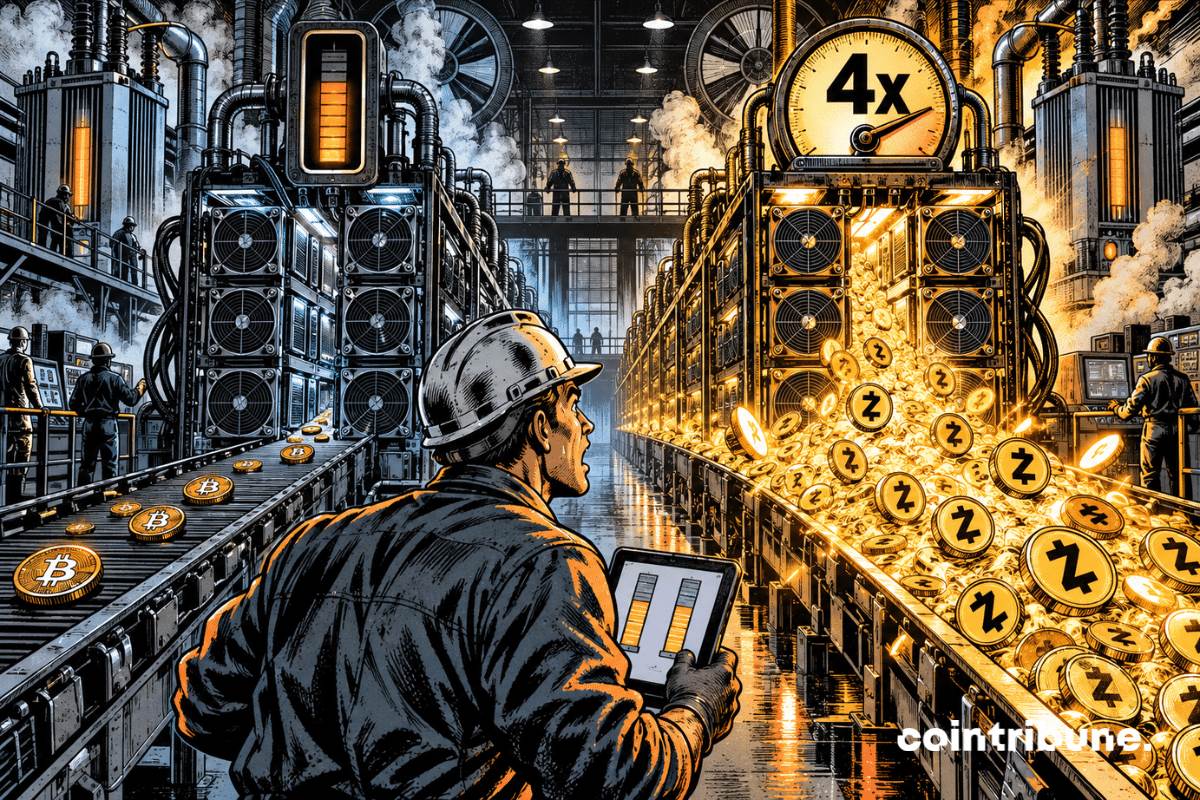
Currently, the revenue per unit of electricity of Zcash mining is much higher than that of Bitcoin mining. Data from early September showed that an Antminer Z15 Pro generated gross revenue of approximately US$708 after consuming one megawatt hour (MWh) of electricity, while the Antminer S23 Pro, which is specifically used for BTC mining, only US$179. This ratio is close to 4:1. Of course, this is not net profit: electricity, custody, maintenance and depreciation costs still need to be deducted. But it suffices to explain why new miners are paying close attention to Zcash.
Overview of core data
- The output of a Z15 Pro on the Zcash network is approximately US$708/MWh, while the output of the S23 Pro on the Bitcoin network is approximately US$179/MWh.
- Zcash's network computing power (Sol rate) increased from about 25 GSol/s to more than 30 GSol/s in a few weeks.
- The influx of new machines has begun to erode ZEC's revenue advantage.
Comparison of power generation per megawatt hour
This data cannot be ignored. At the end of August, earnings per megawatt hour for an Antminer Z15 Pro were approximately $727.30; by early September, that figure had dropped to $708. In comparison, the bitcoin-focused S23 Pro earned about $179 while the older S21 Pro dropped to $113.45.
Although Cotribune pointed out this week that bitcoin mining has improved-the hashprice has risen 22.24% in a month to $39.63 per PH/s per day, and miners 'income is recovering, the network-wide hash rate has not increased simultaneously. This is still not enough to narrow the gap. The ratio of 708 to 179 is approximately 3.96, which is the source of "four times higher" mentioned in the current comparison.
It needs to be clear that this calculation compares the gross income generated by the same energy and does not mean that Zcash miners automatically earn four times the profits of Bitcoin miners. Machines vary in price, life and availability. Operators with a large number of S23 Pro mines could not suddenly decide on Monday morning to use these devices to mine Zcash because Bitcoin uses the SHA-256 algorithm, Zcash uses the Equihash algorithm, and ASIC mining machines are dedicated.
The actual meaning of US$708/MWh
The power consumption of a Z15 Pro is approximately 2.78 kilowatts. Running at full capacity for 24 hours, it consumes nearly 66.7 kilowatt-hours. Based on a gross yield of $708 per megawatt hour, the machine currently earns approximately $47 in daily revenue (before expenditure). The Energy Mag also got the same order of magnitude.
Electricity bills can quickly change the outcome. If the electricity price is US$0.05/kWh, the daily electricity price is slightly higher than US$3.30; if it is US$0.10/kWh, the electricity price increases to approximately US$6.70. This is still not profit. Custody fees, pool fees, fans, maintenance, downtime, taxes and fees are also deducted, especially the depreciation of the Z15 Pro. The same goes for Bitcoin. Therefore, revenue per megawatt hour is mainly useful to industrial operators who already have a certain amount of electricity and need to decide which machines are worth consuming that electricity.
The logic completely changes at this point. The question is no longer "Which cryptocurrency is the most valuable?" It's "What kind of computing load today can convert my megawatts into dollars?" In this accurate ranking, Zcash is significantly better than Bitcoin, but it is not the first. According to some sources, certain AI cloud computing loads can generate approximately $941 per megawatt hour. The Z15 Pro ranks somewhere between artificial intelligence and Bitcoin mining.
The rise in ZEC currency prices shakes miners 'computing models
This performance difference is mainly due to the price of Zcash. On September 4, ZEC broke the $1000 mark after trading below $900 during early profitability estimates. On August 24, when ZEC was at a low level, the Z15 Pro generated $727.30 per megawatt hour. Rising token prices mechanically increase the dollar value of rewards received by miners.
At the same time, another incident occurred: Grayscale's Zcash ETF (symbol ZCSH) began trading on NYSE Arca on August 25. The SEC had announced that its registration was effective the day before, and the product directly holds ZEC. Two weeks later, assets under management exceeded $500 million. Grayscale reported that cumulative inflows since the deal began exceeded $70 million, plus a previously announced investment of $100 million.
The timing is quite interesting. This does not claim that ETFs alone have pushed ZEC above $1000. A variety of factors can quickly push asset prices. However, this suggests that while mining revenue has surged, new financial needs have emerged. Zcash also has mechanisms familiar to Bitcoin miners: Proof-of-Work, a capped maximum supply of 21 million coins, and the distribution of rewards to participants protecting the network.
The similarities end here. Zcash adds privacy features and uses different algorithms. For investors, these are two assets; for data center operators, they are mainly two different ways to monetize electricity.
Cypherpunk and Foundry have entered the market with industrial-grade tools
Profitability improvements have not been limited to small miners in the long term. On August 18, Cypherpunk Technologies announced a $33.33 million deal with Winklevoss Capital to build what it calls the world's largest Zcash mine. The deployment power reaches approximately 4.2 GSol/s. At the time of the announcement, this accounted for nearly 18% of Zcash's strength. The machine is installed in the United States. Cypherpunk also said that approximately 43,800 ZECs are distributed to online miners every month.
This is not the only institutional visitor. Foundry, which is already a leader in Bitcoin mining infrastructure, launched a mining pool specifically designed for Zcash this year. The service is targeted at businesses and professional miners and provides processes that comply with KYC (Know Your Customer), AML (Anti-Money Laundering) procedures and corporate reporting.
This trend is of great significance. Zcash has long maintained a mining industry that is much smaller than Bitcoin. The entry of listed companies, large mining pools and capital is gradually changing its size. The effect has been shown in network data. At the end of August, the computing power was about 25 GSol/s; at the beginning of September, it exceeded 30 GSol/s. The increase exceeded 20% within a few days. This increase is estimated to be equivalent to nearly 6000 additional Z15 Pros (assuming all this model). The network actually uses multiple types of machines, so this number is mainly used as a power equivalent. Miners saw the income and poured in.
The more miners Zcash attracts, the smaller its advantage
This is the current paradox. ZEC's crypto assets rose between August 24 and early September, but Z15 Pro's revenue fell from $727.30 per megawatt hour to $708, a drop of about 3%. What are the reasons? Because computing power grows faster. Available rewards won't simply double as more machines join the network; they must be shared among more computing power.
As a result, each miner gets smaller share. This mechanism also exists in Bitcoin. When improved hash prices attracted additional ASICs, competition intensified, difficulty finally adjusted, and some profit margins disappeared. On Zcash, the process may be more drastic because the network is smaller. The newly added GSol/s account for a significant part of the total power. For companies now considering ordering thousands of machines,$708 per megawatt hour does not guarantee revenue through 2027. This refers to the situation in September 2026. Anything is possible: if ZEC falls, if computing power accelerates and rises again, if Z15 Pro prices rise, or if electricity bills become more expensive. High returns attract new competitors who ultimately reduce their returns.
Bitcoin is still huge, but its miners are going through a difficult year
Zcash's higher output per megawatt hour does not mean that its industry has surpassed Bitcoin. Bitcoin remains far ahead in terms of network value, computing power, industrial investment, liquidity and the size of the mining ecosystem. The problem is the compression of profit margins. In June, JPMorgan estimated that under the conditions at the time, 15% to 20% of Bitcoin miners were losing money.
Canaan's financial report released on September 8 provides a specific case. The company produced 243 BTC units in the second quarter of 2026. Its mining revenue was US$17.7 million, compared with US$28.1 million in the same period last year. Jia Nan reported an average competitive electricity cost of approximately US$0.043/kWh. Even with such low electricity bills, the period was not easy. Quarterly mining activity costs reached US$20.4 million, including electricity, custody fees and machine depreciation.
Bitcoin then rebounded and the hash price improved. However, not all miners are eager to add machines. Hash rates are still below previous highs, and some companies are now seeking another use for data centers. Zcash took advantage of this hesitation period at the right time.
AI is now competing with Bitcoin and Zcash for the same megawatts of electricity
The real competitor for cryptocurrency mining may not be other blockchains, but artificial intelligence. Large miners already have the resources that artificial intelligence companies are looking for: ready-made power, land, network connections, data centers and experience running high-intensity computing loads. As a result, several Bitcoin miners have begun signing high-performance computing contracts. We have observed this migration: some operators are reserving more and more of their power capacity for AI rather than Bitcoin.
Miners 'surge into AI puts pressure on Bitcoin's hash rate. Certain cloud AI loads generate approximately $941 per megawatt hour, Zcash is approximately $708, and the S23 Pro Bitcoin mining for comparison is approximately $179. These three activities are not completely interchangeable. Converting mining sites into AI data centers requires major investments: cooling systems, fiber optics, guaranteed availability, GPU servers and long-term contracts. But this is the comparison financial management now makes. Every megawatt of electricity can be distributed somewhere. As a result, Bitcoin has to resist competition not only from other proof-of-work cryptocurrencies, but also from customers who can sign multi-year AI computing contracts.
Zcash currently enjoys a rare window period. Its currency price has risen sharply, and the number of miners has not yet fully kept pace with the price. Energy gains are still almost four times those of the benchmark Bitcoin. This window can be maintained or closed quickly. Computing power has increased by more than 20%, and despite the rise in ZEC, Z15 Pro's revenue is still declining. Markets are already at work.
For miners, the conclusions are not as shocking as the four-fold ratio. Currently, Zcash produces more per megawatt hour. Bitcoin is still a deeper industry. In some configurations, AI pays even more. Three markets, one resource: electricity.