Exchange Ranking
 Top Exchanges
 24h Volume Ranking
 Popularity Ranking
 Exchange BTC Balance
 Proof of Reserves
 Decentralized Exchanges
 Funding Rate
 Funding Heatmap
 Liquidation Data
 Max Pain
 Long/Short Ratio
 Whale L/S Ratio
 Binance/Okex/Huobi L/S
 Bitfinex Margin L/S
 ETF Tracker
 Solana ETF
 XRP ETF
 Hong Kong ETF
 Bitcoin Treasuries
 Crypto Reversal
 Ethereum Reserves
 HyperLiquid Wallet Analysis
 Hyperliquid Whale Watch
 Large Transactions
 On-chain Movement
 Bitcoin ROI
 Stablecoin Market Cap
 Options Analysis
 News
News Articles
 Economic Calendar
 Features
 Wallet
 Contract Calculator


 Security
 Collections
 Watchlist
 Following
 POLYX
POLYX What is POLYX? Why it matters to Polymesh
POLYX is Polymesh's native utility token. Polymesh is a publicly licensed Layer 1 blockchain for regulated assets, while POLYX is the "fuel" that keeps the entire chain running. POLYX has four main functions: payment of transaction and agreement fees, network security through pledges, governance weights for holders, and coordination of interests between operators and users.
The key here is: Most tokens claim to have all of the above functions, but few can connect them to a chain built specifically for compliance and identity verification. And Polymesh did just that.
What is POLYX?
POLYX is a native utility token running on Polymesh. Polymesh is a blockchain built specifically for tokenizing regulated assets and real-world assets (RWA). Every meaningful operation on the chain is closely related to POLYX.
Its functions can be summarized into three categories: fees, pledges, and governance signals. The necessity for its existence is that even the licensing chain requires an economic layer, and POLYX is this level.
What is Polymesh and how does it work?
This is the blockchain that POLYX runs on, and it is crucial to understand this before understanding the rest.
Polymesh as a publicly licensed blockchain
Polymesh is not completely open. Anyone can view data on the chain and hold POLYX, but nodes similar to validators (called node operators) must be licensed entities approved by the Polymesh Management Board.
It's a deliberate trade-off: remain open where it helps transparency and restrict where it protects compliance.
Why Polymesh was built for regulated assets
Authentication, compliance and settlement are not attached to Polymesh through smart contracts, but are built into the agreement itself.
The official project describes Polymesh as a publicly licensed Layer 1 with identity and compliance capabilities designed to serve regulated assets, covering securities tokens and broader real-world asset (RWA) tokenization.
This turns out to be completely different from the goals pursued by most Layer 1 chains. Most chains optimize permissionless access, while Polymesh optimizes regulatory certainty first.
Use of POLYX
This part really answers the question "What is POLYX for?" and goes beyond the single-line definition.
Pay transaction and agreement fees
POLYX is used to pay transaction and agreement fees. Transaction fees scale based on the size and complexity of the operation, and agreement fees apply to specific native functions.
There is also a fee subsidy mechanism. One account can pay fees for another, which is crucial for institutions to bring in new users.
Through the Pledge Guarantee Network
POLYX is a collateral that guarantees the security of Polymesh. Node operators and their nominees need to pledge POLYX to participate in the network's Nomination Proof of Interest (NPoS) consensus mechanism and receive rewards through correct operation.
Without pledge, there is no security. These are the rules.
Participating in Governance
POLYX holders can express support for the Polymesh Improvement Proposal (PIP). Pledging tokens behind proposals is not a symbolic act, but a practical way for communities to shape their roadmap.
Support network incentives
Rewards and fines align operators 'actions with the interests of the chain. Operators that perform well earn POLYX, while operators who behave offline or maliciously will face penalties.
How does POLYX pledge work?
POLYX pledge adopts a nomination proof of interest model and is divided into two roles.
Node operator vs. nominee
Node operator is responsible for running the infrastructure. They must hold a license and obtain approval from the management committee before they can be verified.
Nominees do not run nodes and do not need to do so. They pledged POLYX in the names of operators they trusted and shared the rewards they received.
POLYX Reward Mechanism
Each era (era) will cast a new POLYX as a block reward and distribute it to operators and nominees based on performance. The reward curve aims to achieve a pledge rate of 70%. Below this ratio, the reward will be higher to attract pledgers; above this ratio, the reward will gradually decrease.
What happens when POLYX unbinds?
Unpledge is not completed immediately. The latest official material points out that POLYX in bound status cannot be transferred until it is unbound and an unlocking period of approximately 28 days has passed.
In cryptocurrency standards, 28 days is a long waiting period, but it helps prevent short-term speculation around pledge rewards.
How does Polymesh governance work?
Governance is what Polymesh quietly does best that most chains fail to explain clearly.
What is the Polymesh Improvement Proposal (PIP)?
Polymesh Improvement Proposal (PIP) is a formal on-chain proposal to change certain aspects of the network. Any POLYX holder can submit a PIP by detailing the changes and pledging POLYX behind the proposal.
What do POLYX holders do?
Holders can submit PIP directly or express support for other submitted proposals. Either approach provides a real mechanism for holders, not just a symbolic vote.
What does the management committee do?
The Management Committee reviews the PIP, builds consensus, and votes on the approved proposals for implementation. It exists to protect the network from disruptive changes that threaten regulatory certainty.
Is this more centralized than typical DAO voting? It does. But considering what Polymesh serves, this can be said to be a result of design.
POLYX token economics and supply
Token economics is often an area of ambiguity in many crypto projects, but Polymesh is not.
Is there a maximum supply of POLYX?
No. Official documents clearly state that POLYX does not have a fixed maximum supply, but is cast through block rewards under the consensus of proof of stake. This is noteworthy for those who compare it to hardtop tokens such as Bitcoin.
How the new POLYX was created
New tokens are minted every era and distributed as compensation to operators and pledgers. There is no mining, and there are no pre-programmed halving events.
Impact of pledge incentives on supply
New issuance is capped at 140 million POLYXs per year, which is linked to the network's pledge rate. The fewer pledges, the faster the issuance speed; if the pledges exceed the ideal proportion, the issuance speed will slow down.
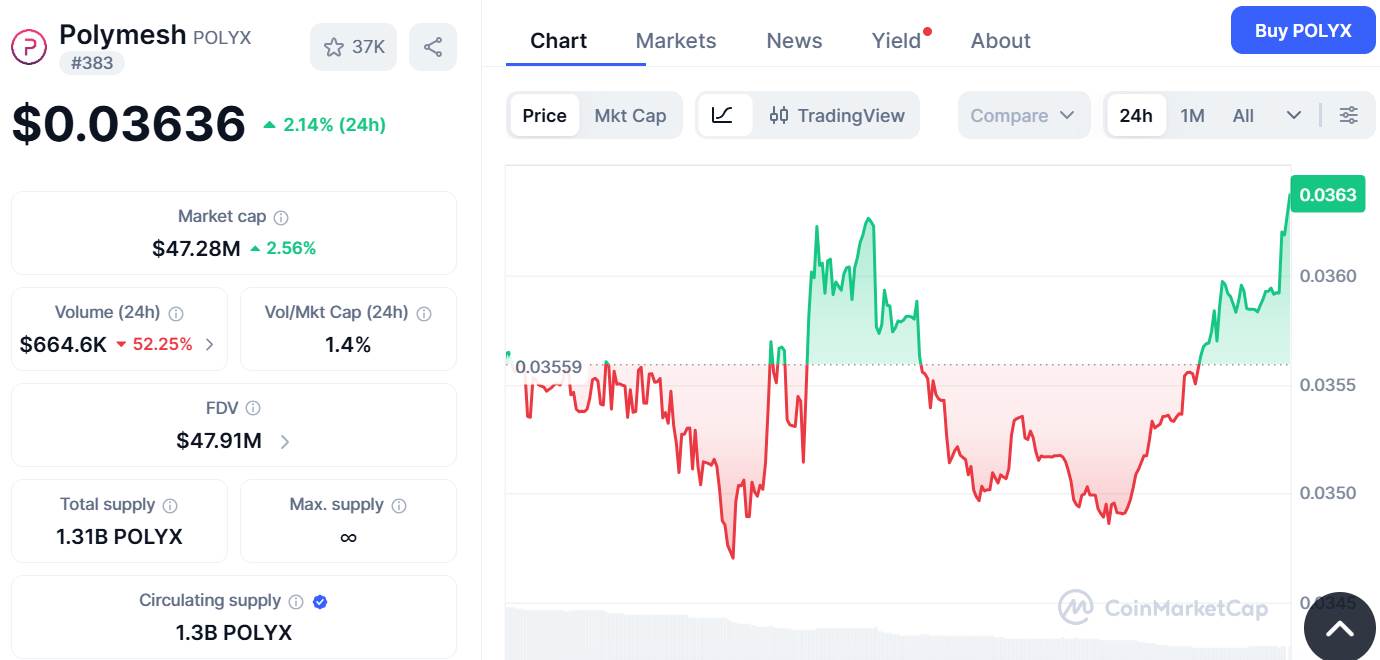
POLYX Market Snapshot
The following data snapshot was recorded at UTC on September 12, 2026, and was sourced from CoinMarketCap:
- Price: Approximately $0.03633
- Market Value: Approximately US$47.28 million
- Circulation Supply: Approximately 1.31 billion POLYX
- Maximum supply: None (no cap, continuous release)
Where is POLYX listed?
POLYX trades on several centralized exchanges, although availability varies by region.
Exchange POLYX Availability Example Market Notes Kraken is POLYX/USD, EUR, USDT depending on region KuCoin is available in the stock market by POLYX/USDT Gate is a POLYX/USDT check for local jurisdiction rules Bitget is a pre-trade confirmation of availability for POLYX/USDT Current market data shows that there are active POLYX trading markets on Gate, KuCoin and Bitget, while Kraken lists multiple POLYX trading pairs.
POLY and POLYX: What is the difference?
People still often confuse these two concepts.
POLY POLYX Ecosystem Polymath Polymesh Network Ethereum Polymesh Character Early Tokens Polymesh Native Tokens Main Purpose Polymath Ecosystem Fees, Pledges, and Governance POLY was Polymath's original ERC-20 token. POLYX is a token running on the living Polymesh chain. They have been related historically, but are not interchangeable today.
Advantages and Risks of POLYX
Every token has pros and cons, and POLYX is no exception.
Potential advantages
- Network utility: POLYX is necessary to interact with Polymesh, linking requirements to actual use.
- Pledge Role: It ensures network security through NPoS, providing the holder with productive use of idle tokens.
- Governance Function: Holders shape the direction of the network through PIP.
- RWA and Institutional Focus: Polymesh targets niche markets that most chains ignore.
Key risks
- Token supply: Uncapped issuance means continued dilution pressure if adoption rates don't keep up.
- Market Volatility: POLYX can fluctuate wildly, just like most crypto assets.
- Liquidity: Thin volumes on some exchanges lead to spreads widening.
- Regulatory dependence: Its selling point depends on the framework that may change.
- Institutional adoption risk: Value depends on whether there are real institutions built on it.
- License verifier model: A small number of licensed operators means less decentralization.
This trade-off quickly becomes apparent when we compare it to the typical unlicensed Layer 1. Polymesh abandoned part of decentralization in order to adapt to regulatory requirements.
Conclusion
POLYX is directly related to Polymesh's mission. It is a token that pays fees, guarantees consensus, and carries governance weights on a chain specifically designed for regulated real-world assets.
Uncapped supply and license verifier models may not suit every investor's taste. But for anyone who cares about tokenization of real-world assets, POLYX deserves to be understood in its own terms, not just as another ticker.
Disclaimer
This document is for information purposes only and does not constitute financial advice. Crypto assets, including POLYX, carry significant risks and prices can change rapidly. Be sure to research and verify the current data yourself before making any decisions.