Exchange Ranking
 Top Exchanges
 24h Volume Ranking
 Popularity Ranking
 Exchange BTC Balance
 Proof of Reserves
 Decentralized Exchanges
 Funding Rate
 Funding Heatmap
 Liquidation Data
 Max Pain
 Long/Short Ratio
 Whale L/S Ratio
 Binance/Okex/Huobi L/S
 Bitfinex Margin L/S
 ETF Tracker
 Solana ETF
 XRP ETF
 Hong Kong ETF
 Bitcoin Treasuries
 Crypto Reversal
 Ethereum Reserves
 HyperLiquid Wallet Analysis
 Hyperliquid Whale Watch
 Large Transactions
 On-chain Movement
 Bitcoin ROI
 Stablecoin Market Cap
 Options Analysis
 News
News Articles
 Economic Calendar
 Features
 Wallet
 Contract Calculator


 Security
 Collections
 Watchlist
 Following
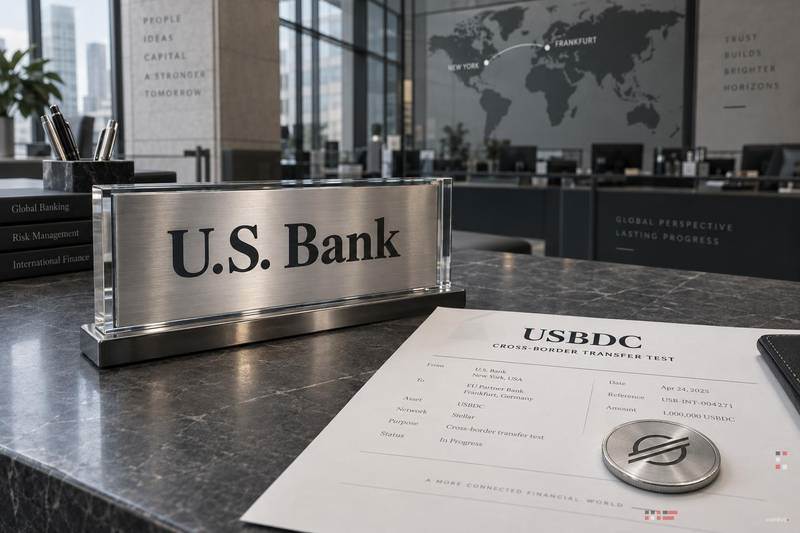
Bank of America tests cross-border USBDC stablecoin transfers on Stellar Network
Bank of America is conducting a test of cross-border USBDC stablecoin transfers based on the Stellar Network between its own entities. This is an early stage internal experiment rather than an actual payment service for customers.
Core Points
- Bank of America is testing the transfer function of the USBDC stablecoin.
- Transfers are cross-border operations and occur between different entities within the bank.
- This test was run on top of the Stellar network.
Test background and purpose
Bank of America is using the Stellar network to conduct a cross-border transfer test involving USBDC, a stablecoin. The current nature of the event is defined as a "trial" and has not yet been officially launched, nor have any verified results been announced. The test was designed to assess whether banks can transfer funds between their branches through the stablecoin rather than settling through traditional correspondent bank channels. The designated asset is the USBDC, and the designated settlement channel is the public Stellar network.
Role of the Stellar network in testing
As the transmission network for this trial, the Stellar network is positioned similar to experiments conducted by other institutions using public ledgers. For example, the Bank for International Settlements (BIS) tested XRP Ledger's work for settlement use cases. This framework reflects the trend of financial institutions 'exploration of public distributed ledger technology.
Test scope: Only intra-bank entities
All participants are entities within Bank of America. Existing reports indicate that customer access rights have not yet been established and that trials are strictly limited to within the bank. Transfers are made only between entities within the bank and do not involve interactions between the bank and external counterparties. This suggests that the work is an internal experiment similar to treasury management rather than a public payment product. The move also comes as other institutions explore the role of bank-related digital assets, such as Block Inc. seeking a federal license to custody Bitcoin.
Explanation of the description of "cross-border"
Although the report described the transfer as "cross-border", it did not specify the specific entities, countries, customers or transaction volume involved. In addition, the report did not confirm settlement speed, cost savings or production readiness.
Key details to be confirmed
Currently available reports lack the key details needed to evaluate the trial. This information gap is accompanied by the overall development momentum in the stablecoin field this year. For example, Circle's EURC was launched in Upbit, South Korea. However, the specific test results and launch details still need to be verified. Trading timing, trading volume, measured results and future availability are not clearly stated. Reserve arrangements and regulatory status have also not been verified, with neither approval nor approval confirmed. This missing information may exist in other sources not covered in this briefing.
Disclaimer : This article is for reference only and does not constitute financial or investment advice. There are significant risks in the cryptocurrency and digital asset markets. Be sure to conduct independent research before making a decision.