Exchange Ranking
 Top Exchanges
 24h Volume Ranking
 Popularity Ranking
 Exchange BTC Balance
 Proof of Reserves
 Decentralized Exchanges
 Funding Rate
 Funding Heatmap
 Liquidation Data
 Max Pain
 Long/Short Ratio
 Whale L/S Ratio
 Binance/Okex/Huobi L/S
 Bitfinex Margin L/S
 ETF Tracker
 Solana ETF
 XRP ETF
 Hong Kong ETF
 Bitcoin Treasuries
 Crypto Reversal
 Ethereum Reserves
 HyperLiquid Wallet Analysis
 Hyperliquid Whale Watch
 Large Transactions
 On-chain Movement
 Bitcoin ROI
 Stablecoin Market Cap
 Options Analysis
 News
News Articles
 Economic Calendar
 Features
 Wallet
 Contract Calculator


 Security
 Collections
 Watchlist
 Following
 BTC
BTC  ETH
ETH Bitmine Immersion Technologies: Converting huge Ethereum vaults into stable income
Bitmine Immersion Technologies announced last week that it would increase its Ethereum treasury reserves, bringing the number of Ethereum (ETH) held to nearly 6 million, and using most of its positions to obtain pledge income. The company also estimates that its annualized pledge revenue could reach hundreds of millions of dollars, a statement that highlights the fact that some listed companies in the cryptocurrency space are moving from a balance sheet strategy of "hold and wait for appreciation" to a similar cash flow generation strategy. transformation.
In an announcement released on Monday, Bitmine disclosed that it had purchased 27,180 ETH units in the past week. The acquisition brought its total ETH holdings to more than 5.95 million, valued at approximately US$15.4 billion-accounting for approximately 4.9% of Ethereum's circulating supply. Including cash and other crypto assets, Bitmine reported a total value of approximately US$15.8 billion.
Core Points
- Bitmine increased its holdings by 27,180 ETH units last week, with its total positions exceeding 5.95 million units (approximately US$15.4 billion).
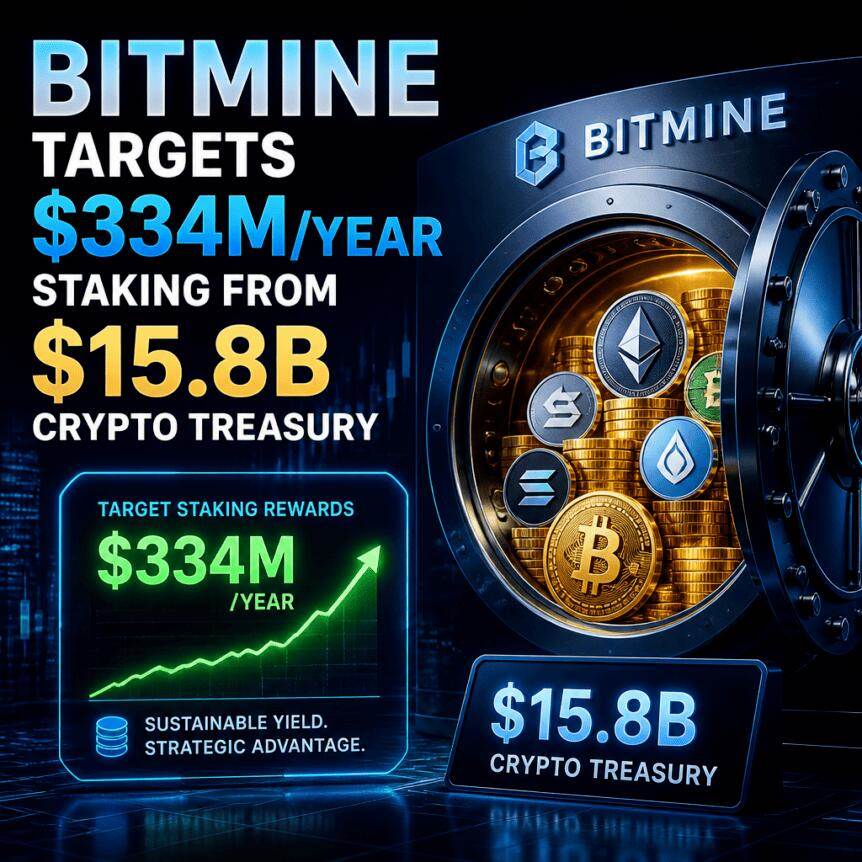
- Currently, more than 5.06 million ETH have been pledged. Based on current rates, Bitmine expects annualized pledge revenue to be US$334 million.
- About 85% of Bitmine's Ethereum has been pledged, indicating that it is betting on recurring gains rather than simply capital appreciation.
- Compared to the Bitcoin treasury strategy, pledge-centered assets can bring different performance drivers-especially in volatile markets.
Bitmine converts large Ethereum vaults into pledged revenue
Bitmine's latest update highlights the revenue component of its Ethereum strategy. According to the company, more than 5.06 million ETH are currently in pledge status. At the rates quoted by Bitmine, this equates to estimated pledge revenue of $334 million per year.
The pledge ratio is crucial to the investment logic constructed by the company. Bitmine said that about 85% of its ETH has been pledged, which means that most of the treasury's funds are earning online rewards rather than idle. This strategy aimed at smoothing market cycle returns means that pledge gains can continue to accumulate even if price fluctuations affect the value of positions.
Bitmine also directly compared it with Grayscale's Ethereum pledge product. According to data from the official website of the Grayscale Ethereum Staking ETF (ETHE), the product uses 84.6% of its Ethereum as collateral. Although Bitmine is not an ETF, this comparison shows that investors are familiar with such configurations and can use them as a benchmark for measuring income-oriented Ethereum exposure.
This revenue-generating design is significantly different from many Bitcoin treasury models. Bitmine emphasized that Bitcoin positions do not generate native pledge gains like Ethereum pledge. For investors tracking these companies, this means that performance can be differentiated by differences in revenue mechanically generated by the balance sheet, rather than just the market repricing of the underlying assets.
The treasury economics implications behind the data
The number of Ethereum reported by Bitmine-5.95 million and still growing-makes it one of the corporate holders with the largest exposure through collateral. Based on the data provided, the value of its Ethereum position alone is approximately US$15.4 billion. Coupled with additional crypto assets and cash, the total position is approximately US$15.8 billion.
The key lesson for investors is that Bitmine's narrative is not just about the size of the treasury, but also about what percentage of the treasury is deployed to activities that generate sustained rewards. When a company can prove that a large number of its positions have been pledged, it more convincingly demonstrates the creation of recurring value rather than simply relying on market appreciation to exceed performance.
Nevertheless, readers should pay attention to parts of the Bitmine announcement that are not explicitly stated. Estimated annualized pledge revenue is clearly linked to "current rates," which means that this number may change if network participation, reward dynamics or market prices change. As a result, the company's economic situation remains affected by the dual impact of the Ethereum pledge environment and broader crypto market conditions.
Stock price performance and market pricing for the strategy
On the day of the announcement, Bitmine's share price was basically flat, trading just below $25 in early trading. Yahoo Finance data shows that the stock has risen nearly 38% in the past month, but remains in decline year-to-date.
This divergence between short-term strength and long-term weakness suggests that investors may be assessing Bitmine's fiscal expansion and pledge earnings logic in stages rather than fully investing immediately. For traders and long-term holders, the market often reacts when a company translates its balance sheet strategy into more specific revenue expectations, but the repricing process may not be uniform as investors test whether assumptions will stand the test of time.
Bitmine's strategic direction is also consistent with previous reports, including reports that the company has committed to expanding treasury accumulation goals.
Strategy (MicroStrategy) continues to reallocate to preferred shares
Although Bitmine goes further into Ethereum pledge, Michael Saylor's Strategy company shows a different capital allocation model. According to Monday's documents and related reports, Strategy did not buy Bitcoin for the second consecutive week.
Instead, Strategy bought back its STRC preferred shares. The company said it repurchased approximately 1.42 million shares, totaling $139.3 million, between September 8 and September 13. The document also mentions previous activity: Strategy bought back $176.3 million worth of STRC in the previous week.
Meanwhile, Strategy's Bitcoin balance was reportedly unchanged at 845,050 BTC as of September 13. Its most recent public Bitcoin purchase occurred in late August, when the company purchased 4,603 BTC for $369.7 million-this is described in the source material as its first Bitcoin purchase since June.
Strategy's suspension of Bitcoin purchases contrasts sharply with Bitmine's continued accumulation of pledges for Ethereum, highlighting a broader tension in corporate crypto investment: Will the main expectation of returns come from additional spot accumulation, balance sheet restructuring, or is it attached to assets? A gain-like mechanism? In Strategy's case, recent behavior suggests its focus is on supporting its preferred stock plan while maintaining existing BTC exposure; in contrast, Bitmine emphasizes that once it holds Ethereum, it itself provides continued pledge rewards.
The next thing worth noting is whether these two methods converge in investor expectations. If pledge proceeds remain attractive and Bitmine maintains high pledge utilization, its treasury may increasingly be seen as having cash-flow-like characteristics. However, if the pledge economy or online reward conditions change, the company's annual estimates may be revised and the market may reprice the strategy accordingly.