Exchange Ranking
 Top Exchanges
 24h Volume Ranking
 Popularity Ranking
 Exchange BTC Balance
 Proof of Reserves
 Decentralized Exchanges
 Funding Rate
 Funding Heatmap
 Liquidation Data
 Max Pain
 Long/Short Ratio
 Whale L/S Ratio
 Binance/Okex/Huobi L/S
 Bitfinex Margin L/S
 ETF Tracker
 Solana ETF
 XRP ETF
 Hong Kong ETF
 Bitcoin Treasuries
 Crypto Reversal
 Ethereum Reserves
 HyperLiquid Wallet Analysis
 Hyperliquid Whale Watch
 Large Transactions
 On-chain Movement
 Bitcoin ROI
 Stablecoin Market Cap
 Options Analysis
 News
 Articles
 Economic Calendar
 Features
 Wallet
 Contract Calculator


 Security
 Collections
 Watchlist
 Following
 BTC
 ETH
Kalshi's "15-minute" short-term market becomes a growth engine for non-sports transactions
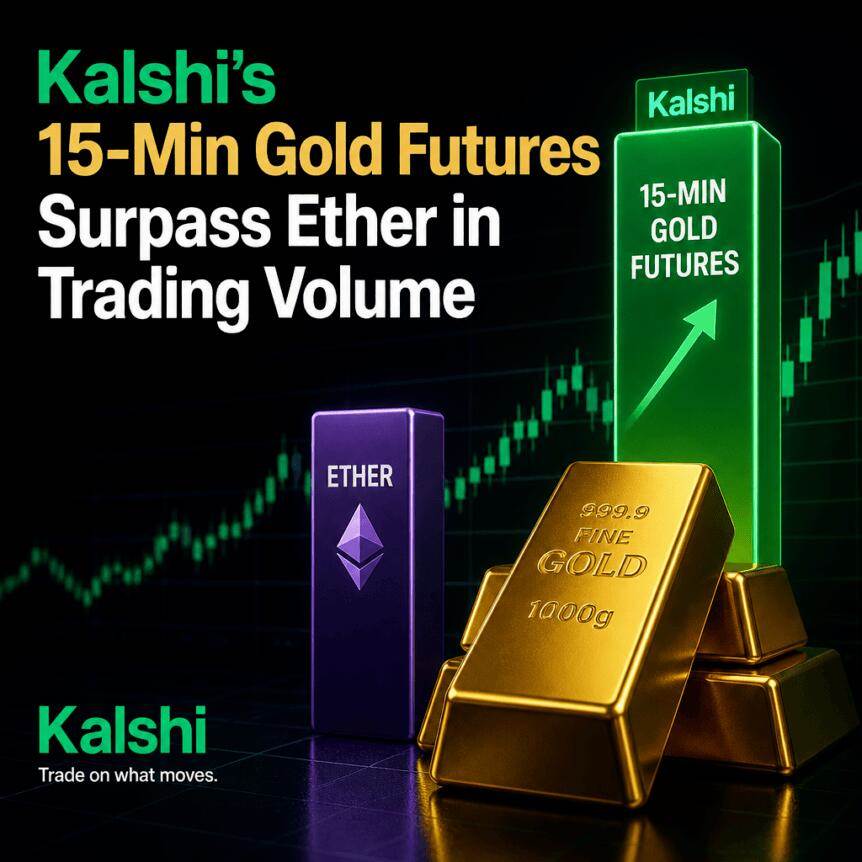
Kalshi's short-term "15-minute" market is outstanding in promoting non-sports activities. Just weeks after the gold contract went public, it incurred fees that were about twice as high as comparable Ether products.
According to Predict Charts data cited in recent analysis, Kalshi's 15-minute gold market generated estimated expenses of approximately US$5 million in September. In comparison, the fees incurred by the 15-minute Ethereum contract during the same period were approximately US$2.6 million, while Bitcoin remains the largest contributor to the platform's non-sports product line, with estimated fees reaching US$60.4 million in September.
Key Points
- September cost estimates: The gold market reached approximately US$5 million in 15 minutes, while Ethereum in 15 minutes was approximately US$2.6 million.
- Bitcoin still ranks first: The Bitcoin market generated estimated fees of approximately US$60.4 million in September, far exceeding other assets.
- Rapid adoption of gold: The performance of the gold contract followed its release in August, indicating that short-term commodity trading was quickly gaining market attention.
- Short-term dominant expenses: InGame's analysis found that 15 minutes of cryptocurrency, commodity and financial markets accounted for 80% of Kalshi's non-sports expenses in the week ending October 5.
- Fee mechanisms are critical: InGame attributes the higher share of short-term fees to Kalshi's odds-based fee structure, which tends to be higher around contracts priced close to 50/50. [TAG
Gold's rapid integration into Kalshi's short-term product line
September's data highlights how Kalshi's market mechanics designed for "15-minute" outcomes-contracts that allow traders to bet on whether the market will rise or fall in the next 15-minute interval-can translate into significant revenue, even for new assets appearing on the platform. [TAG
Predict Charts estimates show that gold generated almost twice as much in September as comparable Ethereum contracts. This result is particularly significant because the gold 15-minute market was launched in August, meaning that September's figures reflect a relatively short development cycle rather than long-term steady growth. [TAG
Kalshi's broader commodities business provides context. The company said in September that commodity trading volume reached $400 million in seven months, describing it as more than four times the volume of cryptocurrency market production during the same period. Kalshi interpreted this as evidence that cryptocurrency-like market categories can expand rapidly on its platform-from tens of millions of dollars to billions of dollars per month.
How fast are Ethereum and Bitcoin expanding?
September's fee comparison is based on Kalshi's longer growth record for short-term cryptocurrency products. The data cited in the article shows that after the 15-minute Bitcoin market was launched in December, by July, it had become Kalshi's largest non-cross-link market series except cross-link betting. At the same time, 15-minute Ethereum contracts accelerated rapidly early in the cycle: analysis pointed out that the number of Ethereum 15-minute contracts increased from 6.1 million in January 2026 to 233 million in July.
尽管继续增长,以太坊15分钟的势头不足以在9月份保持领先。文章指出,以太坊15分钟合约数量在9月再次上升至3.18亿,但黄金当月以5.42亿的成交量超越了她。
换句话说,短期加密货币的成交量持续增长,但黄金的进入似乎通过活动量和收入影响两个维度重塑了非体育类资产的相对排名。
为何15分钟市场能带来不成比例的高利润
短期市场已不仅仅是新产品线——它们越来越成为Kalshi平台费用集中的核心所在。
周二发布并在文章中引用的InGame分析发现,截至10月5日的七天里,15分钟的加密货币、商品和金融市场产生了2,040万美元的费用。同一分析指出,这占该时期Kalshi非体育类费用的80%。
InGame还强调了成交量与费用之间的关系。在同一周,15分钟市场负责13%的交易量,但占平台费用的20%——这表明短期合约比长期或时间敏感度较低的替代方案具有更高的货币化率。
The analysis attributed this effect to Kalshi's expense formula. InGame reporter Daniel O'Boyle writes that the fee structure depends on the odds of the contract, and prices on contracts close to 50/50 results (as a proportion of volume) tend to be higher than the biggest hot or cold. For traders, this means that the venue's fee capture is not simply proportional to the volume of activity-it is also influenced by how the market prices risk and uncertainty when contracts are offered.
For developers and operators focusing on fee economics, the practical lesson is that short-term markets may attract frequent transactions, but revenue advantages may further depend on how often these contracts settle to a range close to the equilibrium odds-which occurs naturally in a fast-moving, event-driven 15-minute window.
What these trends mean for Kalshi's next phase
The rapid adoption of gold and evidence of short-term contracts leading fees suggests that Kalshi is effectively building its business around time-bound market discovery. Bitcoin already dominates non-sports expenses with a huge advantage, but gold's September performance suggests that new asset classes can enter the short-term ecosystem and compete for disproportionate revenue.
What is uncertain is whether this shift will last after early adoption. While September fee comparisons provide a clear signal, traders and analysts are likely to pay close attention to whether gold maintains its extraordinary fee contribution as liquidity builds up during the month and whether Ethereum continues to expand volume at a rate that can offset the growth in gold's market share.
In the short term, the most useful monitoring indicators are the 15-minute series of ongoing contract numbers and fee estimates-especially the balance between volume shares and fee shares-because these indicators reflect both trader engagement and how Kalshi's odds-based fee mechanism translates market pricing into platform revenue.