Exchange Ranking
 Top Exchanges
 24h Volume Ranking
 Popularity Ranking
 Exchange BTC Balance
 Proof of Reserves
 Decentralized Exchanges
 Funding Rate
 Funding Heatmap
 Liquidation Data
 Max Pain
 Long/Short Ratio
 Whale L/S Ratio
 Binance/Okex/Huobi L/S
 Bitfinex Margin L/S
 ETF Tracker
 Solana ETF
 XRP ETF
 Hong Kong ETF
 Bitcoin Treasuries
 Crypto Reversal
 Ethereum Reserves
 HyperLiquid Wallet Analysis
 Hyperliquid Whale Watch
 Large Transactions
 On-chain Movement
 Bitcoin ROI
 Stablecoin Market Cap
 Options Analysis
 News
 Articles
 Economic Calendar
 Features
 Wallet
 Contract Calculator


 Security
 Collections
 Watchlist
 Following
 BTC
Why does the price of Bitcoin experience significant fluctuations every four years? The answer lies in the “Bitcoin halving” event. This event not only affects the supply of new Bitcoins but also often triggers cyclical market booms. Understanding the mechanism behind the Bitcoin halving can help you better grasp its impact on the market and prices, and it can also assist in optimizing investment strategies. This guide will explain in detail the principles, importance of the Bitcoin halving, and its implications for investment decisions, enabling you to handle cyclical fluctuations in the cryptocurrency market more effectively.

What exactly is the Bitcoin halving?
The Bitcoin halving, also known as the reduction of block rewards, is a pre-designed event that occurs every four years, or once every 210,000 blocks. During each halving, the reward awarded to miners for verifying transactions is halved. This concept was proposed by Satoshi Nakamoto, the mysterious creator of Bitcoin, with the aim of making Bitcoin a scarce asset like gold. This inherent scarcity mechanism helps maintain the value of Bitcoin by slowing down the creation of new Bitcoins, ensuring that the total number of Bitcoins never exceeds 21 million.
How does the Bitcoin halving work?
要了解比特币减半的原理,我们先来探索一下比特币挖矿过程 。比特币基于区块链技术运行,矿工使用功能强大的计算机来解决复杂的加密难题。当矿工解开这些谜题时,他们就会向区块链添加新的区块,确保网络安全并验证交易。作为回报,矿工会收到新铸造的比特币作为奖励。每挖出21万个区块,矿工获得的奖励就会减半。这种自动减少会减缓进入流通的新比特币的供应,从而造成稀缺性,通常会增加需求。
例如,比特币推出时,矿工每个区块可获得 50 BTC,但经过几次减半后,现在的奖励要低得多。2025年,比特币挖矿奖励仅为每个区块 3.125 BTC。
比特币减半日期是什么时候?
历史上,比特币大约每四年减半一次,具体情况如下:
● 2012年11月28日:奖励从 50 BTC 降至 25 BTC。
● 2016年7月9日:奖励从 25 BTC 降至 12.5 BTC。
● 2020年5月11日:奖励从 12.5 BTC 降至 6.25 BTC。
● 2024年4月20日:奖励从 6.25 BTC 降至 3.125 BTC。
历史上,每次减半都会对比特币价格产生重大影响,往往会引发市场牛市周期。
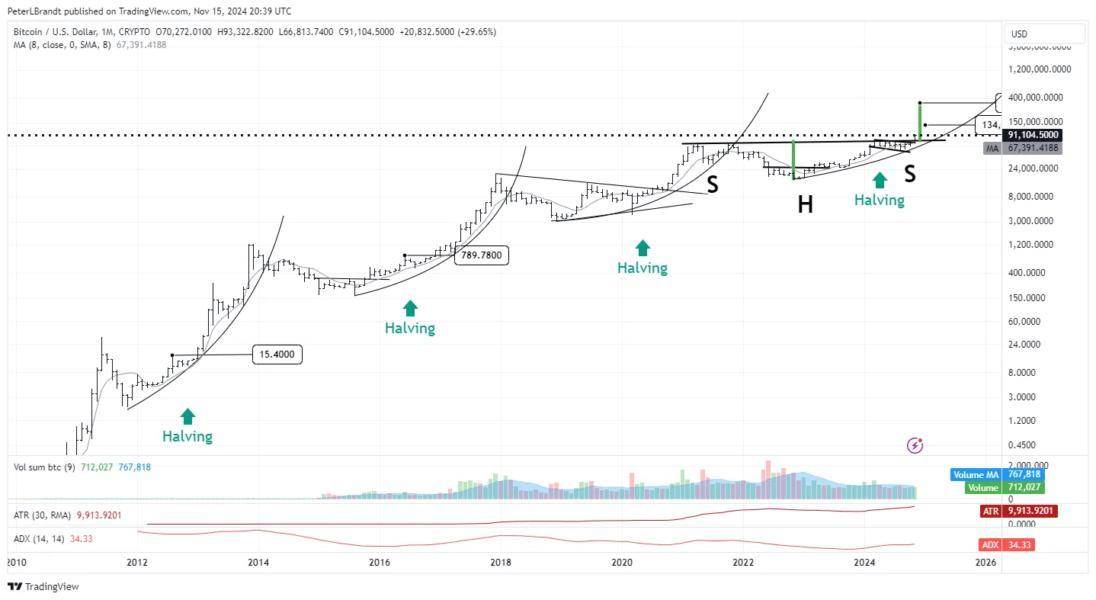
BTC 价格 历史。
下一次比特币减半是什么时候?
The last Bitcoin halving occurred on April 20, 2024, when the block reward was reduced from 6.25 BTC to 3.125 BTC. Based on the predictable schedule for block creation and the interval between 210,000 blocks, the next Bitcoin halving is expected to take place in April 2028. Investors typically develop strategies based on these dates, attempting to predict potential market changes.
Why is the Bitcoin halving important?
The Bitcoin halving is crucial because it directly affects the inflation rate of cryptocurrencies, maintaining their scarcity and influencing market prices. A decrease in supply, combined with stable or increasing demand, usually leads to price increases. For example, after the halving in 2016, Bitcoin’s price rose from around $600 to nearly $20,000 in December 2017. Similarly, after the halving in 2020, Bitcoin reached a peak price of approximately $69,000 in November 2021. Analysts expect Bitcoin prices to continue rising, potentially reaching $180,000 to $200,000 by the end of 2025. This is largely due to the impact of the Bitcoin halving in 2024.
Should one invest in Bitcoin during its decline?
Investing around Bitcoin halving events involves both opportunities and risks. Historically, these events trigger significant market cycles:
● Before the halving: Prices usually increase gradually as expectations rise.
● Right after the halving: There may be short-term fluctuations or temporary price corrections.
● During the long period after the halving: There is often a strong bull market and significant price growth.
Practical tips for investing during these periods include:
● Adopt the DCA strategy, investing a fixed amount of money regularly to reduce risk from fluctuations in prices.
● Stay informed about current trends through trusted platforms like Bitget. These platforms offer analysis tools and customized investment options tailored to market conditions.
● Diversify your cryptocurrency portfolio to minimize risks during periods of volatility.
What will happen when all bitcoins are mined?
The total supply of bitcoins is limited to 21 million units. The last bitcoin is expected to be mined around 2140. After that, miners will no longer receive block rewards; their income will come entirely from transaction fees. This change will fundamentally transform the mining economy, potentially increasing transaction fees or forcing miners to find other sources of income. However, with the increasing popularity of Bitcoin and technological advancements, it’s expected that the Bitcoin network will continue to operate safely and smoothly.
How to avoid common mistakes during Bitcoin halving events
Expecting a sharp rise in price immediately after the halving event is a common misconception. However, market reactions can vary greatly, and there may even be short-term declines. Investors should be patient and focus on long-term trends, avoiding impulsive decisions due to immediate market fluctuations.
Ignoring the economic impacts of mining
Many people overlook the economic impact of the halving event on miners. This can lead to miners reducing their operations or withdrawing from the market, thereby temporarily affecting transaction speeds and costs. Tracking miner behavior helps investors effectively predict and navigate these short-term disruptions.
Ignoring external economic and regulatory factors is also important.
The halving event isn’t a isolated occurrence; broader economic conditions, regulatory changes, and global events can all have significant impacts on Bitcoin prices. It’s crucial to stay informed about macroeconomic developments and regulatory news in order to make balanced investment decisions.
Bitcoin Halving: 60-second quick answers
1. What is the Bitcoin halving?
The Bitcoin halving is an scheduled event where, after mining 210,000 blocks, the rewards for miners are halved. This helps to control the supply of Bitcoin and maintain its scarcity.
2. How often does the Bitcoin halving occur?
The Bitcoin halving occurs approximately every four years, or once every 210,000 blocks.
3. Does the Bitcoin halving affect its price?
Based on historical data, there is indeed an impact. When supply decreases while demand remains stable or increases, prices often rise significantly after the halving.
4. How many times has the Bitcoin halving occurred so far?
Since 2008, Bitcoin has undergone four halvings: in 2012, 2016, 2020, and 2024.
5. Can Bitcoin prices be predicted based on halving events?
Although it’s difficult to accurately predict price movements, historical data shows that prices increase significantly within one year after a halving event occurs.
6. What will happen if Bitcoin becomes impossible to mine anymore?
Once all 21 million Bitcoins are mined (estimated to happen around 2140), miners will have to rely entirely on transaction fees to earn income.