Exchange Ranking
 Top Exchanges
 24h Volume Ranking
 Popularity Ranking
 Exchange BTC Balance
 Proof of Reserves
 Decentralized Exchanges
 Funding Rate
 Funding Heatmap
 Liquidation Data
 Max Pain
 Long/Short Ratio
 Whale L/S Ratio
 Binance/Okex/Huobi L/S
 Bitfinex Margin L/S
 ETF Tracker
 Solana ETF
 XRP ETF
 Hong Kong ETF
 Bitcoin Treasuries
 Crypto Reversal
 Ethereum Reserves
 HyperLiquid Wallet Analysis
 Hyperliquid Whale Watch
 Large Transactions
 On-chain Movement
 Bitcoin ROI
 Stablecoin Market Cap
 Options Analysis
 News
 Articles
 Economic Calendar
 Features
 Wallet
 Contract Calculator


 Security
 Collections
 Watchlist
 Following
According to the latest report by the Blockchain Games Alliance (BGA), blockchain game developers are placing more emphasis on infrastructure and underlying systems, rather than token-driven growth strategies. The adoption of stablecoins has become one of the three key drivers, indicating that the development of games is shifting towards fundamentals, monetization, and payment infrastructure.

On Wednesday, BGA released the “Industry Status Report 2025,” which shows that developers’ perspectives on the factors that drive the success of blockchain games have changed.
According to the report, the top three driving factors for growth are the release of high-quality games (29.5%), revenue-driven business models (27.5%), and the use of stablecoins in payments (27.3%).
The research results indicate that the industry is moving away from speculative cycles and reliance on large Web2 brands, prioritizing the development of commercially viable games based on Web3-native transaction frameworks.
“What we see from the data is that the gaming industry is becoming more globalized, standardized, and focused on creating excellent games for real players,” said Sebastien Borget, co-chair of BGA and co-founder of The Sandbox.
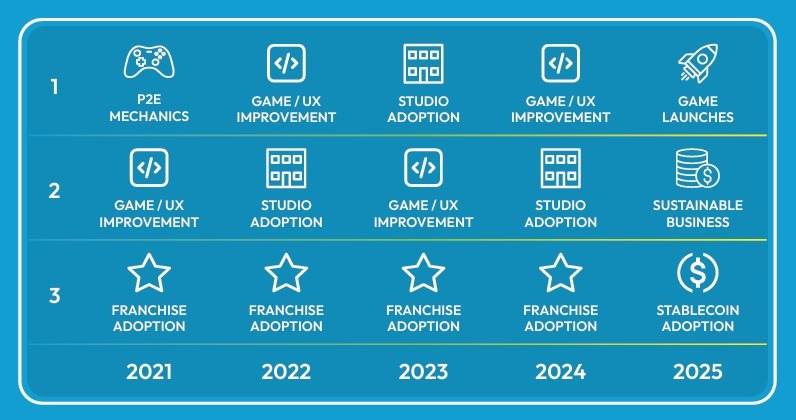
These are the key factors driving the growth of the blockchain gaming industry. Source: BGA survey
Over the past five years, the factors driving blockchain games have evolved.
This report reflects the significant changes in the factors that drive the development of the blockchain gaming industry over the past five years.
From 2021 to 2023, respondents strongly preferred external catalysts for growth. These included the popularity of “play-to-earn” games, as well as the desire for major Web2 publishers to participate in ensuring the legitimacy of the industry.
By 2024, as friction and repetitive game mechanics hindered the development of Web3 games, attention shifted towards improving user experience, accessibility, and onboarding for new users.
This year’s survey shows that developers have become more mature in their approaches. They now associate success with innovative gameplay mechanics, sustainable monetization strategies, and infrastructure that supports consumer engagement.
The report indicates that stablecoins have long been a key component of decentralized finance, and now they are also considered an important part of the gaming economy.
This suggests that friction-free payment experiences, similar to those offered by fiat currencies, could contribute to the success of Web3 games.
Dependence on traditional gaming giants has decreased.
The survey also revealed a significant reduction in people’s reliance on traditional publishers. Currently, only about 17.2% of respondents consider traditional publishers to be crucial catalysts for growth, compared to 35.8% in 2024.
Instead, interoperability (26.1%), AI integration (25.9%), and player-driven creator economies (25.5%) emerged as the top three drivers.
Developers’ increasing focus on stablecoin infrastructure reflects broader policy trends.
On a global scale, the regulatory framework for stablecoins is evolving rapidly. The United States is leading the way with the GENIUS Act, while Europe has implemented its own framework for the crypto asset market (MiCA).