Exchange Ranking
 Top Exchanges
 24h Volume Ranking
 Popularity Ranking
 Exchange BTC Balance
 Proof of Reserves
 Decentralized Exchanges
 Funding Rate
 Funding Heatmap
 Liquidation Data
 Max Pain
 Long/Short Ratio
 Whale L/S Ratio
 Binance/Okex/Huobi L/S
 Bitfinex Margin L/S
 ETF Tracker
 Solana ETF
 XRP ETF
 Hong Kong ETF
 Bitcoin Treasuries
 Crypto Reversal
 Ethereum Reserves
 HyperLiquid Wallet Analysis
 Hyperliquid Whale Watch
 Large Transactions
 On-chain Movement
 Bitcoin ROI
 Stablecoin Market Cap
 Options Analysis
 News
 Articles
 Economic Calendar
 Features
 Wallet
 Contract Calculator


 Security
 Collections
 Watchlist
 Following
 ETH
In previous articles related to the Interop series, we discussed OIF (Intent Framework) and EIL (Interoperability Layer). These technologies address issues related to cross-chain intent standardization (ensuring that the entire network understands what you want to do) and execution channels (allowing for standardized transactions involving funds).
However, achieving a perfect “single-chain experience” still requires balancing speed with trust. After all, in current interoperability scenarios, either we have to endure slowdowns—such as the 7-day wait period required for Optimistic Rollup to confirm results—or we must sacrifice decentralization by relying on the trust-based assumptions of multi-signature bridges.
To break this “impossible triangle,” it’s essential to have foundational capabilities that span both the Ethereum interoperability roadmap’s “Acceleration” phase and the final stages of development—specifically, the “real-time proof-of-stake” technology provided by ZK.
And in the recently activated Fusaka upgrade, the relatively unnoticed EIP-7825 played a crucial role in removing one of the major technical obstacles.
Behind the Fusaka upgrade lies the underappreciated EIP-7825.
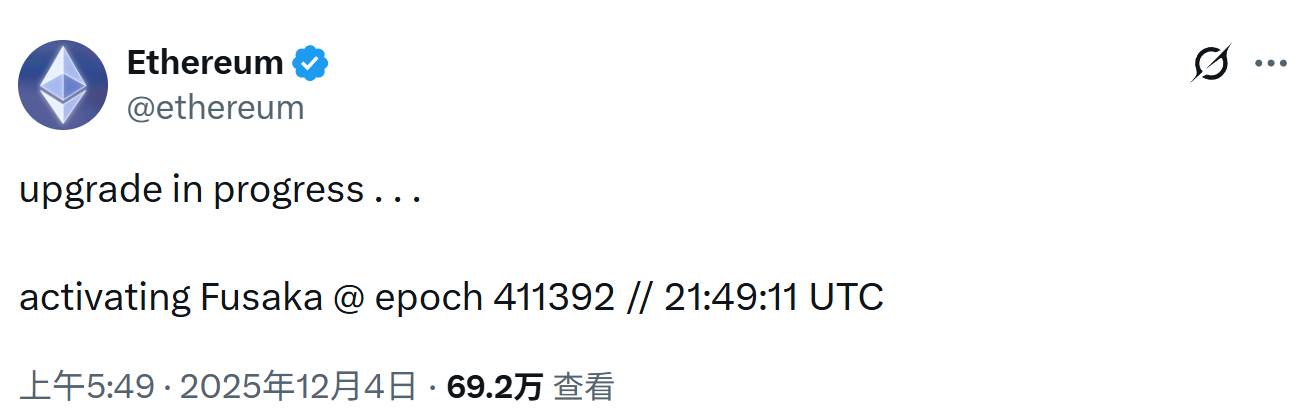
On December 4th, the Ethereum Fusaka upgrade was officially launched on the mainnet. However, it wasn’t as significant as the Dencun upgrade back then. The focus of the market was mostly on Blob scalability and PeerDAS, with discussions revolving around further reducing the data costs associated with L2 layers.
But behind all this hype, there’s another overlooked proposal: EIP-7825. This proposal has helped remove one of the biggest obstacles to implementing L1 zkEVM and real-time proof-of-stake in Ethereum. It can even be said that EIP-7825 is quietly paving the way for the eventual completion of Interop projects.
During this upgrade of Fusaka, everyone’s attention was focused on the issue of capacity expansion: the capacity of Blob storage was increased by 8 times. Combined with PeerDAS random sampling verification, this has completely changed the cost structure of data availability-related operations.
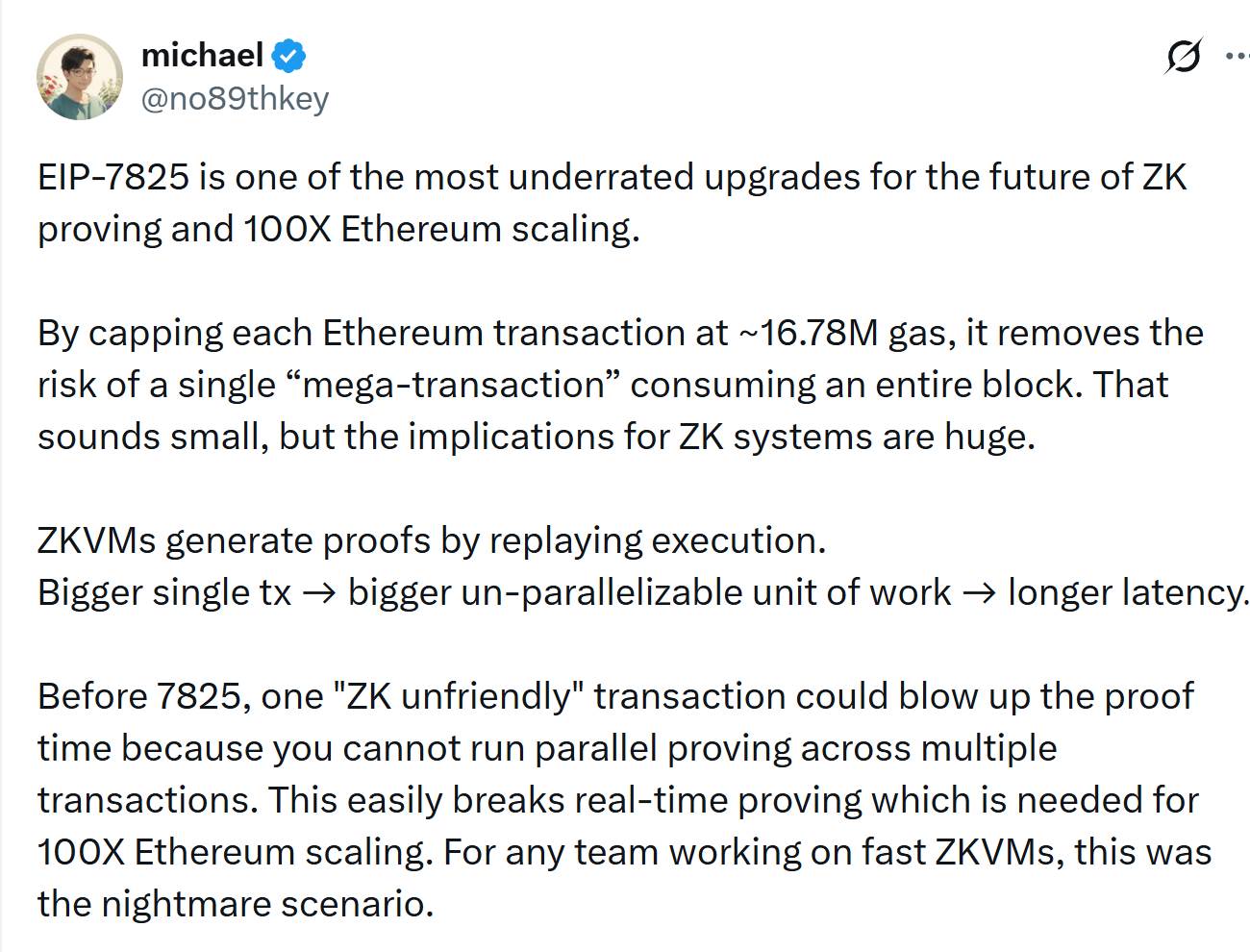
Indeed, a cheaper L2 is beneficial, but for Ethereum’s long-term ZK roadmap, EIP-7825 is the real game-changer. It sets a gas limit of 16.78 million gas per transaction.
As we all know, this year Ethereum’s gas limit has been raised to 60 million gas per block. However, even if the limit continues to increase, theoretically, if someone is willing to pay an extremely high gas price, they can still send a very complex “mega-transaction” that will occupy all 60 million gas capacity in the block, thereby blocking the entire block.
This was possible in the past, but EIP-7825 introduced a new restriction: no matter how large the block is, a single transaction cannot consume more than 16.78 million gas.
So why limit the size of individual transactions? In reality, this change has no impact on ordinary users’ transactions. But for ZK Prover, it’s a matter of life or death, and this is closely related to how the ZK system generates proofs.
To put it simply, before EIP-7825, if a block contained a mega-transaction that consumed 60 million gas, the ZK Prover had to process that complex transaction sequentially, without any ability to split or parallelize it. It’s like having a single-lane highway, with a very slow truck at the front, and all other vehicles (other transactions) have to wait for it to finish processing.
This undoubtedly sentences “real-time proof-of-work” to death—since the time required to generate proofs is completely uncontrollable, and it may take several minutes or even longer.
With EIP-7825 in place, even if the block capacity increases to 100 million GAS, since each transaction is limited to 16.78 million GAS, each block can be broken down into predictable, bounded, and parallelizable “small tasks”. This means that Ethereum’s proof-of-work mechanism has transformed from a difficult “logical problem” into a simple “computational problem”.
As long as we have enough parallel computing power, we can process these small tasks quickly, thereby generating ZK proofs for large blocks.
As Brevis co-founder and CEO Michael said, EIP-7825 is one of the most overlooked upgrades on the path to 100 times faster scalability for ZK and Ethereum in the future. It turns “real-time proof-of-work” from a “theoretically impossible” concept into something that can be implemented practically. As long as we can solve the computational problem through parallel processing, even blocks with 200 million GAS could potentially generate proofs in seconds. This isn’t just a breakthrough for ZK technology; it also lays the physical foundation for instant cross-chain settlements within the Ethereum Interoperability Layer (EIL).
So, this upgrade might not seem like a major breakthrough, but in reality, it represents a significant advancement towards ZK’s roadmap and the future scalability of Ethereum in 2026.
Second, L1 zkEVM: The “trust anchor” for Ethereum interoperability.
不过EIP-7825虽然通过限制单笔交易大小,为实时证明铺平了物理道路(可并行化),但这只是硬币的一面,另一面在于,以太坊主网自身如何利用这种能力?
这就涉及到了以太坊路线图中最硬核的叙事——L1 zkEVM。
长期以来,zkEVM被视作扩展以太坊的「圣杯」,不仅因为其能解决性能瓶颈,更因为它重新定义了区块链的信任机制,其核心思路是让以太坊主网具备生成、验证ZK证明的能力。
换言之,未来以太坊的每个区块执行后,都能输出一份可验证的数学证明,使其他节点(尤其是轻节点和L2)无需重复计算即可确认结果的正确性——如果把生成ZK证明的能力直接写进以太坊协议层(L1),提议者(Proposer)每打包一个区块并生成一个ZK证明,验证节点就不再需要重跑交易,只需要验证这个极小的数学证明。
这对互操作性意味着什么?
在Interop的语境下,L1 zkEVM的意义远超扩容本身,可以说它是所有L2的「信任锚点」,毕竟如果以太坊L1能够实时生成证明,意味着所有的L2都可以实时、无信任地读取L1的最终状态,这将带来两个质变:
● 消除挑战期:链与链之间的确认时间将从「7天(OP机制)」压缩到「秒级(ZK机制)」;
● Decentralized connectivity: Cross-chain transactions no longer require trust in third-party multi-signature bridges. Instead, we can rely on the mathematical principles of the Ethereum main network.
This is also the physical foundation upon which EIL (Interoperability Layer) can function effectively—without the real-time finality of L1, interoperability between L2s will always be subject to “latency” issues.
With the existence of L1 zkEVM and the elimination of physical limitations through EIP-7825, what about the specific implementation tools?
This leads us to a subtle evolution in the ZK technology stack: from zkEVM to zkVM.
Thirdly, Fusaka & EIP-7825: The roadmap for interoperability is undergoing a significant transformation.
If EIP-7825 provides a “parallel hardware environment” for ZK by limiting the size of individual transactions, then the evolution of the ZK technology stack aims to find a “more efficient software architecture”. Although this may sound like a difficult concept, it actually represents two stages in the development of ZK.
The first stage is naturally zkEVM, which can be considered a compatible or改良派 solution.
The goal here is to closely mimic every instruction of Ethereum’s EVM, allowing developers to deploy Solidity code directly, thereby reducing the costs and barriers associated with migration.
In other words, the greatest advantage of zkEVM is its compatibility with existing Ethereum applications. This greatly reduces the workload for Ethereum developers, who can reuse most of the existing infrastructure and tools (including execution clients, block explorers, debugging tools, etc.).
然而,也正因如此,由于EVM当初设计时并未考虑ZK友好性,为了兼容,zkEVM的证明效率往往有天花板,证明时间要慢得多,历史包袱较重。
而zkVM则属于激进的革命派,直接构建了一个对ZK证明极其友好的虚拟机(如基于RISC-V或WASM),以加快证明时间,并实现更好的执行速度和性能。
但也会失去与许多EVM功能的兼容性,以及使用现有工具(如低级调试器)的能力,不过目前一个明显的趋势是越来越多的L2项目开始卸下包袱,极致优化证明速度和成本,探索基于zkVM的架构。
那为什么说Fusaka升级是解锁器?
毕竟在EIP-7825之前,无论是zkEVM还是zkVM,一旦遇到以太坊上的巨型交易,都会因为无法拆分任务而导致证明生成时间暴涨。
而现在,EIP-7825强制将交易拆解为可预测的小单元,有了可并行环境,zkVM这种高效架构就能发挥最大威力,哪怕是复杂的以太坊区块,放入zkVM中,配合并行算力,也能实现实时证明。
这对互操作意味着什么?zkVM的普及叠加EIP-7825,意味着生成证明的成本将大幅下降。当生成一个跨链证明的成本低到可以忽略不计,且速度快到像发邮件一样时,传统的「跨链桥」将彻底消失,取而代之的是底层的通用消息协议。
Finally,
. As mentioned in several previous articles in the Interop series, the ultimate goal of Interop isn’t just about enabling asset transfer across chains. It goes far beyond the concept of “asset bridges” and represents a comprehensive set of system-level capabilities, including cross-chain data communication, cross-chain logic execution, cross-chain user experience, and cross-chain security and consensus mechanisms.
From this perspective, Interop can be seen as a universal language for protocols within the Ethereum ecosystem. Its significance lies not only in the transfer of value but also in the sharing of logic. ZK plays a crucial role here—it ensures the correctness of executions, supports real-time state verification, and makes cross-domain calls possible. In other words, without real-time ZK, it would be difficult to achieve truly usable Interop experiences.
So when EIP-7825 is quietly activated during the Fusaka upgrade, and L1 zkEVM becomes a reality, we are getting closer to that ultimate state: executions, settlements, and proofs being completely abstracted away from users, with them having no awareness of the existence of chains at all.
This is also the desired outcome of Interop for each of us in the future.