Exchange Ranking
 Top Exchanges
 24h Volume Ranking
 Popularity Ranking
 Exchange BTC Balance
 Proof of Reserves
 Decentralized Exchanges
 Funding Rate
 Funding Heatmap
 Liquidation Data
 Max Pain
 Long/Short Ratio
 Whale L/S Ratio
 Binance/Okex/Huobi L/S
 Bitfinex Margin L/S
 ETF Tracker
 Solana ETF
 XRP ETF
 Hong Kong ETF
 Bitcoin Treasuries
 Crypto Reversal
 Ethereum Reserves
 HyperLiquid Wallet Analysis
 Hyperliquid Whale Watch
 Large Transactions
 On-chain Movement
 Bitcoin ROI
 Stablecoin Market Cap
 Options Analysis
 News
 Articles
 Economic Calendar
 Features
 Wallet
 Contract Calculator


 Security
 Collections
 Watchlist
 Following
 NEAR
The NEAR protocol recently achieved a record-breaking throughput of 1 million transactions per second (TPS) in publicly available shard-based benchmarks, drawing attention once again to the competitive landscape of high-performance public chains. Against the backdrop of ongoing expansion in the Ethereum ecosystem and increasingly fierce competition among various chains, NEAR uses real-world test data to counter doubts: high throughput is no longer just a concept—it’s a tangible capability that can be measured and verified. As high-concurrency applications such as AI-native applications, blockchain-based games, and social networks become more prevalent by 2025, the entire crypto industry is re-evaluating the limits of underlying infrastructure. NEAR’s achievements have made determining which chain will host next-generation applications a hot topic of discussion.
● NEAR successfully surpassed the 1 million TPS threshold in real-time shard-based tests, using actual code and fully open benchmark data.
● This test utilized 70 shards on consumer-grade hardware to demonstrate horizontal scalability under heavy loads.
● New optimizations in execution, consensus, and storage have improved throughput stability.
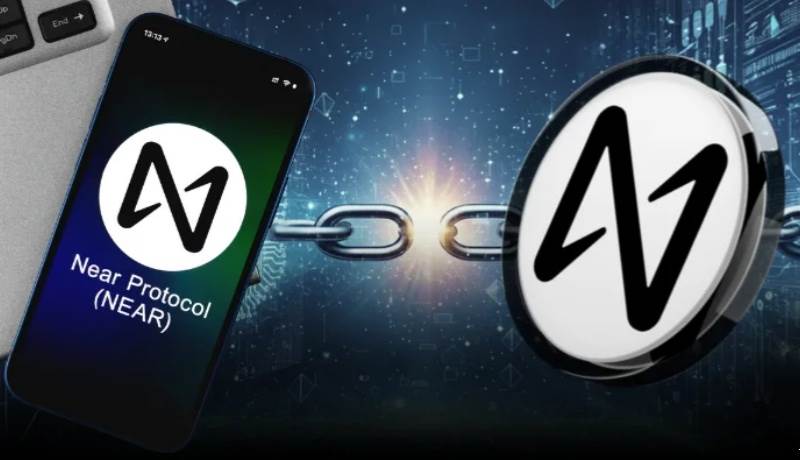
In its first publicly verifiable shard-based benchmarks, the NEAR protocol achieved a network transaction rate of over one million transactions per second, setting a new performance milestone. This data places NEAR among the top performers in terms of throughput, providing one of the most compelling evidence for the feasibility of a fully shard-based Layer-1 architecture.

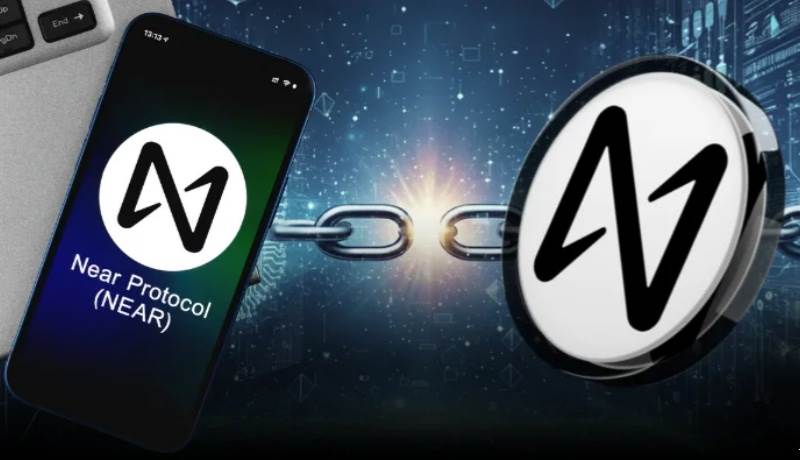
NEAR achieved 1 million TPS in publicly available shard-based benchmarks (Source: X)
NEAR protocol: Tests designed to reflect real-world network conditions.
该基准测试基于NEAR的实际核心代码,而非实验分支或独立原型。报告指出,工程师将活动分布在70个分片上,并使用了类似于大型网络在高负载下所呈现的流量分布。
该测试方案使用了谷歌云的C4D虚拟机,这些实例价格相对低廉,并搭载了最新一代的AMD EPYC处理器。每台机器每月费用约为900美元,这个价格对于验证者而非专业运营商来说都在可承受范围内。然而,为了专注于吞吐量,测试排除了合约调用,并将交易直接送入内存池。
此外,区块gas限制也被取消,账户活动遵循Zipf模式,这种模式通常会在大量用户并行交互时自然出现。团队报告称,与早期内部试验中使用的硬件相比,C4D机器的性能提升了约45%。
分片技术的可扩展性在满负荷运行时得到验证
在NEAR推出Nightshade 2.0一年多之后,这一里程碑终于到来。Nightshade 2.0是一项重要的分片升级,它引入了无状态验证,并降低了区块生产所需的开销。在主网上,这些改进使得网络能够扩展到九个分片,将区块生成时间缩短至约600毫秒,并在约1.2秒内完成最终确认。
In the benchmark tests, the throughput steadily improved as the number of shards increased. This is expected for a shard-based network, but such results are rarely seen in large-scale testing scenarios. Most Layer-1 chains still use a monolithic architecture, with all operations needing to be processed through a single pipeline. However, the NEAR architecture distributes operations, storage, and state across separate shards, allowing the network to expand its capacity without significantly increasing costs or requiring additional nodes.
The successful outcome was achieved through various technical improvements. These include enhancements to signature verification, reimplementation of trie trees and database mechanisms, optimization of stateless witness processing, adjustments to the consensus process, and the introduction of new tools for analyzing the timing within each block.
These details have been made public, enabling researchers to carefully analyze the conditions and replicate the results.
Transparency is achieved through fully reproducible tests.
NEAR has released benchmark scripts, the commit hashes used during testing, and a publicly accessible Grafana dashboard containing detailed performance metrics. The dashboard shows that the network can maintain stable block production while exceeding the 1 million TPS threshold.
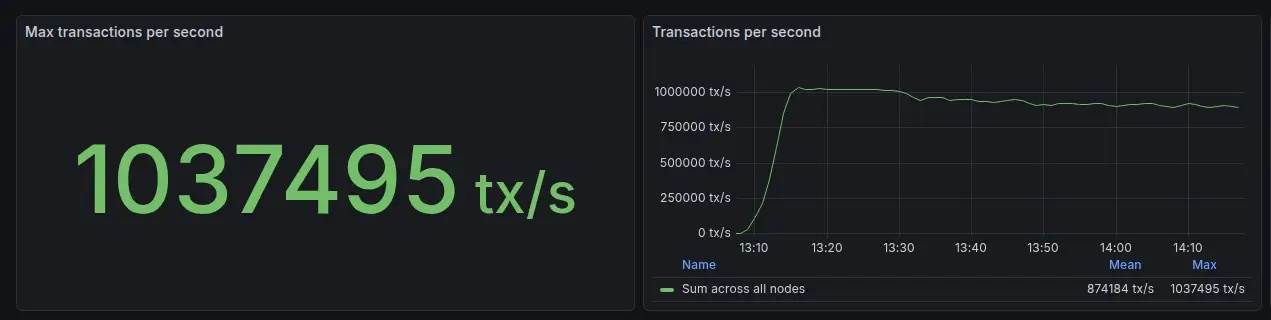
The NEAR protocol achieves a throughput of 1 million transactions per second. (Source: NEAR Protocol)
The team noted that many validators run on bare-metal servers, and their performance is generally superior to that of the cloud servers used in this test. This means that there is significant room for improvement in actual performance. In such an industry, claims about high TPS often rely on closed systems or test platforms that aren’t based on real-world deployments. The emphasis on transparency is particularly important in this context.
The broader context of NEAR’s ecosystem and market position
Compared to other high-throughput networks, NEAR currently ranks among the top in theoretical benchmark tests. Data released by Chainspect on December 8 showed that Sonic, ICP, and Aptos followed closely behind, with throughput levels of approximately 400,000 TPS, 210,000 TPS, and 160,000 TPS respectively. The actual throughput of mainstream chains is still far below theoretical values. During the same period, Solana’s real-time throughput was around 1238 TPS, ranking first.
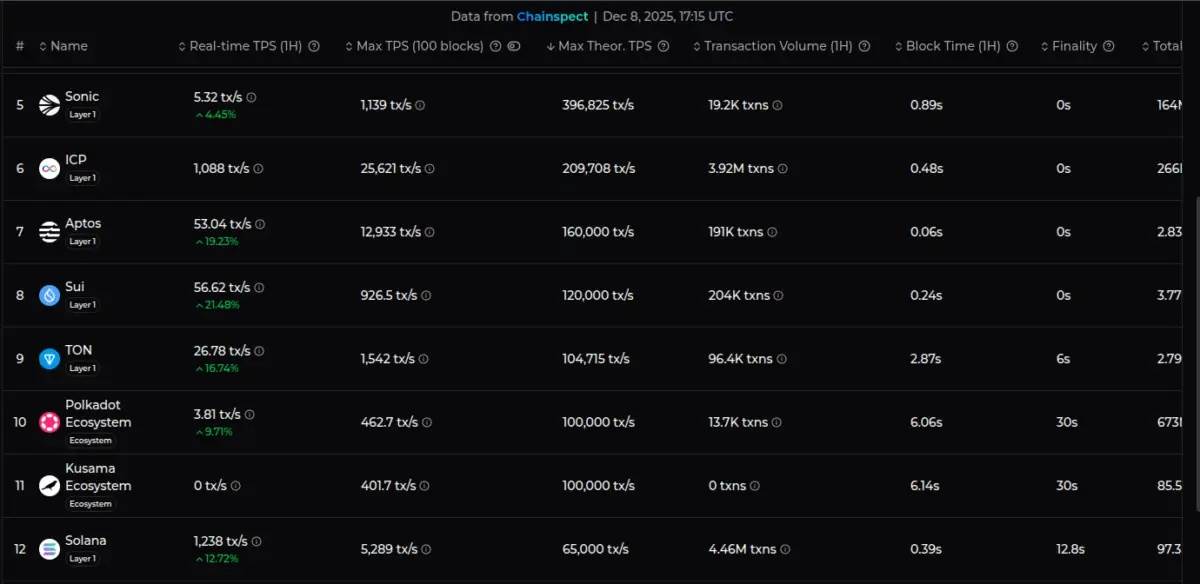
The fastest blockchain ranked by TPS (source: Chainspect)
This timing coincides with a series of new ecosystem developments. TravAI, built on the ADI Chain, allows agents on the chain to complete entire travel booking processes. NEAR AI Cloud and Private Chat have already been integrated, including being adopted by the Brave browser. At the same time, the volume of transactions processed through NEAR Intents has reached a record high, exceeding $7 billion.
The next key tasks of the team include dynamic sharding, intelligent contract execution on sharded systems, further optimization of execution processes, as well as separating the consensus layer from the execution layer to reduce latency. Most of the code used in the benchmark tests has already been deployed on the main network, and the remaining parts are planned to be released in version 2.12.
Overall, the results with 1 million TPS indicate that NEAR’s architecture can support decentralized systems under high loads, cross-chain routing, and emerging AI-driven activities on the chain—all without relying on specialized hardware or a centralized sorting layer.