Exchange Ranking
 Top Exchanges
 24h Volume Ranking
 Popularity Ranking
 Exchange BTC Balance
 Proof of Reserves
 Decentralized Exchanges
 Funding Rate
 Funding Heatmap
 Liquidation Data
 Max Pain
 Long/Short Ratio
 Whale L/S Ratio
 Binance/Okex/Huobi L/S
 Bitfinex Margin L/S
 ETF Tracker
 Solana ETF
 XRP ETF
 Hong Kong ETF
 Bitcoin Treasuries
 Crypto Reversal
 Ethereum Reserves
 HyperLiquid Wallet Analysis
 Hyperliquid Whale Watch
 Large Transactions
 On-chain Movement
 Bitcoin ROI
 Stablecoin Market Cap
 Options Analysis
 News
 Articles
 Economic Calendar
 Features
 Wallet
 Contract Calculator


 Security
 Collections
 Watchlist
 Following
Renowned blockchain analyst Willy Woo recently warned that the next wave of crypto bear market may not be caused by internal bubbles or regulatory issues within the cryptocurrency industry. Instead, it could be due to a global economic downturn. He pointed out that the last time such a macroeconomic decline occurred was during the financial crisis of 2008, just before the emergence of Bitcoin. If the economy as a whole remains sluggish, even if blockchain technology and applications continue to develop, crypto assets will find it difficult to survive independently. In other words, the future market may no longer be solely a “game within the cryptocurrency industry” but will be heavily influenced by global economic trends. This means that crypto investors must adopt a more macro-level perspective to understand the direction of the next wave of changes.

Analyst Willy Woo said that the next crypto bear market could be particularly severe, driven by an unprecedented economic downturn in the cryptocurrency sector.
Woo stated on Monday that the next bear market “will be defined by another cycle that will be forgotten by everyone.”
He mentioned that we have already taken into account the four-year Bitcoin halving event and the global M2 supply chain by combining them together.
He said, “Central banks inject M2 every four years, and these two factors combine to create a trend.”
However, Woo explained that the next bear market will be determined by the business cycle. He mentioned that the last time a true business cycle downturn occurred was in 2008 and 2001, when the cryptocurrency market hadn’t yet emerged.
“If we experience a business cycle like those in 2001 or 2008, it will test the way BTC is traded. Will it fall like technology stocks, or will it fall like gold?”
Business cycles can affect liquidity
. A business cycle downturn refers to a period of economic contraction, during which GDP decreases, unemployment rates rise, consumer spending declines, and business activity slows down. This phenomenon is often referred to as an economic recession, and it typically occurs after periods of economic expansion.
Woo believes that the crypto market isn’t isolated; it’s influenced by broader economic cycles, especially through its impact on liquidity.
The business cycle downturn in 2001, also known as the “Internet Bubble,” led to rising unemployment rates and a 50% decline in the U.S. stock market (S&P 500 index) within two years. This bubble was caused by overvalued tech companies going bankrupt and excessive speculation.
In 2008, the subprime mortgage crisis, banking system collapse, and credit freeze led to a “financial crisis,” resulting in a significant decline in GDP, soaring unemployment rates, and a 56% drop in the S&P 500 index.
Timing during bear markets
The National Bureau of Economic Research (NBER) uses four key indicators to identify economic recessions: employment, personal income, industrial production, and retail sales.
At the beginning of 2020, due to lockdowns caused by the pandemic, economic recessions reached their peak, but these downturns were short-lived. Currently, the threat of economic recessions remains uncertain, but risks still exist.
贸易关税的出台也使这一周期变得更加复杂,贸易关税已经削弱了 2025 年上半年的经济增长,预计到 2026 年上半年仍将拖累 GDP 增长。
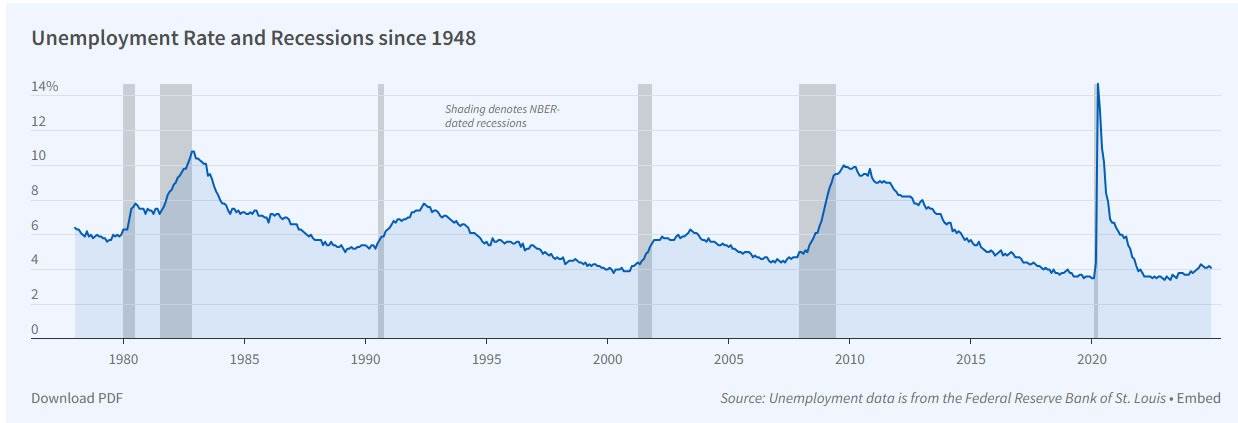
历史商业周期和衰退。来源: NBER
Woo 总结道,市场具有投机性,这意味着它们会将未来事件(包括 M2 货币供应量)纳入定价。“要么 BTC 正在向全球市场传递顶峰已到的信息,要么 BTC 即将迎头赶上,”他说道。