Exchange Ranking
 Top Exchanges
 24h Volume Ranking
 Popularity Ranking
 Exchange BTC Balance
 Proof of Reserves
 Decentralized Exchanges
 Funding Rate
 Funding Heatmap
 Liquidation Data
 Max Pain
 Long/Short Ratio
 Whale L/S Ratio
 Binance/Okex/Huobi L/S
 Bitfinex Margin L/S
 ETF Tracker
 Solana ETF
 XRP ETF
 Hong Kong ETF
 Bitcoin Treasuries
 Crypto Reversal
 Ethereum Reserves
 HyperLiquid Wallet Analysis
 Hyperliquid Whale Watch
 Large Transactions
 On-chain Movement
 Bitcoin ROI
 Stablecoin Market Cap
 Options Analysis
 News
 Articles
 Economic Calendar
 Features
 Wallet
 Contract Calculator


 Security
 Collections
 Watchlist
 Following
If you want to stop losing money in the cryptocurrency industry, the first thing you need to do is stop trading intraday.
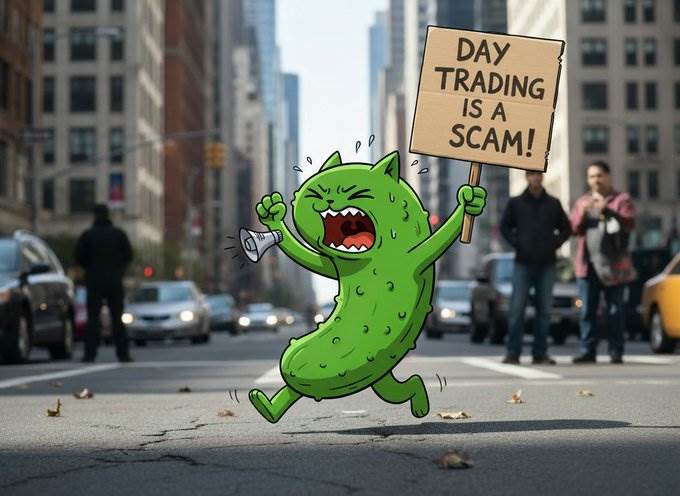
After all, retail intraday trading is essentially a scam from a structural perspective.
This article is quite long, but if you can spend 120 seconds reading it, I guarantee you’ll be grateful to me in a few years.
I have been trading since I was a teenager.
There were times when I felt like Batman, experiencing victories that made me feel great. But there were also times of failure that broke my heart and still affect me today.
I tried every strategy I could think of in retail trading.
I even traded intraday for a whole year, thinking that this would save me. But it ended up being a complete failure. Every time I remember it, it still hurts me deeply.
My profit and loss statements were terrible. In fact, my grandmother (for whom I set up automatic Bitcoin purchases) made more money than I did.
Then I became a低频波段交易者. I hardly ever held positions. As soon as I made a profit, I would immediately exit the market and take a break from trading.
It wasn’t until then that my life started to improve, and everything finally got back on track.
I’m not a saint. I wrote this article to help save that young, stupid, naive, and impulsive version of myself.
Firstly, as a retail day trading operator, you engage in high-frequency trading. However, you don’t have any real advantages whatsoever—no real order flows, no real liquidity information, no market maker positions, no execution advantages, nothing at all. You can get by by trading just a few times per quarter. But what about trading more than 10 times per week? Even with the strongest “self-discipline” and “risk management” skills in the world, mathematics still seems overwhelming to you.
The failure of retailers isn’t because they never win. We fail because we never stop trading. And high-frequency trading has only one possible outcome.
That’s why I set up a punishment mechanism for myself when I exceed my quarterly trading limits.
Every major failure I experience happens after achieving significant victories. This is because I don’t stop there; I keep going forward.
Every major victory I achieve (and I actually keep those profits for a long time) is because I capitalize on major market trends and then stay calm.
This pattern is so obvious that it’s almost unacceptable.
Victory doesn’t mean suddenly making a huge profit. Victory means keeping that money, not losing it next year.
I saw some 14-year-olds on TikTok who claimed to be day traders. They draw charts on TradingView, thinking that they’ve unlocked some kind of daily trading system after buying a course from a certain expert or having a Discord account.
It makes me feel disgusted. If they knew that this was a form of gambling, I wouldn’t mind it at all. At least they understand the rules of the game.
But today’s intraday trading boom is much larger in scale than the delivery-based trading booms in 2016 and 2017. And we all know what happened to those booms in the end.
People underestimate the difficulty of trading, but they overestimate their own abilities.
The problem isn’t just related to mathematics. Yes, the more you trade, the fewer times you need to stop trading, but it becomes harder to keep making profits.
But the real problem is that young retail traders truly believe that as long as they practice “self-discipline” and “risk management,” trading isn’t considered gambling at all. They see intraday trading as a skill that can be performed like any other routine task.
This applies not only to cryptocurrency intraday trading. The same logic applies to U.S. stock trading and almost every market.
High-frequency trading works only within institutional settings.
Take U.S. stock trading as an example. Do you know that institutional traders don’t even look at charts or TradingView at all? They use Bloomberg terminals to access data that retail traders never have access to.
Of course, you probably know this. But teenagers between 14 and 18 years old don’t realize this. They think they’re using indicators that all traders use.
That’s the real danger. If you know you’re gambling, at least you’ll know when to cut your losses. But once you think it’s a “system,” you won’t ever stop. You’ll keep clicking buttons until the market completely ruins you.
It’s simply like a casino disguised as a coffee shop.
When you enter Las Vegas or Macau, you know exactly what you’re facing.
You see lights, gambling tables, dealers, and noise. Your brain knows that this is gambling.
But today, day trading is like being in a casino disguised as a coffee shop.
New traders think they’re here to “learn skills,” but they don’t realize that they’re just sitting at a table designed to slowly drain their energy.
So they never stop. That’s the whole tragedy. It’s not about winning or losing.
They really believe they’re not gambling, which is why they keep playing until they lose everything.
And those retail traders who seem to be “profitable”… to be honest, most of them just caught a lucky break once.
They were lucky enough to hit a good opportunity, and their previous failures helped them develop enough self-discipline to know when to stop after winning.
Even so, this small group accounts for less than one percent of the total retail volume.
It’s not difficult to make money in trading. What’s really hard is to keep it up.