Exchange Ranking
 Top Exchanges
 24h Volume Ranking
 Popularity Ranking
 Exchange BTC Balance
 Proof of Reserves
 Decentralized Exchanges
 Funding Rate
 Funding Heatmap
 Liquidation Data
 Max Pain
 Long/Short Ratio
 Whale L/S Ratio
 Binance/Okex/Huobi L/S
 Bitfinex Margin L/S
 ETF Tracker
 Solana ETF
 XRP ETF
 Hong Kong ETF
 Bitcoin Treasuries
 Crypto Reversal
 Ethereum Reserves
 HyperLiquid Wallet Analysis
 Hyperliquid Whale Watch
 Large Transactions
 On-chain Movement
 Bitcoin ROI
 Stablecoin Market Cap
 Options Analysis
 News
 Articles
 Economic Calendar
 Features
 Wallet
 Contract Calculator


 Security
 Collections
 Watchlist
 Following
 ETH
At the latest万向区块链峰会上,Ethereum co-founder Vitalik Buterin delivered a groundbreaking speech, discussing the latest advancements and future directions of Ethereum. He pointed out that cryptographic technologies are transitioning from the “conceptual stage” to a truly practical era of application. Advances in Ethereum’s ecosystem in terms of scalability, privacy, and security will enable decentralized applications to become widely available at low costs within the next 5 to 10 years. With technologies like Rollup and zero-knowledge proofs becoming more mature, the world of cryptography is moving from niche circles to broader real-world applications.
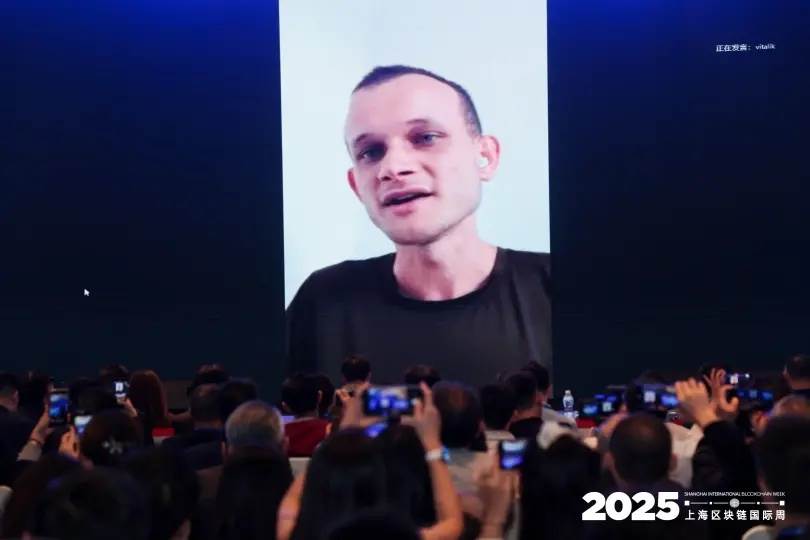
The 2025 Shanghai International Blockchain Week and the 11th Global Blockchain Summit took place today. Ethereum co-founder Vitalik Buterin gave a speech titled “New Developments in Ethereum and Its Applications for the Future.” Vitalik stated that blockchain and cryptographic technologies have made significant progress over the past decade, and in the next 5 to 10 years, we will reach a stage where these technologies can be truly scalable, affordable, and useful.
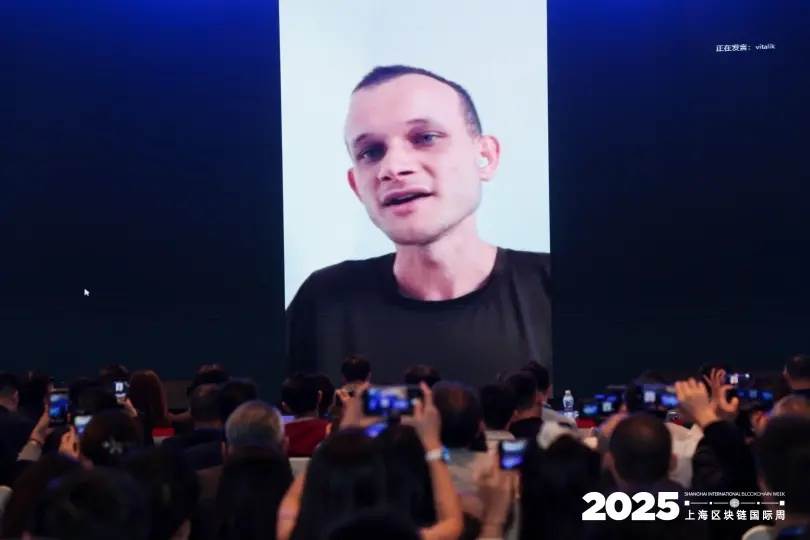
Here is the full text of the speech:
Hello everyone! Thank you for joining this blockchain event. Over the past decade, both blockchain and cryptographic technologies have developed significantly. At the beginning of blockchain technology, its value proposition was quite different from what it is today.
Today, I want to talk about blockchain and cryptographic technologies. If blockchain, ZK, FHE, and all other technologies are scalable, and if they are also developer-friendly and inexpensive, then what can we use these technologies for?
In fact, there are many aspects of cryptography. On the left side, there are two common techniques used in modern cryptography. The first is signature-based authentication, and the second is encryption. Encryption is what differentiates APGB from ACBS. Everyone should remember that 20 years ago, ACBS didn’t exist yet. But 20 years later, all websites, apps, and applications rely on encryption for security purposes.
ACBS consists of two main components: encryption and signature-based authentication. Why wasn’t this possible 20 years ago? It’s because the costs associated with these technologies were virtually zero at that time. In fact, these technologies existed even before 1976 and 1978. Later, RSA emerged as one of the first modern cryptographic algorithms.
Around the 1980s, starting in 1989, digital signatures became widely used. By around 1992, PCP was developed. By 2015, this technology had become much more advanced, affordable, and simple to use. As a result, people no longer needed to worry about its limitations.
Over the past decade, I’ve been working on several new cryptographic technologies. One of them is zero-knowledge proof, and the other is homomorphic encryption.
It’s possible that by 2023 or 2025, homomorphic encryption will become ten times more efficient. Currently, we already have Blocks, which help with secure extensions at level L2. Right now, we have six Blocks available, and we plan to introduce another fifty within the next two or three years.
At the L2 level, this year we have increased the number of transactions processed from 30 million to 45 million. But we plan to further increase this number—perhaps by a factor of 10 or 100. You might think that the technology cost is very low, and the user experience for developers has improved significantly. The blockchain industry has also made similar progress recently. So, what’s the outcome? If you’re thinking about ZK technology now, perhaps the question is: why do we need ZK? Can we avoid using ZK at all? Many times, with blockchain technology as well, people wonder why we need it, and whether it’s really necessary. This technology is still quite new.
In five years, I guess many people will be wondering why not use ZK, why not use blockchain at all. Ethereum will have a significant impact in the short term. We have a plan: on Ethereum’s website, you can see that there are many instances where ZK is used to verify transactions on Ethereum L1. Two years ago, this seemed impossible; people thought it would take five or even ten years to achieve such things. But now, with just 50 GPUs, it’s possible to verify almost every Ethereum block in real time. Not 30 million transactions, but 45 million. So, when we expand our network in the long term, we can create a more scalable and decentralized network. Why? Because we don’t need every node to handle all transactions within the blockchain. Most nodes can use ZK for verification, and the verification process can be completed in just one millisecond—very quickly.
ZK还有一个优点是隐私,所以我们今年可以有一个项目口号,我们要思考所有以太坊隐私的环节,包括链上交易隐私、链下交易隐私,包括各种各样的应用,所有现在可以做这个。两年前可以做一点点,但现在可以做的比之前多。还有一个重要的问题,密码学和区块链和硬件的关系,我们在区块链领域有一句话,“不是你的私钥,不是你的币”,如果你自己不控制钱包的私钥,你的私钥是别人控制,如果是别人控制的你无法验证你的币是不是安全的。2023年的时候我们会加另外一句话“不是你的硅,不是你的私钥”。因为所有区块链里做的事情都会靠密码学,密码学都是靠私钥的,算法需要在硬件里运行,需要在硬件里保存,如果你无法相信你的硬件,你就无法相信所有在硬件上发生的事情。
其实很多领域都有这个问题,区块链有数字资产和数字身份,但IOT也有这个问题,如果所有设备在里面都有一个电脑,那你怎么能相信它呢?医疗也有这个问题,在医疗领域的隐私也是很重要的。
We recently started a interesting project. If you use DeFi coins or DXR in Singapore, you might notice that there’s a small device that can measure various indicators related to air quality—such as carbon dioxide levels, among others. Such devices help us understand what’s happening in the air, which is very important in the field of healthcare. But privacy issues are also crucial. In ten or twenty years, the amount of information available in the physical world could be thousands of times greater than it is today. How can we protect privacy and security? That’s why we’re working on future versions of this device, incorporating cryptographic technologies. This way, we can access the data we need while still protecting the privacy of everyone and every location. ZK is a great tool for this purpose.
First, we know that cryptography is essential, but we’ve found that it can actually be used effectively. Second, open-source and verified hardware is also important. There are many similarities between the blockchain industry and many other fields. There’s a lot of development happening in all these areas. How can you get involved?
I think there are three possible answers:
First, start your own business. You can create or support applications that use ZK, FHE, and blockchain technologies.
Second, focus on the development and optimization of underlying cryptographic technologies. The Ethereum Foundation has a Lean team, and there are many opportunities for collaboration. You can contact the Lean team.
Thirdly, we can utilize current technologies such as Scroll, taiko, lighter, intmax, aztec, and other related applications. There’s also ZK voting technology in use—for example, zkpassport has been available for about two years, and Aragon announced at the beginning of this year that they would use ZK voting for various purposes, along with other wallet solutions. Now, there are many ways in which people can participate in these areas.
I think the questions that need to be considered in five or ten years are these: Many technologies like HTTPS use simple cryptography techniques like signatures and encryption. But you might not know that these technologies exist. These technologies are extremely convenient; they can be used directly without worrying about costs or user-related issues. If ZK-based blockchain technologies, such as L1, L2, and FHE, could achieve the same level of efficiency, then all problems would be solved. If this becomes possible, what can we do with these technologies? The answer isn’t simple. We need to start experimenting now. With each passing year, we can develop more and more applications. I’m happy to participate in this process of technological development with everyone else. I hope to continue doing so in the future.