Exchange Ranking
 Top Exchanges
 24h Volume Ranking
 Popularity Ranking
 Exchange BTC Balance
 Proof of Reserves
 Decentralized Exchanges
 Funding Rate
 Funding Heatmap
 Liquidation Data
 Max Pain
 Long/Short Ratio
 Whale L/S Ratio
 Binance/Okex/Huobi L/S
 Bitfinex Margin L/S
 ETF Tracker
 Solana ETF
 XRP ETF
 Hong Kong ETF
 Bitcoin Treasuries
 Crypto Reversal
 Ethereum Reserves
 HyperLiquid Wallet Analysis
 Hyperliquid Whale Watch
 Large Transactions
 On-chain Movement
 Bitcoin ROI
 Stablecoin Market Cap
 Options Analysis
 News
 Articles
 Economic Calendar
 Features
 Wallet
 Contract Calculator


 Security
 Collections
 Watchlist
 Following
10月11日的加密暴跌虽然让散户心态受挫,但真正的市场故事才刚开始——机构投资者正在悄然布局。通过ETF、托管账户和加密信贷服务,大型资金正陆续进场,包括退休基金401(k)的增持迹象,显示机构对长期价值的信心正在积累。这种“逆势入场”不仅为市场提供支撑,也预示着下一轮行情或将由机构主导,散户情绪虽低迷,但长期牛市逻辑正在悄然形成。

经历“10.11”惊魂一夜,加密市场信心降至冰点。尽管多头在筑底过程中多次组织反攻,但最终均因买盘乏力而屡屡溃散,行情陷入焦灼。值得注意的是,在加密市场震荡走弱之际,美股、A股及大宗商品却整体保持强劲上涨。这种强烈的反差,进一步加剧了市场对“10.11”崩盘可能带来更深层次、更广泛冲击的担忧。
与LUNA崩盘主要冲击机构并引发系统性清算潮不同,“10.11”崩盘更像是一场针对杠杆散户的结构性清洗。其重创群体高度集中于那些高杠杆做多山寨币和参与循环贷套利的中小投资者,使得风险被有效隔离在散户投机领域,未向机构层面蔓延,也未引发系统性的信用塌方与全面流动性紧缩。
However, since the liquidated altcoin positions generally had low leverage ratios, the $40 billion in margin calls actually led to extremely severe losses. This kind of “complete eradication” of market participants not only caused significant wealth destruction but also severely weakened short-term purchasing power in the market, resulting in a prolonged period of volatility and consolidation.
Although the “10.11” crash had a profound impact on the market, institutional confidence remained unshaken. In a sense, this significant correction was seen as a rare “golden opportunity,” providing an opportunity for institutions to make long-term investments.
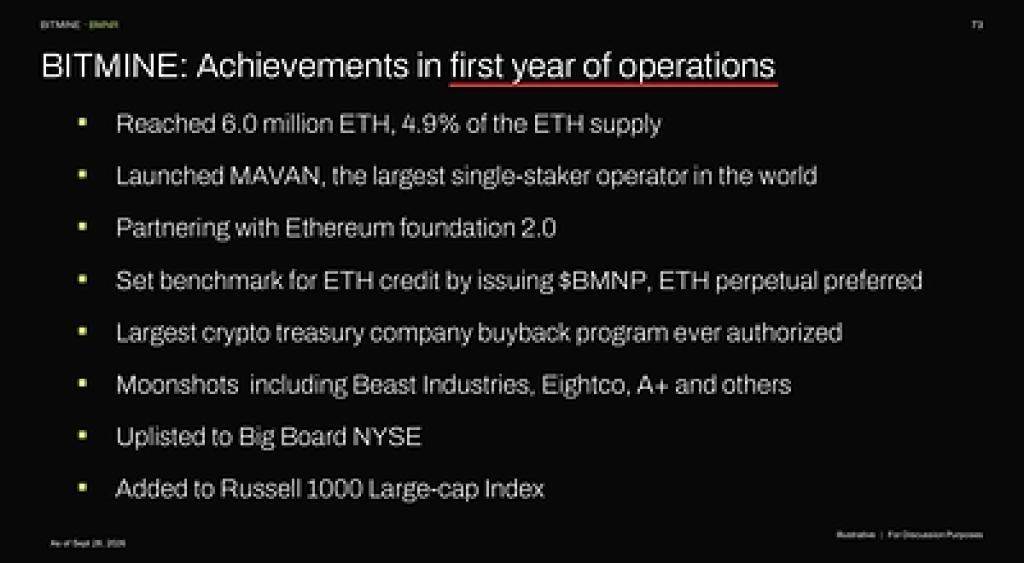
For example, during the week of the crash, the crypto company BitMine increased its holdings of ETH by 203,826 units, raising its share of the Ethereum supply to 2.7%. Its buying efforts were not affected by market panic at all. At the same time, BlackRock’s spot Bitcoin ETF (IBIT) recorded a net inflow of $210.9 million on October 22, after the crash. Institutions are actively investing through compliant channels. Tom.Lee, the chairman of BitMine, stated that Ethereum’s supercycle will not be interrupted due to deleveraging events, and the current price imbalance represents “an extremely attractive risk-reward opportunity.”
Secondly, after the collapse on November 10th, Morgan Stanley announced that it would allow its financial advisors to offer cryptocurrency investments to all customers, regardless of their risk tolerance or net assets. This includes all types of accounts, including those related to retirement plans. Previously, this option was only available to customers who had assets worth at least $1.5 million, had a high risk tolerance, and owned taxable brokerage accounts. It’s worth noting that Trump recently lifted restrictions on investing in cryptocurrencies through the 401(k) pension plan in August. This market correction seems to be akin to “backing someone up when they need help.”
Meanwhile, Citibank announced that it would provide custody and tokenization services for certain institutional clients. This means that some customers can hold and trade Bitcoin and Ethereum on Citibank’s platform. More importantly, JPMorgan will soon allow institutional clients to use Bitcoin and Ethereum as collateral for loans. This indicates that major Wall Street banks are taking more substantial steps to integrate cryptocurrencies into the core operations of the traditional financial system (a significant milestone).
Currently, the proportion of cryptocurrencies in the portfolios of global sovereign wealth funds and pension funds remains extremely low, almost negligible. A survey conducted in August 2025 revealed that only 9% of pension fund managers surveyed had made any structured investments in cryptocurrencies; the weighted average proportion invested by all surveyed institutions was even as low as 0.3%. Sovereign wealth funds, in particular, are more cautious, with their overall investment proportion falling below 0.1%. Nevertheless, the market has recently seen a symbolic “breakthrough”: in October 2025, the Luxembourg Intergenerational Sovereign Wealth Fund announced that it had allocated 1% of its assets to a Bitcoin ETF. This made it the first national fund in the eurozone to publicly invest in a Bitcoin ETF, marking a historic shift in the way mainstream institutions allocate their resources.
Standard Chartered Bank revealed in a research report in February 2025 that the Abu Dhabi Sovereign Fund holds approximately 4,700 Bitcoins in Baird’s spot Bitcoin ETF (IBIT), and it is expected that this portfolio will continue to grow. The report also indicated that the Czech National Bank is considering allocating 5% of its large foreign exchange reserves to Bitcoin, indicating that traditional reserve management institutions are becoming more accepting of digital assets. If 401(k) plans and sovereign wealth funds eventually allocate 1%-3% of their resources to cryptocurrencies, this could create billions of dollars in additional investment opportunities for the market.
在当前宏观环境下,美联储降息周期开启导致美债收益率持续承压,同时标普500指数估值已逼近二十年高位,传统资产配置正面临显著的收益挑战。面对这一结构性转变,401(k)养老金要实现7%-8%的长期回报目标,将加密货币纳入资产配置已从边缘选项升级为战略必需。
传统的60/40股债组合收益空间日益收窄,而加密货币凭借其独特的高增长潜力,为提升整体投资组合收益提供了新的可能。虽然这类资产波动性较高,但将1%-3%的资产配置于比特币等主流加密资产,既能利用其与传统资产的低相关性优化风险收益结构,又不会对投资组合的长期稳定性构成实质性威胁。在这个传统收益来源持续弱化的时代,忽视加密货币这类高成长性资产,反而可能成为制约实现长期回报目标的主要风险。