Exchange Ranking
 Top Exchanges
 24h Volume Ranking
 Popularity Ranking
 Exchange BTC Balance
 Proof of Reserves
 Decentralized Exchanges
 Funding Rate
 Funding Heatmap
 Liquidation Data
 Max Pain
 Long/Short Ratio
 Whale L/S Ratio
 Binance/Okex/Huobi L/S
 Bitfinex Margin L/S
 ETF Tracker
 Solana ETF
 XRP ETF
 Hong Kong ETF
 Bitcoin Treasuries
 Crypto Reversal
 Ethereum Reserves
 HyperLiquid Wallet Analysis
 Hyperliquid Whale Watch
 Large Transactions
 On-chain Movement
 Bitcoin ROI
 Stablecoin Market Cap
 Options Analysis
 News
 Articles
 Economic Calendar
 Features
 Wallet
 Contract Calculator


 Security
 Collections
 Watchlist
 Following
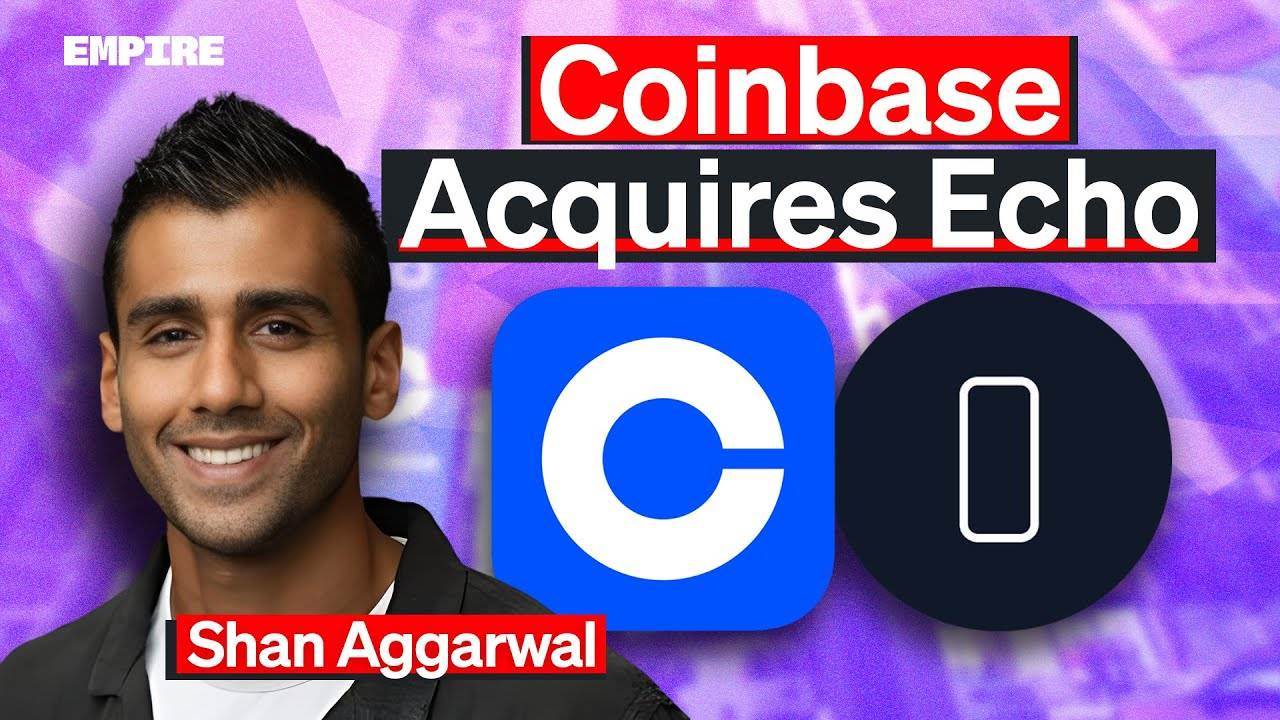
Coinbase officially announced its acquisition of the blockchain finance company Echo. In a recent podcast, Shan Aggarwal, CEO of Coinbase, shared details about this acquisition. Aggarwal said that this collaboration is not just a business expansion, but also a crucial step for Coinbase towards becoming a “blockchain-based capital market”. Echo has extensive experience in compliant blockchain financing, and it will help Coinbase bridge the gap between traditional finance and the crypto world. The podcast also mentioned that this acquisition will drive the development of new services such as tokenized stocks and predictive markets, bringing Coinbase one step closer to becoming a “one-stop crypto finance platform”. In other words, they are trying to bring the familiar Wall Street ecosystem to the blockchain.
Shan’s background
Yano: Many people may be familiar with Coinbase’s executive team, such as Emily, Paul, or Brian. But I think you, as someone who worked behind the scenes, have led many important efforts related to venture investing, mergers and acquisitions, and corporate development. Today, I really want to learn more about your career background and your experiences over the past few years.
Shan:
我在2018年5月加入Coinbase,当时公司规模还很小,大约只有150名员工,办公室也比较简单,就在旧金山。我在加入Coinbase之前就对加密货币领域充满兴趣。当时我在一家名为Greycroft的早期成长型风险投资公司工作,主要专注于金融科技和媒体领域的投资。我一直对新兴技术保持敏感,在2017年初我第一次读以太坊白皮书,这让我眼前一亮,因为它让我联想到早期App Store的时代——那时开发者可以利用一个全新的平台,创建各种创新应用。而以太坊正好开启了ICO时代,所以我花了很多时间参与相关社区活动。
2018年,我决定全职投身加密货币行业,于是加入了Coinbase。当时公司还没有专门的企业发展团队,Emily刚刚加入,并开始搭建我们的并购能力,我帮助启动了Coinbase Ventures项目,并逐步扩展其规模。
我参与的第一件重要事件是领导2018年的E轮融资。当时我们在80亿美元估值下成功募集资金。这是我第一次真正感受到加密货币的市场波动性——融资期间比特币的价格还在2万美元左右,但不久后就暴跌至约3000美元。我看到许多投资者试图撤回承诺,这次经历对我来说非常特别,最终我们还是顺利完成了融资。之后,我负责投资者关系工作,一直到公司IPO。我实际参与了我们S1文件的大部分撰写工作,并亲历了直接上市的全过程。有趣的是,在上市时,我们曾尝试对Coinbase的股票进行代币化,并设计了一个双轨计划,但由于监管障碍,最终不得不放弃这个方案,以确保传统上市流程的顺利进行。这段经历非常特别,因为我们成为了第一家上市的加密货币公司,并在人工智能时代之前完成了S1文件的撰写。
完全是按照传统流程从零开始。最近,我主要负责公司的合作伙伴关系、投资,以及业务运营和战略工作。从整体来看,我的角色是帮助制定公司的战略方向,并确保我们能够高效地执行。
Yano:你提到过尝试对Coinbase的股票进行代币化,这个事情我之前并不了解。能详细谈谈吗?
Shan:
Yes, we did try. Internally, we had a project called Clementine. Our goal was to enable Coinbase to go public on NASDAQ while also offering a digital version of its stocks—a “digital twin”—so that these stocks could be traded directly on the Coinbase platform. However, the regulatory environment and market awareness at that time were far from what they are now. We conducted numerous discussions and debates in order to advance this project, but ultimately, we couldn’t find any viable regulatory pathways. To avoid delaying the traditional listing process, we decided to complete the listing in April 2021 using the traditional method.
Acquiring Echo
Yano: You are acquiring Echo. Could you provide more details about this transaction?
Shan:
We are very pleased to have completed the acquisition of Echo. The main goal of this transaction is to make capital markets more accessible and open. Through Echo, we can provide developers, blockchain protocols, and asset issuers with compliant online financing services. These funds can come directly from their most loyal and active user base—those who actually use their products, rather than relying solely on traditional institutional investors.
I believe this acquisition aligns perfectly with Coinbase’s mission. We are committed to creating more economic freedom for people around the world. We believe that blockchain and cryptocurrencies can provide more open and inclusive financial services. Echo provides us with a crucial tool for conducting compliant financing activities on the blockchain, thereby helping capital to better connect with investment opportunities.
Yano: How was this deal brought about? Echo is a company founded by Cobie. Was it Cobie who approached you, or did you approach him instead? What was the process behind this deal?
Shan:
This is actually the result of long-term collaboration between our two companies. We have been working with Echo for a long time, and their project started on the Base platform. Earlier this year, we supported the development of Echo Group through the Base Ecosystem Fund. The investors in this fund wanted to support the companies we invest in, while also helping to grow the Base ecosystem. Many companies within the Base ecosystem are also seeking more financing opportunities. This partnership represents a great starting point. As we gain a deeper understanding of Echo, we realize that this could be an opportunity to help projects within the ecosystem conduct community sales and public token sales, thereby promoting the development of the entire ecosystem.
The total value of this deal is not yet finalized. It is estimated to be between $350 million and $400 million, depending on the price of Coinbase’s stock. This is a combination of cash and shares. Due to the high volatility of stock prices, the exact amount may change, but it will likely remain within this range.
Yano: I remember when you acquired Deribit, the initial valuation was 2 billion dollars. A week later, it rose to 3 billion dollars, and then further to 4 billion dollars. Apparently, the founders chose Coinbase’s shares—which was a good decision for them. So, as the acquirer, how did you come up with these deals? I believe many entrepreneurs hope to be acquired by Coinbase one day. Could you share some experiences with us?
Shan:
That’s a great question. Since I joined Coinbase, we’ve completed 40 acquisitions. We’re quite active in mergers and acquisitions. This acquisition of Echo is our eighth transaction this year. When considering acquisitions, we usually plan based on product strategy and long-term priorities. These decisions are made taking into account customer feedback, as well as the needs of investors and developers. Once we have clear goals, we evaluate the best ways to achieve them. While we can develop products from scratch, this often leads to delays and a lack of expertise.
Therefore, we scan the market for outstanding companies that have made progress in their fields. If we find a company that not only excels in technology and products, but whose team culture also aligns well with ours, we won’t hesitate to acquire them and integrate them into Coinbase, giving them greater opportunities to grow on the platform.
Our initial goal was still the strategic objectives we wanted to achieve. Many entrepreneurs contacted me, hoping to sell their companies. However, Coinbase already has a presence in multiple markets, so we must focus our efforts on ensuring that every acquisition and integration effort aligns with our long-term goals. If the goals aren’t clear, it can lead to wasted resources, making things more complicated and difficult to manage.
Yano: How did you determine the purchase price? The valuation for this acquisition ranged between $3 million and $4 million. Obviously, this was related to Coinbase’s stock price. But how did you come up with that price? I assume it wasn’t based on revenue multiples, since Echo isn’t currently profitable yet.
Shan:
It really depends on the specific circumstances. Companies like Deribit have stable revenues and profits, and we can evaluate their valuations using traditional financial analysis methods. But for companies like Echo, we pay more attention to their future potential rather than their current performance. Often, we make acquisitions based on technology and team capabilities, because we believe these resources can help us achieve faster growth and greater success. We approach these transactions with a forward-looking perspective, evaluating the potential outcomes over the next 12 to 24 months, as well as the potential revenue gains that can be achieved. Based on this, we determine the purchase price.
Yano:我对Coinbase的并购印象最深刻的一点是你们在整合能力上的表现,尤其是在创始人收益期结束后,仍然能够留住他们。你们的托管业务来自Zapo,主要经纪业务来自Tagomi,衍生品业务来自FedEx,质押业务转型为Bison Trails,资产管理业务来自One River,这个名单似乎还在不断增加。
你们是如何整合这些业务,同时留住创始人和团队的?能谈谈整合过程吗?
Shan:
这是我非常自豪的一点。实际上,我们的管理团队中有三位重要成员都是通过收购加入Coinbase的。比如Tagomi的创始人Greg Tusar,现在负责我们的机构业务;Rob Witoff是Coinbase的早期工程领导者,曾参与Unit 410的开发;还有Jesse Pollak,目前负责Base项目,他也是通过收购加入的。
我们在整合过程中,不仅关注产品和技术的结合,更重要的是文化的融合和团队的契合度。我们希望团队能够认同Coinbase的使命,成为真正的“传教士”,而不是单纯为了短期利益的“雇佣兵”。在传统的并购中,很多团队只关心收益期和薪酬待遇,这种模式虽然没有错,但可能会影响团队的长期留存和目标的实现。
We place great emphasis on the long-term compatibility between teams and our culture during the screening process. If a team aligns with our values, they are likely to stay with us and work together with us over time. This is why we can achieve the results you mentioned—team members often stay at Coinbase for three years, five years, or even longer after joining. Therefore, we invest a lot of effort in ensuring cultural integration and effective teamwork. I believe this is key to successful mergers and acquisitions.
Coinbase’s ultimate goal is
Yano: You recently acquired another company called Liquifi, which isn’t very well-known. With this acquisition, it seems like you’re trying to build a stronger capital structure for your company. Over the past decade, Coinbase focused mainly on serving traders and investors. Now, it seems like you’re moving towards serving businesses in the financial services sector. Could you talk about the combination of Liquifi and Echo? What is your ultimate goal? And what exactly are you doing?
Shan:
Our ultimate goal is to fully migrate the capital market onto the blockchain. Currently, Coinbase primarily serves as a secondary trading platform for cryptocurrency tokens. However, through Liquifi and Echo, we can provide token issuers with a complete set of end-to-end solutions, helping them navigate the entire process from company creation, token management to financing. This ultimately facilitates the launch and growth of projects. While our initial focus was on cryptocurrencies and blockchain projects, we have observed that there is a gradual integration between traditional finance and blockchain technology. Tokens act as the bridge between these two worlds. By using tokens, traditional assets can be digitized and transferred to the blockchain. The infrastructure provided by Liquifi and Echo not only supports cryptocurrencies but can also be applied to other types of assets. Therefore, these modular components allow us to rebuild the structure of the capital market from scratch, integrating these capabilities into Coinbase’s product suite.
Yano: So what’s Echo’s main goal? Is it to increase the scale of project financing? Or to attract more issuers to participate? Or to improve the liquidity of the secondary market and community engagement? How do you assess these goals?
Shan:
At present, our focus is on promoting capital flow through project financing. This not only provides funding sources for companies in need of financing but also allows ordinary investors to access investment opportunities they previously couldn’t access.
Yano: So, your vision is that my Coinbase account will not only contain Bitcoin, Ethereum, and Solana, but also provide a new option for users—such as participating in Series A financing or joining public token sales projects. Users can directly invest using their dollar balances in their accounts. Is that correct?
Shan:
In the future, once these tokens are issued, they can be traded on the Coinbase exchange, or they can be listed on the Base platform for trading on the blockchain infrastructure. This actually fills the gap in the “pre-listing” phase of the existing capital markets.
Yano: What else do you need in this capital structure? For example, Liquifi can provide capital table management, while Echo can offer financing support. What other aspects are currently missing?
Shan:
I think one key aspect is regulatory compliance. Liquifi and Echo’s on-chain infrastructure can support any type of token, but the question is: which tokens can be legally issued? Are they commodity-based tokens, or securities-based tokens? What’s the difference between them? These issues require time to be addressed, so that this vision can truly become a reality.
In addition, we also need to consider the platforms where these tokens can be traded. While they can be traded on Coinbase’s centralized exchanges, we believe that over time, they should also be able to be circulated on decentralized exchange (DEX) platforms. However, ensuring proper permission management and compliance in these transactions is another important challenge.
We have already laid the foundation in many areas—for example, the Coinbase Verifications project, which you may have heard of. This project allows users to tokenize their KYC information and store it in their wallets, enabling us to verify who is conducting transactions on DEXs. Through these underlying tools, we hope to provide users with more open and transparent financial services on the blockchain.
Coinbase’s listing strategy
Yano: What do you think about the ultimate form of these tokens being listed? What do you believe the future of token listing will look like? Also, I noticed that you have launched the “Blue Carpet” initiative. Could you talk about your understanding of the final state of token listing?
Shan:
I believe that many tokens will be created. Historically, listing on a stock exchange has always been a significant marketing event. We believe that we should list and support as many crypto tokens as possible. The real challenge lies in how to filter or prioritize the quality of these tokens. We don’t want to impose our own judgments on others, telling them what are good assets and what are bad ones. That would be like a “big brother” who is constantly monitoring everyone’s decisions. Instead, we prefer to provide comprehensive disclosures and thorough research, so that people can access accurate information and rely on it when making their decisions.
In this field, there is indeed a lot of misleading information. Therefore, I think organizations like Blockworks play a crucial role in increasing industry transparency and authenticity. Additionally, we’re exploring the possibility of introducing predictive market mechanisms to further enhance the accuracy and credibility of information.
In the future, you will see more and more tokens available for users to choose from. We’re also working hard to provide users with better education and information resources, helping them make informed investment decisions.
Yano: Let’s talk about launch pads again. You acquired Echo, and another major player is Legion. I know that Legion has partnerships with Kraken, and possibly other exchanges as well. What do you think about the development of this field? Will every exchange offer its own launch pad and ICO services? Will this become standard among exchanges?
Shan:
I cannot speak on behalf of other exchanges, but for us, this is indeed a logical strategic choice. I believe other exchanges may also adopt similar approaches. We have high hopes for Echo, as we believe they are leading in the field of on-chain capital formation. So far, Echo has helped raise over $200 million for various projects, involving more than 300 investment cases. These include some very well-known and successful projects like Plasma and MegaETH. We believe Echo has a significant advantage in attracting high-quality issuers and supporting protocol development. Additionally, they have a broad base of investors.
Yano: Is there any acquisition that you regret losing?
Shan:
That’s a good question. Phantom is a great example. They are currently very successful, and their team is also outstanding. We were very interested in acquiring Phantom at that time, but ultimately, no deal was struck. They seized the market opportunity and grew rapidly. It’s admirable to see their achievements since then.
Coinbase Ventures
Yano:接下来我们聊聊Coinbase在风险投资方面的布局。Coinbase Ventures团队显然表现非常出色,我认为你们是行业内最活跃的风险投资机构之一,甚至可能是完成交易数量最多的公司之一。你们现在的排名是行业第一还是前三?我相信你们肯定有这些数据。能否谈谈你们的风险投资策略,以及它如何与市场营销和广告(MMA)相结合?
Shan:
这是个好问题。自2018年以来,我们已经完成了超过500项加密领域的投资,是行业内最活跃的风险投资机构之一。我们的投资组合也在不断扩大,尤其是随着Base生态系统基金的推出。我们始终坚持在不同的市场周期中保持投资的连续性。比如,在市场热潮期,很多人会涌入并积极参与,但在熊市期间,资本获取往往会变得更加困难。
Our motivation for initiating venture capital investments was based on our observation that many talented developers wanted to build applications and protocols outside of Coinbase. At that time, there were not enough investors focused on the crypto industry. So we wondered whether Coinbase could support the growth of the entire ecosystem in some way. This is how the Ecosystem Fund was created. Initially, we invested small amounts of money in promising founders, especially those who were innovating in areas we believed had great potential. Over time, the fund grew larger, and now it focuses on investing in the best companies in the industry. We also hope to achieve significant financial returns through these investments.
This not only allows us to support innovation in the industry, but it also provides us with a great opportunity to observe the development of the entire ecosystem. In the crypto industry, predicting future trends can be very difficult. However, I believe that by observing what the best people in the industry are doing, we can often predict trends more accurately. For example, in certain areas like social apps or stablecoin issuance, we often see two or three companies launching at the same time. One of them might become the leader, while the other follows closely behind. These phenomena often indicate future industry trends. Through such observations, we can provide guidance for Coinbase’s long-term strategic direction. Once the direction is clear, we decide whether to develop or acquire companies, or to work together with suitable partners. In the past, we have had successful experiences in these areas.
Yano: So, what is the core goal of Coinbase Ventures? Is it simply to pursue financial returns, or does it aim to bring strategic value to Coinbase through these investments?
Shan: Currently, our main goal is to generate financial returns. Of course, we also hope to establish good relationships with leading founders in the industry through our investments.
Yano: Are there any special aspects regarding venture capital investments? For example, would people approach you directly and say, “Hey, Sean, this company has great potential. Should we consider acquiring it?”
Shan: Yes, such situations do occur. I usually get involved in these discussions, which helps me understand the performance of our portfolio companies better. I can see which companies are doing well and which may be facing challenges. But most of the time, we base our decisions on Coinbase’s strategic needs, focusing on the best companies in the industry to see who is actually doing something interesting. For me, this approach gives me confidence, as our success rate in venture capital investments is quite high. Many companies that end up on our acquisition list were actually targets of our investments. Of course, this isn’t a hard rule; we’ve also acquired companies that we didn’t invest in. But when we have established a trusting relationship with the founders, the entire acquisition process becomes much smoother.
Advice for entrepreneurs
Yano: We know many founders in the cryptocurrency industry. I think at least half of them think, “One day, I’ll sell my company to Coinbase.” It seems like this has become a common plan for many founders when it comes to exiting their businesses. If you were to give advice to these people, what would you say?
Shan: First of all, I believe it’s very important to understand Coinbase and build key relationships with its team. Whether through Coinbase’s venture capital department or its business development team, getting in touch with us as soon as possible will be very beneficial in the long run.
Secondly, I recommend that founders carefully consider how their future plans align with those of Coinbase. Many founders might say, “This is the product we’re developing” or “These are the achievements we’ve made.” These are certainly important, but from our perspective, the more crucial question is: “What value can be created through our collaboration if we actually make an acquisition?” In other words, can the combination of our resources and capabilities unlock new opportunities?
While past achievements are important, our most successful acquisitions have been those where external innovations are combined with Coinbase’s resources to create entirely new value. For example, Tagomi is a great example of this. Tagomi is a company specializing in institutional trading. They have developed top-tier trading infrastructure and successfully established a separate crypto brokerage business. At the same time, Coinbase is expanding its asset custody services, and we have a strong foundation of assets and a solid balance sheet.
To truly expand the scope of high-quality brokerage services, several conditions need to be met simultaneously: top-tier trading infrastructure, balance sheets capable of handling large-scale transactions, and reliable custody services to ensure the safe storage of funds and efficient transactions.
Therefore, integrating Tagomi’s technology with Coinbase’s resources is a logical choice. After the integration, we found that there was a significant market demand for such services. For example, in 2021, many companies approached us, hoping to purchase billions of dollars worth of Bitcoin. At that time, there were no other solutions available in the market that could meet the needs of such large transactions. With Tagomi’s trading technology, Coinbase’s brand reputation, and custody capabilities, we created Coinbase Prime, which has become a leading premium brokerage platform in the crypto industry. This is a classic example of successful integration through strategic collaboration.
Acquisition process
Yano: You have completed 40 transactions so far. What is the ratio of transactions where the client contacted you actively versus those where you contacted them voluntarily? In other words, how many times did the clients find you first, and how many times were it you who initiated contact?
Shan:
That’s a good question. I haven’t kept track of this data specifically. Sometimes it’s difficult to determine who initiated contact first, as relationships often develop over time. It’s like a “long-term two-way interaction”.
Yano: For example, in the investment in Echo, we have established contact with the team. But eventually, there will come a moment when someone asks, “Are you interested in acquiring us?” or “Would you consider partnering with us?” In most cases, it’s us who take the initiative and express our interest directly. Since we have a clear understanding of Coinbase’s long-term development plans, we tend to approach leading companies in relevant fields when we decide to seek cooperation. Of course, there are exceptions. For instance, we might discover an opportunity that we realize is important, even if it wasn’t our primary goal at that time. Overall, I believe that about 75% of cases involve us taking the initiative, while 25% involve us reaching out passively.Yano: There’s an old saying: “Companies are bought, not sold.” When it comes to investing in companies like Tagomi, Zapo, Liquifi, and Echo, do you rely on traditional investment banks or crypto-related investment firms, or do you not need any investment banks at all?
Shan:
We certainly appreciate the professionalism of investment banks. However, in most cases, we find that dealing directly with founders is more efficient and preferred. Our transactions are usually conducted directly with the founders themselves. It can be said that investment banks are used very rarely—almost none at all. As for buyer advisors, we never relied on them, as Coinbase already has a professional team in place who is capable of handling this task. Nevertheless, in recent years, there have been some excellent investment banking services available in the crypto sector.
Usually, we have a clear understanding of the needs and goals of the target company, and we’ve established relationships with them. These transactions are more like brainstorming sessions between Coinbase and the founders, discussing how they can create value together in the future. Additionally, we place great importance on cultural compatibility, as these founders could potentially play important leadership roles at Coinbase over a period of five to ten years. Therefore, ensuring cultural alignment is crucial in our acquisition process.
Yano: Do you have any standard procedures for handling transaction structures? For example, some transactions involve all equity, others involve all cash, and still others involve performance commitments or other metrics. How do you balance these factors?
Shan:
We don’t have any fixed patterns or strict scripts. I believe this is precisely where the art of trading lies. The various tools and methods you mentioned are actually just means to achieve our goals. What’s important is that we clearly define our objectives, have confidence in certain areas, and assess relevant risks accordingly. In most cases, we prefer to avoid adding too many complex structures to our transactions. I don’t want complicated performance commitments or multiple milestones, but doing so could lead to inconsistencies in incentives between Coinbase and the acquired companies. The acquired companies might focus on meeting their own targets, while Coinbase needs to focus on broader strategic goals. Therefore, we prefer that both companies work together towards a common goal, rather than acting independently. Of course, there are some special situations where performance commitments are necessary, but I believe the key is to keep each team independent and autonomous, so they can focus on achieving their own goals.
Yano: How much time do you spend talking with founders before deciding whether to acquire them?
Shan:
Generally speaking, I can quickly determine whether there are sufficient reasons to make an acquisition. Of course, achieving a deal requires the coordination of several factors. The founder must be willing to sell, and we also need to have enough motivation and urgency to facilitate the transaction. As you mentioned, it’s about “the company being bought,” not “the company being sold.” Many factors need to be coordinated, and ultimately, success often depends on timing.
Sometimes, I think that a certain company would be an ideal target for acquisition by Coinbase. But if the timing isn’t right, it becomes difficult to reach a deal. For example, if they have just completed a round of financing and the valuation exceeds our acceptable range, then we will have to miss out sadly. Sometimes I think, “If only we had known this six months earlier.” But that’s the reality of business. Once something is missed, we have to move on and look forward.
Yano: Is there any situation where, after thorough due diligence, your team is very optimistic about the company, and senior management also agrees with it? But in the end, the proposal is rejected by Brian?
Shan:
Such situations have not occurred. However, we have encountered some cases where problems were identified during the due diligence process, which overturned our previous assumptions. This is precisely the purpose of due diligence. We hope everything goes smoothly, but after signing the terms of engagement, we will conduct a thorough review of the company’s core operations. This includes not only financial and team-related aspects, but also compliance issues, legal risks, and how the company manages its employees throughout its lifecycle.
Additionally, the crypto market itself is highly volatile, so it’s not easy to accurately assess pricing, especially in the short term. We typically evaluate a company over a period of three to five years, sometimes even longer, without focusing too much on the short-term performance of 12 months. However, 2022 is a typical example of this. At that time, the global market underwent significant changes, and everyone had to adapt to the new realities.
Views on predicting the market
Yano:我们来聊聊预测市场吧,你们最近对Calcium进行了投资。预测市场在Coinbase的战略中扮演什么角色?你如何看待Polymarket和Calcium?
Shan:
其实我们也是Polymarket早期轮次的投资者,我们对预测市场非常感兴趣。我们一直认为,加密货币的核心价值之一是为非流动性资产注入流动性,从而创造新的市场。而预测市场正是一个很好的例子,它展示了如何让人们围绕生活中重要的事件下注,比如体育比赛或选举等。从更广泛的趋势来看,日常生活的“金融化”正在加速,人们希望通过这些市场获得更多的参与感。
我们认为预测市场与Coinbase的业务有很强的协同效应,因此计划将其整合到我们的产品中,为用户提供相关服务。我们投资了Polymarket和Calcium,这两家公司都很出色,但采取了不同的策略。Polymarket更专注于国际市场,并从一开始就基于链上操作。而Calcium则聚焦于美国市场,并努力在监管合规性上取得突破。特别是在体育博彩领域,未来一年可能会有更多法律判决推动这一市场的发展,我们对此充满期待。
Yano:那么一年后我们是否可能通过Coinbase平台参与体育博彩?
Shan:
有可能,我们预计在12个月内,用户就能通过Coinbase参与体育博彩。
Yano:你认为Polymarket和Calcium会形成竞争关系,还是说市场足够大,能容纳两者共存?你们是否考虑过最终收购其中一家?
Shan:
我认为市场空间足够大,可以让它们都取得成功。就像传统金融中的期货和期权市场一样,不同的交易所各有专长。我预计预测市场也会呈现类似的格局,比如有些平台专注于实时直播,而另一些则深耕体育领域,针对NFL、NBA或足球等具体赛事提供专业服务。虽然目前市场还处于早期阶段,但随着监管环境的逐渐明朗,我们认为这一领域有巨大的增长潜力。
Yano:你们最近的高管会议上,预测市场占了多少讨论时间?
Shan:
我们已经将其列为今年年底和明年的优先事项之一,我们认为预测市场可以吸引比传统加密交易更广泛的用户群体,这对我们的业务发展非常有意义。同时,这对加密作为一种资产类别也具有重要意义。预测市场有潜力吸引许多从未接触过加密的人进入这个领域。比如,有些人可能觉得加密货币太过前沿或小众,但他们却愿意在NFL比赛上下注。
Yano: When I think of Coinbase and prediction markets, I think of your investment in Calcium. I believe there’s a view that the competition between startups and established companies ultimately boils down to whether startups can gain distribution capabilities before established companies introduce similar innovations. In this context, I would say that Coinbase is a “established company,” while companies like Polymarket and Calcium are “startups.”
Although you’re investing in these companies and working with them, why not develop your own prediction market instead? After all, as an established company, you have greater resources available to quickly launch your own prediction market and reach over 100 million users directly, rather than letting startups compete for this market share.
Shan: You’re right. We certainly have the ability to do so, but I think some of the core capabilities that these companies possess aren’t easy to replicate. For example, companies like Polymarket and Calcium have certain key licenses, which aren’t easily obtained in a short period of time. Additionally, they can solve market problems using a certain degree of discretion, which is a very unique capability. So, this is indeed an option we need to consider carefully.
We already have a designated contract market, which is a derivatives exchange regulated by the CFTC. This exchange was approved in 2022. In the future, we will need to decide whether to build new markets, acquire existing ones, or engage in cooperation with other entities. The goal is to provide our users with the best possible products, while continuously improving our operations.
Yano: Can we talk about tokenized stocks and tokenized equity issues? I’d like to hear your thoughts on this market. For example, what about tokenizing your own equity, tokenizing stocks, and integrating these technologies into the blockchain?
Shan:
I believe we are still in the early stages of this field. Currently, the biggest obstacle is regulatory issues, not technical problems. In fact, the technical conditions for tokenizing stocks are already ready. I believe that in the future, most capital markets, even the entire financial sector, could be integrated into the blockchain. But all of this must be done within the framework of regulatory requirements. The traditional equity market functions well overall, although not everyone has equal access to it. For example, people in some regions cannot equally access the capital market. Mechanisms like T+2 settlement could greatly improve efficiency if they can be implemented on the blockchain.
However, there is still a lot of work to be done. For example, we need to improve the transparency and integrity of the market, so that users can have sufficient confidence in the security of the on-chain markets and the participants involved. I believe that some of the most promising companies today are those that can connect traditional financial markets with on-chain capital markets. For instance, Superstate is a fascinating company, as it can facilitate the exchange between securities traded on exchanges and those traded on the chain. I’m confident that such markets will eventually emerge.
But for now, the practical applications of on-chain securities remain limited. Questions like how to transfer them, where to trade them, and whether lending markets can be established based on them still lack clear answers.
Yano: As you can see, this market hasn’t really taken off yet, compared to Galaxy’s stocks. I hope it will become more open, but for now, its performance isn’t very satisfactory.
Shan:
That’s true, but I believe this is a significant step forward. I appreciate their efforts; what they’re doing is very similar to our attempts in 2021. They’ve set an example for many companies, and in the future, traditional markets and blockchain-based markets can coexist. I believe we will see more blockchain-based markets, especially with innovative applications like perpetual stock contracts. Since the stock spot market isn’t available 24/7, it’s currently difficult to achieve 24/7 trading. But once assets are on the blockchain, it becomes possible to support continuous trading throughout the year, thereby enabling the introduction of perpetual stock contracts. Similar applications could also be extended to private securities, although these securities might not be tradable freely. I noticed that Hyperliquid has conducted interesting experiments in this area recently. After the launch of HIP 3, their vision is to make all assets support perpetual contracts, which is very appealing. However, all of this depends on the underlying assets being tokenized and held on the blockchain, so as to reduce market imbalances caused by price differences.
Yano: I want to ask a hypothetical question. I think Blockworks is a traditional equity business without tokens, and it doesn’t operate based on blockchain technology like some other protocols. So, traditionally, we would choose to go public on NASDAQ, which is typical practice for startups over the past few decades. But our target audience mostly operates on the blockchain, and they hold substantial capital there.
When we look at Superstate’s efforts, we wonder whether Blockworks should opt for an on-chain IPO rather than a traditional one. Does an on-chain IPO mean that we need to issue tokens? If you were in our position, what would you think?
Shan: I believe that an on-chain IPO is a great choice, as it aligns better with your target audience. If you choose an on-chain IPO, you can use tools like Liquifi to manage your capital structure and achieve on-chain financing through Echo or Sonar. This approach is worth exploring further. However, you need to consider that although on-chain IPOs are more suitable for your audience, the scale of the on-chain capital market is still much smaller compared to traditional markets. Especially when it comes to capital pools and available funds, while the on-chain market may be more suitable for your business, its overall size is still limited.
I think that during this transition period, it might be a better strategy to combine both on-chain and traditional IPOs, just like Galaxy did. This way, you can serve both on-chain users and the mainstream audience interested in crypto assets.
Yano: That’s a good idea; we should study this in detail. So, which topics during Coinbase’s executive meeting unexpectedly took up a lot of time? Besides market predictions and perpetual contracts, what other interesting topics were discussed?
Shan:
Yes, we indeed spent a lot of time thinking about the pace of transitioning from off-chain to on-chain operations, as this directly affects our decision-making processes. You know, during the early days of Coinbase, we had to obtain regulatory permits in each market, open bank accounts, etc., in order to provide users with a platform for trading encrypted assets. It was a very cumbersome and complex process. But once the assets were on-chain, they became more flexible and portable, allowing for the creation of new financial markets more easily. We invested significant effort into our future plans on-chain, ensuring that there was adequate infrastructure to support this transition. For example, we have developed tools like Base and the Base app, and even integrated on-chain protocols into the Coinbase platform.
Depending on our expectations regarding the pace of this transition, if the change happens faster, we need to adjust our resource allocation strategies, prioritizing the development of on-chain markets. If the change occurs more slowly, we need to balance resources to continue supporting off-chain markets. Therefore, when determining priorities and resource allocation, we always strive to find this balance.
Yano: Shan, is there anything we haven’t discussed yet? Especially regarding Coinbase’s vision of becoming a “universal exchange”?
Shan:
I believe we have covered a lot of topics related to the “Everything Exchange”. In fact, this can be seen as a summary of the process of tokenization. In the past, people tended to distinguish between encrypted assets and traditional financial assets. But once financial assets become tokenized, this distinction becomes less clear. We aim to provide users with comprehensive asset management services, whether it’s cryptocurrencies, stocks, prediction markets, or even tokenized private securities and pre-sale tokens that may emerge in the future. The acquisition of Echo is an important step toward achieving this goal. More broadly, it marks significant progress in our efforts to integrate blockchain technology into the capital market.
Does the market cycle still exist?
Yano: Before ending, Shan, I would like to hear your thoughts on the market cycle. What stage do we currently find ourselves in? Does the market cycle still exist? I’m very interested in your latest insights.
Shan:
That’s a great question, and it was one of the topics we discussed in depth during the executive meeting. I believe the market cycle still exists, but its volatility and extreme levels have decreased compared to before. Nowadays, the cycles in the crypto market are influenced not only by factors within the industry but also by macroeconomic conditions.
As for whether there will be another bear market in the future, I believe it is possible. However, compared to the bear markets in 2018 or 2022, future bear markets may not be as severe or painful. This is because we are already seeing the emergence of more stable use cases, those that have less reliance on fluctuations in crypto asset prices. For example, stablecoins are a typical example of such use cases. Stablecoins can be considered early representatives of tokenized assets. Since 2018, the market size of stablecoins has grown significantly, with their total market value now exceeding $300 billion.
Additionally, we see endless innovations related to stablecoins. Globally, many emerging stablecoin banks are rapidly gaining popularity, offering users more efficient and convenient financial services. These services would otherwise require significant capital and time to implement. Therefore, I believe these innovations are helping to reduce the overall volatility of the market, thereby minimizing the impact of price fluctuations on crypto asset markets.
Yano: If you think the market is approaching the “top” of the cycle, would you choose to slow down investment or mergers and acquisitions efforts?
Shan: We don’t deliberately slow down our pace. Our focus remains on finding the best investment opportunities that align with the company’s strategy. Of course, when evaluating pricing and valuation, we take into account the market trends over the next three to four years. This inevitably involves the impact of cycles. After all, most crypto businesses rely to some extent on the performance of the entire market.
However, we don’t have any specific plans to adjust our investment strategy based on market cycles. Nevertheless, during market downturns, new investment opportunities usually decrease naturally. This is a pattern that we have observed over past cycles.