Exchange Ranking
 Top Exchanges
 24h Volume Ranking
 Popularity Ranking
 Exchange BTC Balance
 Proof of Reserves
 Decentralized Exchanges
 Funding Rate
 Funding Heatmap
 Liquidation Data
 Max Pain
 Long/Short Ratio
 Whale L/S Ratio
 Binance/Okex/Huobi L/S
 Bitfinex Margin L/S
 ETF Tracker
 Solana ETF
 XRP ETF
 Hong Kong ETF
 Bitcoin Treasuries
 Crypto Reversal
 Ethereum Reserves
 HyperLiquid Wallet Analysis
 Hyperliquid Whale Watch
 Large Transactions
 On-chain Movement
 Bitcoin ROI
 Stablecoin Market Cap
 Options Analysis
 News
 Articles
 Economic Calendar
 Features
 Wallet
 Contract Calculator


 Security
 Collections
 Watchlist
 Following
 BTC
 ETH
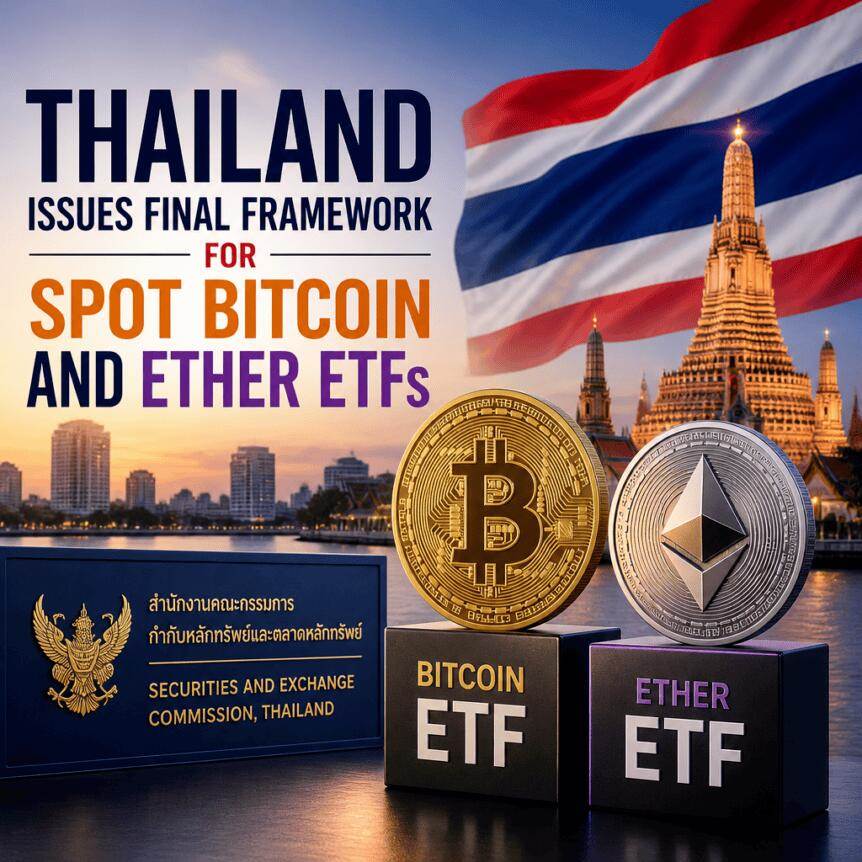
Thailand's financial regulator promotes the inclusion of spot cryptocurrencies into regulated market systems
The Securities and Exchange Commission of Thailand (SEC) formally finalized rules on Thursday to allow cryptocurrency exchange-traded funds (ETFs) to be listed on the Stock Exchange of Thailand. The first batch of approved products are limited to Bitcoin and Ethereum spot-linked ETFs. The framework will officially take effect on October 16, 2026.
Under the new regulations, cryptocurrency ETFs must be traded exclusively on the Stock Exchange of Thailand. In addition, the rules restrict the way Thai retail investors can obtain cryptocurrency products through overseas structures, aiming to bring custody, product regulation and investor protection into the local regulatory framework.
Core Points
- The Securities and Exchange Commission of Thailand has finalized the listing rules for cryptocurrency ETFs on the Stock Exchange of Thailand, with an effective date of October 16, 2026.
- Only spot ETFs linked to Bitcoin and Ethereum are allowed in the initial stage; structured products (such as depositary receipts) linked to overseas ETFs are not allowed in the listing stage.
- Thai mutual funds and private equity funds can invest in cryptocurrency ETFs established in Thailand, expanding the range of qualified investors compared with the previous rule that only invested in overseas products.
- Brokers are prohibited from providing margin loans to ETFs that purchase cryptocurrencies, and ETF assets must be held by digital asset custodians regulated by the Securities and Exchange Commission.
- Investors must receive risk information and confirm understanding before trading, and ETFs must operate in a passive management manner, tracking the price of a single cryptocurrency.
Path for Thai investors to obtain compliant exposure to Bitcoin and Ethereum
Prior to this, Thai investors seeking compliant exposure to major cryptocurrencies faced limited options. The framework established by the Securities and Exchange Commission provides access to Bitcoin and Ethereum-linked ETFs through domestic exchange trading channels, rather than relying entirely on overseas listed products.
Regulators said that the rules will take effect on October 16, 2026, and cryptocurrency ETFs must be listed and traded on Thailand's major exchanges. This domestic listing requirement is at the heart of the Securities and Exchange Commission's strategy: It closely ties custody, product rules and investor protection to local regulatory boundaries.
Industry participants see this change as a potential catalyst for expanding participation. Attakrit Chimphlapibul, co-founder of Bitkub Group, said in an interview that similar to the spot ETF launched in the United States, it opens up more convenient channels for institutional and retail investors to invest in digital assets.
Scope and Restrictions of Licensing
The initial limits set by the Securities and Exchange Commission are very clear. The cryptocurrency ETFs approved under this framework are only pegged to Bitcoin and Ethereum. Although the rules are intended to expand access, they also set clear limits on the use of overseas ETF structures.
It is worth noting that the Securities and Exchange Commission pointed out that products linked to overseas cryptocurrency ETFs (such as depositary receipts) will not be allowed initially. In addition, Thai brokerages will be prohibited from assisting retail investors in investing in overseas cryptocurrency ETFs unless they are targeted at institutional clients and high-net-worth individuals.
This means that the focus of the first phase is likely to focus on locally distributed products rather than imported packaged products. Traders and advisers need to pay close attention to how brokers classify client qualifications and how the list of ETFs approved under the new system will be structured.
Fund access has been expanded, but brokerage leverage has been limited
The Securities and Exchange Commission has also adjusted its policy for investing in collective investment vehicles. Regulators said mutual funds and private equity funds can invest in cryptocurrency ETFs established in Thailand, where previously they could only invest in overseas cryptocurrency ETFs.
This shift is crucial to Thailand's investment industry because it changes the flow of funds. If fund managers previously relied on cryptocurrency products listed overseas, the new rules create a domestic alternative that is more in line with local custody and compliance expectations.
At the same time, the Securities and Exchange Commission takes measures to prevent certain high-risk trading activities. The new regulations prohibit brokers from providing margin loans to purchase cryptocurrency ETFs. The restriction reduces the likelihood that retail investors will leverage access to ETFs-an area that regulators typically focus on when designing compliant entry points for volatile assets.
Custody requirements add another layer of protection. The Securities and Exchange Commission requires fund assets to be held by digital asset custodians regulated by the Securities and Exchange Commission.
Structural requirements for ETFs
The Securities and Exchange Commission's framework contains operational constraints designed to ensure predictability of ETF behavior and align it with the underlying cryptocurrency index that the fund aims to track.
Cryptocurrency ETFs must be managed as passive investment vehicles to track the price of the cryptocurrency in which they invest. The product must also maintain a net exposure to a single cryptocurrency, which represents an average of at least 80% of net asset value in each fiscal year.
On the investor side, the Securities and Exchange Commission has requirements for disclosure and confirmation. Investors must receive information about the product before trading and confirm that they understand the risks involved. According to the Securities and Exchange Commission, the move is aimed at ensuring that retail participants can make informed decisions-especially in a market where product mechanisms and market volatility are difficult to interpret for first-time entrants.
Regulatory Process and Market Feedback
These rules are not developed overnight. The Securities and Exchange Commission said it consulted on the proposed principles in April and May, and then entered the draft stage in August and September. The Securities and Exchange Commission statement indicated that a majority of respondents supported the proposals.
For observers concerned about the direction of Thailand's crypto policy, this suggests that regulators are working through a full consultation cycle rather than relying on temporary approvals. This also suggests that while maintaining strict restrictions on external affiliation structures and brokerage leverage, the Securities and Exchange Commission believes that market feedback is sufficient to support the implementation of the final requirements.
此前的报道指出,监管机构一直在制定旨在让散户在国内市场获得加密货币衍生品敞口的草案规则;ETF框架遵循了类似的模式,即在建立合规产品路径的同时,控制这些产品与海外市场的连接方式。
随着生效日期定于2026年10月16日,投资者和券商面临的关键问题是:在新的条件下,泰国上市的比特币和以太坊ETF将多快推出?以及在“上市初期无存托凭证”的限制下,是否会涌现出任何产品设计?市场参与者还应密切关注券商资格检查和投资者确认在实际操作中的实施方式,因为这些运营细节将决定散户访问权能否从纸面规则顺利转化为实际交易。