Exchange Ranking
 Top Exchanges
 24h Volume Ranking
 Popularity Ranking
 Exchange BTC Balance
 Proof of Reserves
 Decentralized Exchanges
 Funding Rate
 Funding Heatmap
 Liquidation Data
 Max Pain
 Long/Short Ratio
 Whale L/S Ratio
 Binance/Okex/Huobi L/S
 Bitfinex Margin L/S
 ETF Tracker
 Solana ETF
 XRP ETF
 Hong Kong ETF
 Bitcoin Treasuries
 Crypto Reversal
 Ethereum Reserves
 HyperLiquid Wallet Analysis
 Hyperliquid Whale Watch
 Large Transactions
 On-chain Movement
 Bitcoin ROI
 Stablecoin Market Cap
 Options Analysis
 News
 Articles
 Economic Calendar
 Features
 Wallet
 Contract Calculator


 Security
 Collections
 Watchlist
 Following
The U.S. Supreme Court may need to clarify the regulatory boundaries of federal regulators over forecasting markets
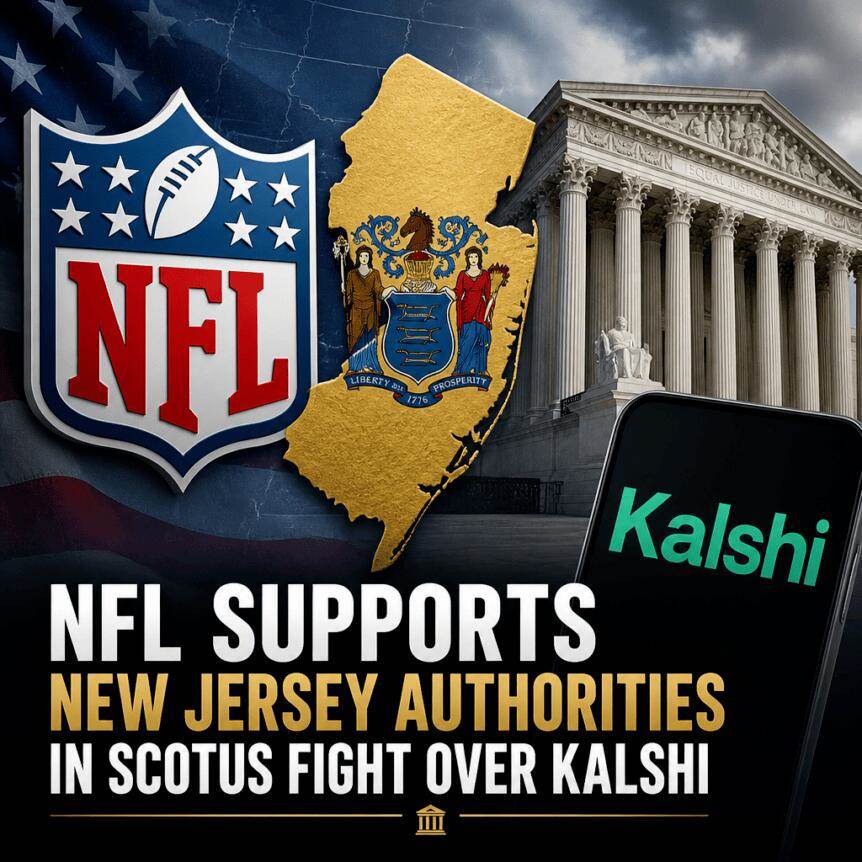
As the National Football League (NFL) filed an amicus curiae opinion supporting New Jersey's request to the Supreme Court to review the case involving Kalshi, the U.S. Supreme Court may soon be required to clarify the scope of federal regulators 'power to regulate forecasting markets.
In an opinion filed Wednesday, the NFL urged the Supreme Court to hear appeals against New Jersey Attorney General Jennifer Davenport and Mary Jo Flaherty, the state's interim director of gaming enforcement. At the heart of the controversy is whether contracts to predict market events fall under federal regulation-specifically the jurisdiction of the Commodity Futures Trading Commission (CFTC)-or whether states retain primary regulatory powers.
Core Points
- The NFL supports New Jersey's request to the Supreme Court to review Kalshi's lawsuit, arguing that the issue concerns the integrity of sporting events and consumer protection.
- The NFL maintains that many event contracts are "highly susceptible to manipulation" and therefore pose a particular risk to game integrity.
- The NFL believes that from a league perspective, the CFTC failed to provide "reasonable safeguards" for such contracts.
- New Jersey and 39 other states say unresolved federal and state regulatory conflicts have sparked a "national turf battle" that only the Supreme Court can resolve.
- As of Thursday, the Supreme Court had not said whether it would accept the case;Kalshi had until November 9 to respond.
NFL's Position on Supreme Court Filing
The NFL's amicus curiae opinion was filed in response to a request by New Jersey officials that the Supreme Court consider the appropriate jurisdiction of the Forecast Markets Company. The NFL's involvement is eye-catching because it directly connects legal issues about regulatory powers to potential sporting game outcomes.
According to the opinion, the case should be reviewed in part because the labeling or structure of contracts involving sporting events-such as those traded on Kalshi and other platforms-may raise concerns about whether they should be considered "swap contracts." The NFL also argued that the controversy deserved the Supreme Court's attention to help "maintain game integrity" and "protect customers."
To support its concerns, the NFL cited data showing that the forecast market is still closely tied to the league's games. The submission noted that on the first Sunday of the football season,"more than half of the forecast market transaction volume"($1.8 billion of the approximately $3.3 billion) was related to the NFL.
The NFL not only provided data and qualitative analysis, but also further argued that many event contracts could be manipulated if a small number of participants had the relevant details in advance. Opinion asserts that the biggest threats come from contracts that may be tied to outcomes relevant to participants (including players, coaches or officials) and decision-makers.
As the NFL stated in its opinion, these bets "pose the greatest threat to the integrity of the game" because "many can be manipulated by individual individuals", especially if relevant information is known in advance-for example, players can change performance, coaches can change lineup, or officials can make (or not make) certain calls.
Why New Jersey claims that federal and state roles conflict
New Jersey's basic case aims to explore how the federal government and states regulate the prediction market. The state believes there is a conflict between the CFTC's practices and state powers, which has led to inconsistent results and uncertainty for regulators, platforms and market entities.
On Wednesday, 39 states and Washington, D.C. also filed amicus curiae opinions in favor of New Jersey. The opinion described the controversy as a "national turf battle" and argued that the issue could not be resolved without guidance from the Supreme Court.
In these submissions, states warned that delays could exacerbate conflicts between the federation and states. They argued that this situation led to unpredictability as to what law would apply and to whom, and urged courts to step in to resolve their alleged differences so that lower courts could receive clear guidance on the issues raised.
Kalshi has previously opposed this fragmented regulatory system. After New Jersey filed a petition in September, Kalshi spokesman Dani Lever told reporters that the company could not be regulated by "50 different regulators." Previous reports have pointed to a broader stake: whether prediction markets will be seen as a regulated federal tool or as a state governance activity similar to gambling.
The NFL argues that federalizing sports betting regulation is a "significant issue"
Another core theme in the NFL document is the scope of federal power-in particular whether sports betting is handled through federal regulation or through state frameworks.
The NFL argued that the Supreme Court should consider whether federalizing sports betting regulation poses a "significant issue" and suggested that the CFTC failed to provide an adequate framework to mitigate what the league said was the risks inherent in certain event contracts.
Thedocument also highlights the lack of consumer protection for this product. The NFL believes that the regulatory system lacks what the league calls "reasonable safeguards" under the CFTC for the types of incident contracts involved.
While the NFL's opinion itself is not a substantive ruling decision, it strengthens the view that predicting legal classifications of market contracts may have practical consequences that go beyond court definitions-especially for league and competition integrity.
What will happen next as the court considers whether to accept the case
截至周四,最高法院尚未宣布是否会批准审查该请愿书。下一个程序性里程碑属于Kalshi一方:该公司获得了延长回应期的许可,必须在11月9日之前解决包括管辖权、可操纵的事件合约以及消费者保护等问题。
即使最高法院最终拒绝受理此案,关于预测市场的更广泛辩论也不太可能停止。联邦与州方法之间的冲突已经引发了多项行动和挑战,随着法院努力确定CFTC的权力是否延伸至预测平台上交易的各种合约,新的上诉可能会不断出现。
对于投资者、开发者和市场参与者来说,最重要的一点是观察最高法院是否发出信号,表示有兴趣解决监管地盘的问题;这一决定将塑造平台多快能预期到一致的合规期望,以及联赛和各州如何继续界定与事件合约交易相关的风险。