Exchange Ranking
 Top Exchanges
 24h Volume Ranking
 Popularity Ranking
 Exchange BTC Balance
 Proof of Reserves
 Decentralized Exchanges
 Funding Rate
 Funding Heatmap
 Liquidation Data
 Max Pain
 Long/Short Ratio
 Whale L/S Ratio
 Binance/Okex/Huobi L/S
 Bitfinex Margin L/S
 ETF Tracker
 Solana ETF
 XRP ETF
 Hong Kong ETF
 Bitcoin Treasuries
 Crypto Reversal
 Ethereum Reserves
 HyperLiquid Wallet Analysis
 Hyperliquid Whale Watch
 Large Transactions
 On-chain Movement
 Bitcoin ROI
 Stablecoin Market Cap
 Options Analysis
 News
 Articles
 Economic Calendar
 Features
 Wallet
 Contract Calculator


 Security
 Collections
 Watchlist
 Following
 BTC
 ETH
There is a new direction in the debate over encryption security: AI advancements could lead to the collapse of elliptic curve cryptography.
The security debate in the field of encryption is taking a unusual turn. The focus is no longer limited to hacker attacks, fraud, or the failure of exchanges. Instead, attention is drawn to a more serious scenario: attackers might use advanced AI technologies to discover mathematical vulnerabilities faster than human cryptographers, thereby being able to derive private keys from public keys.
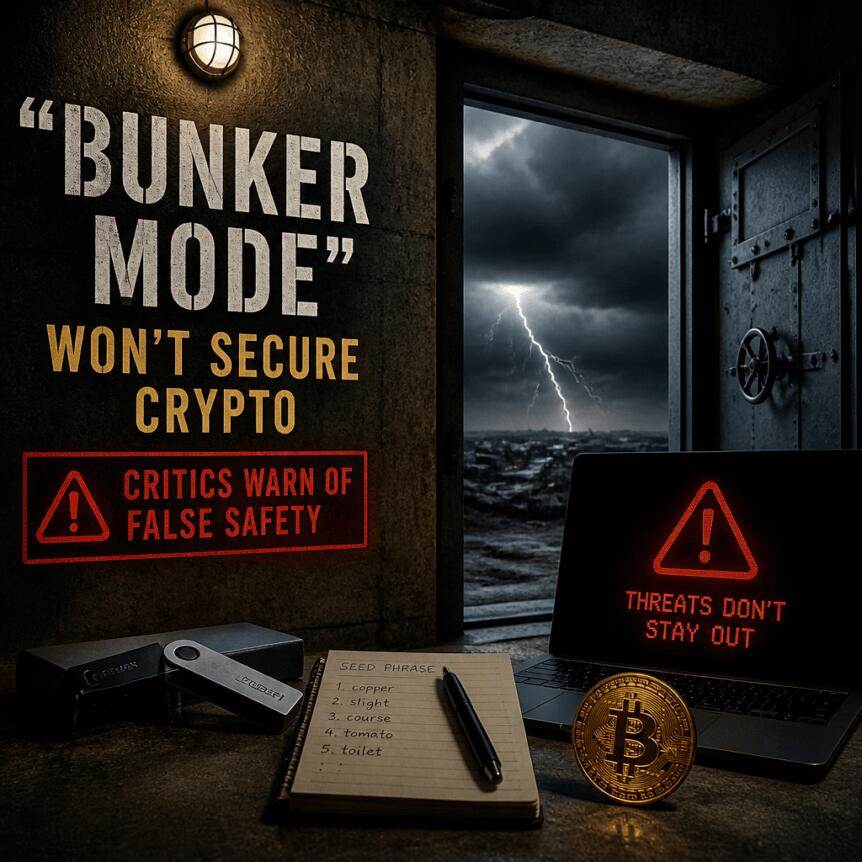
Justin Drake, a researcher at Ethereum, urges the industry to enter a “bunker mode” for planning. He believes that elliptic curve cryptography, including ECDSA, could collapse within months rather than years. It’s reasonable to be prepared for this possibility. While some experts view this warning as a cautious and modest suggestion, others question this premise, emphasizing that there are currently no credible public attacks on ECDSA. They also warn that rushed transitions could introduce new risks.
Key points:
- Justin Drake urges adoption of “bunker mode” planning. He warns that AI could accelerate the discovery of classical attacks that aren’t quantum-based, thereby undermining elliptic curve cryptography like ECDSA.
- Critics point out that there is insufficient evidence of credible public advances against ECDSA, and the industry hasn’t proven any feasible methods for cracking it. Therefore, rushing to switch to new addresses could be more harmful than beneficial.
- Details regarding hardware wallets and account systems are crucial: If the extended public key or wallet infrastructure is compromised, the “new addresses” may not be able to protect funds properly.
- Some ecosystems are already exploring post-quantum and alternative signature schemes, but the timeline remains uncertain. Emergency hard forks or recovery plans are still in the proposal stage.
- Even with mitigation measures, it’s not possible to fix all related components, such as consensus mechanisms, data commitments, and infrastructure signatures. Additionally, Bitcoin’s address practices vary depending on the type of script used.
Drake’s “bunker mode” warnings and the cryptographic foundations they target
Drake’s concerns go beyond the threat of quantum computers. In an article published on the X platform (formerly Twitter), he pointed out that AI can help identify mathematical attacks that can be carried out without quantum hardware, which could weaken the elliptic curve cryptography used in blockchain networks.
“I believe that the likelihood of ECDSA [Elliptic Curve Digital Signature Algorithm] failing before the ‘Qday’ is quite high. In the worst-case scenario, this might take months, rather than years.”
Drake also suggested developing mitigation plans focused on transferring assets to new addresses with unexposed public keys, thereby limiting the information that attackers can exploit. The core assumption behind this approach is that if the elliptic curve scheme becomes vulnerable, attackers could use the information in the public key to recover the private key.
Counterarguments: There is no evidence indicating that ECDSA is vulnerable. “Hasty actions” might actually have the opposite effect.
Not everyone believes that panic is necessary. Matthew Green, a professor of cryptography, has evaluated the stakes involved. He believes that public key cryptography may become ineffective, and this view has increased people’s attention to Drake’s warnings.
However, Yehuda Lindell, the chief cryptographer at Coinbase, said he doesn’t know of any evidence that the long-term mathematical assumptions behind elliptic curve cryptography have been weakened. Another prominent critic is Lucien Bourdon, a Bitcoin analyst who works for Trezor hardware wallets. He told media outlets that there is currently no credible progress in attacking the mathematical principles behind ECDSA, whether through AI or other methods.
Bourdon also warned against treating mathematical papers generated by AI as proof of an impending collapse. He believes that even if such research exists, it may not lead to actual attacks on ECDSA. Drake’s position also acknowledges this uncertainty, defining his timeline as the worst-case scenario. Nevertheless, critics say that this debate shouldn’t be interpreted as a signal to transfer funds immediately—because rapid and aggressive actions can make users more vulnerable to scams.
Bourdon’s warning focuses on the risks associated with rushed responses: people are prone to making mistakes when acting in a hurry, and scammers often exploit the urgency surrounding “imminent technical failures” to carry out their schemes.
Why “transfering to a new address” might not solve the problem
Even if the exposed public key is part of the threat model, simply rotating addresses may not be enough. Zach Herbert, CEO and co-founder of FoundationHQ, pointed out that extended public keys could undermine the effectiveness of the “new address” concept. If the xpub has been shared with wallet applications or third parties, attackers might have access to the information needed to derive the intended location of the public key. In such cases, attackers don’t need to monitor new recipient addresses on the chain; shared xpubs can be used to derive the corresponding private key. Herbert also emphasized that leaks can occur not only in individual chain transaction history but also through wallet architecture and account management practices. Therefore, “stealth mode” planning likely involves more than just changing addresses—it may require updating how wallet management keys are handled, as well as the operational procedures of devices. Eli Ben-Sasson, co-founder and CEO of StarkWare, also rejected the idea that problems can be solved simply by moving coins around. He pointed out that if cryptography fails, the changes could affect not just wallet signatures, but also aspects like infrastructure-level signatures, consensus mechanisms, and the Kate-Zaverucha-Goldberg (KZG) polynomial commitment scheme used for blob data. Ben-Sasson added that network-level impacts could be significant, as gas fees could skyrocket if most functions rely on faulty cryptographic primitives.
Bitcoin demonstrates how mitigation measures can vary depending on the design. Some types of Bitcoin addresses hide the entire public key behind a cryptographic hash before any transaction is performed. In contrast, Taproot exposes the public key directly on the chain. Bourdon pointed out that common SegWit addresses (starting with bc1q) still keep the public key hidden before transactions are sent. Wallets like Trezor generate new recipient addresses to prevent address reuse. However, there’s one aspect that concerns Bitcoin users: whenever a Bitcoin transaction is executed, the public key becomes exposed in the mempool, which could create an opportunity for classical attacks on the signature scheme.
The efforts to counter quantum attacks on different chains vary. The “Recovery Plan” remains a proposal
. Despite intense debates about urgency and feasibility, some networks are already moving towards anti-quantum methods—though these methods differ in design and scope.
According to the anti-quantum roadmap published by NEAR Protocol, users can add a quantum-safe key that meets FIPS-204 standards to their existing mainnet accounts in a single transaction, without having to transfer assets. Wallets like Meteor are also described as supporting quantum-safe signatures, which rely on lattice-based cryptography. Vitalik Buterin, the founder of Ethereum, expressed concerns that lattice-based cryptography might also be vulnerable to attacks, complicating long-term prospects.
Ethereum is working on a more comprehensive roadmap to counter quantum attacks, involving the use of hash-based signatures and zero-knowledge proofs. The network has also planned emergency hard forks and recovery mechanisms in theory. In March 2024, Vitalik Buterin outlined a potential hard fork strategy, focusing on rolling back blocks after large-scale thefts, disabling regular wallet transactions, and allowing users to use seed phrases as proof of knowledge to recover their funds. However, Max Shannon, senior research associate at Bitwise Europe, described this as a proposal rather than a realizable solution, without any specific timeline.
Starknet’s account abstraction architecture offers another perspective. Ben-Sasson believes that the core idea of account abstraction is that signature schemes can be exchanged without the need to transfer funds to new addresses. Of course, other components still need attention—especially certain parts of the network state tree and the way Ethereum-backed security measures work.
On Solana, if public keys are exposed by default, migrating addresses may not be a meaningful solution. Jacob Creech, vice president of technology at the Solana Foundation, said that if Solana’s signature scheme becomes vulnerable, users don’t need to enter “blind mode.” He described a potential upgrade that would allow users to prove their ownership of secret seeds using hash-based proofs, and switch to a more secure signature scheme. He noted that even though the upgrade isn’t yet available, there are already feasible prototypes.
Are the threats truly serious enough to warrant immediate action?
Bitwise’s Max Shannon stated that he does not consider this theoretical risk to be an immediate concern, but he believes that it is still worth being cautious in the long run. Herbert also said that while discussing new addresses and the exposure of xpub as a thought experiment can be useful, these steps do not constitute a complete plan for a cryptographic collapse.
Additionally, there are operational limitations: some users may have old devices, complex multi-signature settings, or hold Bitcoin positions that have not been touched for many years. In such cases, mere software updates cannot automatically protect funds.
Bourdon also pointed out more targeted criticisms: Drake’s warnings and his discussions about Ethereum’s roadmap seem to be intertwined. Bourdon suggested that this information might play a role in prioritizing certain aspects of the roadmap. Even if this interpretation is controversial, it highlights the key issue that readers should consider: before there is a specific, publicly demonstrated attack, it is better to plan carefully rather than acting impulsively.
One point that the crypto industry may reach consensus on in the future is that if cryptographic primitives fail in practice, the industry needs to coordinate its responses among wallets, protocols, and infrastructure. Changing addresses might be the easiest part—if it indeed matters—while more complex system migrations could prove more difficult.
Currently, the most important observation is whether researchers are moving from theoretical risks to specific, reproducible attacks, and whether major chain and wallet providers have actually implemented post-quantum options beyond their roadmaps and proposals.