Exchange Ranking
 Top Exchanges
 24h Volume Ranking
 Popularity Ranking
 Exchange BTC Balance
 Proof of Reserves
 Decentralized Exchanges
 Funding Rate
 Funding Heatmap
 Liquidation Data
 Max Pain
 Long/Short Ratio
 Whale L/S Ratio
 Binance/Okex/Huobi L/S
 Bitfinex Margin L/S
 ETF Tracker
 Solana ETF
 XRP ETF
 Hong Kong ETF
 Bitcoin Treasuries
 Crypto Reversal
 Ethereum Reserves
 HyperLiquid Wallet Analysis
 Hyperliquid Whale Watch
 Large Transactions
 On-chain Movement
 Bitcoin ROI
 Stablecoin Market Cap
 Options Analysis
 News
News Articles
 Economic Calendar
 Features
 Wallet
 Contract Calculator


 Security
 Collections
 Watchlist
 Following
 HBAR
HBAR  XLM
XLM  XRP
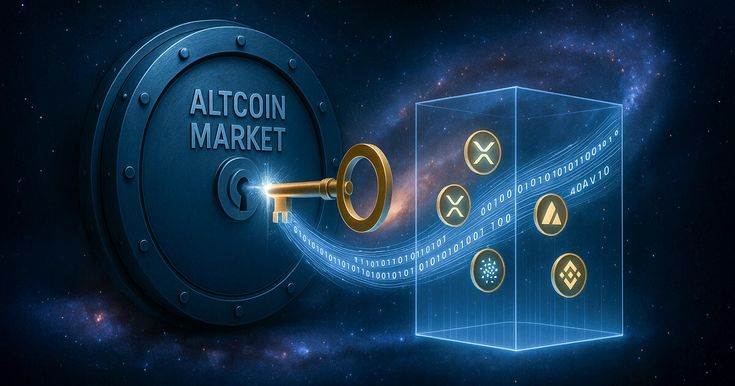
XRP Cryptocurrency investors often debate: In the future when blockchain becomes an important part of the global financial system, who will ultimately win, XRP, HBAR or XLM?
However, this problem may be based on a wrong premise. The financial system is not a single market. Cross-border payments, institutional liquidity, tokenized securities, collateral, remittances and consumer payments are completely different issues and require different infrastructure. As more and more traditional financial activities are linked, there may be a space where multiple networks coexist, rather than having a certain blockchain take everything.
Recently, a crypto commentator summed up this view: He believed that XRP could focus on institutional liquidity and cross-border settlements, HBAR could focus on enterprise-level tokenization, and XLM could focus on remittances and consumer payments. Although this division is not entirely accurate (the three ecosystems are increasingly overlapping), the broader argument is reasonable. Even the International Monetary Fund (IMF) describes tokenization as a key factor that could change the way execution, clearing and settlement operate across the financial system.
XRP's narrative goes beyond cross-border payments
XRP's original value proposition makes it the most understandable of the three. XRP can serve as a bridging asset between currencies, allowing value to flow across borders without requiring financial institutions to maintain large amounts of up-front liquidity in different currencies. Ripple said XRP transactions can be settled in seconds, while XRP also provides liquidity to the XRP Ledger (XRPL) decentralized exchange.
But describing XRP only as a cross-border payment currency has become increasingly outdated. XRPL is also being positioned for tokenization, trading, escrow, stablecoins, and institutional DeFi for real-world assets (RWA). Ripple said the ledger has processed more than $1 trillion in value between counterparties and is building features specifically targeted at regulated financial institutions.
stablecoins add another dimension. RLUSD, USDC and a variety of other fiat currencies are already available for XRPL. In this environment, XRP has the potential to provide liquidity between assets rather than requiring every transaction on the network to be priced in XRP. This distinction is crucial for investors. Adoption of Ripple products or even XRPL does not automatically translate into equivalent demand for XRP. Institutions can use stablecoins and other tokenized assets on their ledgers, and products offered by Ripple do not necessarily require XRP.
Therefore, the core of the argument in support of XRP investment is whether native assets are gradually becoming effective liquidity tools connecting different assets and markets on XRPL, rather than simply assuming that every Ripple partnership means increased use of XRP.
HBAR takes a different route
Hedera's value proposition is different. Rather than focusing primarily on remittances or currency bridging, it builds its identity on enterprise applications, tokenization, and organization-level distributed ledger infrastructure. This makes the growing market for tokenized real-world assets particularly relevant to HBAR.
Financial institutions are exploring how bonds, money-market funds, collateral and other traditional assets exist on distributed ledgers. The appeal is not just about moving existing securities onto blockchain. Tokenization allows ownership, payments and settlements to be achieved through programmable infrastructure.
The IMF recently described this possibility in broader terms, pointing out that sharing digital ledgers could allow execution, clearing and settlement (processes that traditionally occur in sequence) to be more closely integrated.
Hedera has participated in institutional experiments in this area. A well-known example involves Lloyds Banking Group, Aberdeen Investments and Archax using tokenized real-world assets on Hedera as collateral for foreign exchange transactions.
This does not mean that Wall Street is about to turn to Hedera on a large scale. Pilot projects, proof-of-concept and individual tokenization projects are very different from large-scale adoption. Just as the adoption of XRPL does not automatically generate a corresponding proportion of XRP's purchasing power, companies 'use of Hedera does not mean that HBAR prices must rise in tandem with online activity.
However, Hedera is competing in a potentially huge market: the underlying infrastructure of tokenized capital markets.
XLM may win in the field where consumers are truly exposed to cryptocurrencies
Stellar occupies another interesting position. The network has long been committed to moving funds, especially cross-border funds, cheaply and quickly. But Stellar does not need XLM itself as an asset transferred in every transaction; it can carry stablecoins and other tokenized currencies. This makes Stellar particularly relevant in remittance and payment applications.
People who send US dollars internationally do not necessarily care whether blockchain technology is involved. What they care about is the cost of transferring money, how quickly the recipient receives the money, and whether those funds can easily flow between the digital and financial systems. It is here that Stellar's cooperation with payment companies becomes important. For example, MoneyGram uses Stellar infrastructure to connect digital assets to its physical cash network, and the ecosystem is increasingly incorporating stablecoins and tokenized fiat currencies. Therefore, recent institutional comparisons have positioned Stellar's advantages in stablecoin payments and cross-border capital movements.
XLM still functions as Stellar's native asset, including paying for transaction costs and meeting network requirements. But investors once again need to distinguish network adoption rates from token demand. Millions or billions of dollars flowing through stablecoins on Stellar may be positive evidence of the effectiveness of the network, but it does not mean that the same amount of money will flow into XLM.
Conclusion: XRP, HBAR and XLM may not be competing for the same award
So perhaps the most interesting part of the discussion about XRP vs. HBAR vs. XLM is this: There is no need for a single winner at all. Imagine a future financial transaction involving multiple stages: a financial institution tokenizes an asset on enterprise-facing infrastructure; the asset is used as collateral in other markets; liquidity needs to be moved between currencies or networks; and ultimately, part of the value reaches the business or consumer through payment or remittance services.
There is no technical reason for every stage to occur on the same blockchain. In fact, the current financial system already works this way. Banks, card organizations, clearing houses, securities depositaries, payment processors and foreign exchange markets perform different functions while communicating with each other. A tokenized financial system can follow a similar path.
Even policymakers have not described the future as a blockchain replacing everything. The World Interbank Telecommunication Association (BIS) has discussed the next generation financial system with a token-centered core, while emphasizing interoperability, sound institutional arrangements, and integration with existing dual-tier currency systems.