Exchange Ranking
 Top Exchanges
 24h Volume Ranking
 Popularity Ranking
 Exchange BTC Balance
 Proof of Reserves
 Decentralized Exchanges
 Funding Rate
 Funding Heatmap
 Liquidation Data
 Max Pain
 Long/Short Ratio
 Whale L/S Ratio
 Binance/Okex/Huobi L/S
 Bitfinex Margin L/S
 ETF Tracker
 Solana ETF
 XRP ETF
 Hong Kong ETF
 Bitcoin Treasuries
 Crypto Reversal
 Ethereum Reserves
 HyperLiquid Wallet Analysis
 Hyperliquid Whale Watch
 Large Transactions
 On-chain Movement
 Bitcoin ROI
 Stablecoin Market Cap
 Options Analysis
 News
News Articles
 Economic Calendar
 Features
 Wallet
 Contract Calculator


 Security
 Collections
 Watchlist
 Following
CLARITY Act Update: Trump Ethics controversy puts Senate encryption bill at risk
This week, tensions have emerged over the news of the CLARITY Act (the Clear Act). Republican senators have publicly questioned whether the bipartisan crypto market structure bill will survive when it returns to the full Senate. Once regarded as the result of a rare bipartisan consensus on digital asset policy, it is now deadlocked over ethics provisions directly related to the president. Ahead of the vote scheduled for September 15, lawmakers, the White House and the cryptocurrency industry are watching closely to see if a compromise can still be reached.
Overview of Points
- Republican senators have warned that the CLARITY Act may not be passed as the Senate resumes next week.
- The core disagreement lies in the Democratic Party's request to add an ethics clause to cover President Trump and his family.
- The Senate vote is scheduled for September 15, and 60 votes are needed to advance the debate.
- The White House said Trump's attitude towards passing the bill was "unambiguous".
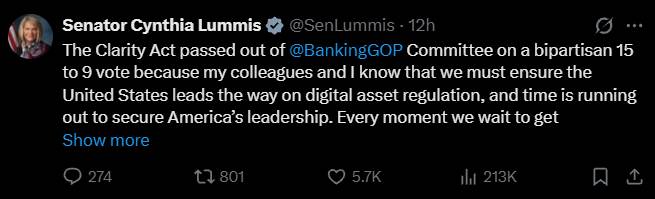
- Senator Cynthia Loomis pointed out that the bill was passed by the Banking Committee with a 15 - 9 vote, showing that it has a bipartisan base.
- Alexander Griff of Paradigm said the bill was "not dead, far from it."
On the eve of the Senate vote on September 15, the CLARITY Act encountered new troubles
According to Semafor, Republican senators said the CLARITY Act is likely to fail when Congress resumes. The bill requires 60 votes to move debate forward, which means it cannot be passed by Republican support alone. At the heart of the standoff is a proposed ethics clause covering the president and his family, and the White House and Democratic negotiators have made little progress on the issue. The results are significant far beyond Washington, D.C., because the bill represents the most comprehensive attempt yet in the United States to create a formal market structure framework for digital assets.
 Why Republican senators say the CLARITY Act may fail
South Dakota Senator Mike Lownz bluntly said that the bill's prospects "do not look optimistic at the moment." North Carolina Senator Tom Tillis further warned that if the White House does not engage in resolving ethical differences,"it will fail." Kansas Senator Roger Marshall provided a different perspective, saying he rarely heard pressure from voters and said: "No one in my hometown asked about it." Taking these remarks together, we can see that even within the Republican Party, there are differences in enthusiasm and sense of urgency. To reach the 60-vote threshold, true Democratic cooperation is needed, not just Republican unity.
Ethics provisions become major obstacle to the CLARITY Act
The controversy centered on whether the bill should include specific ethical safeguards that apply to the president and his relatives. Trump reportedly has huge personal financial exposure to cryptocurrencies, which Democrats believe makes any law regulating the industry particularly necessary for ethics provisions. Republicans, including Senator Cynthia Loomis, argue that Democrats are using ethical requirements as a bargaining tool to obtain broader regulatory concessions, giving future regulators too much power over the crypto industry. This section strictly maintains a statement of facts: no misconduct has been established, and the debate remains a policy and political disagreement rather than a legal determination.

The White House said Trump wants the CLARITY Act to pass
Despite the pessimism in Washington, DC, a White House spokesman said, The administration has worked "tirelessly" with Congress and has reached what it describes as "the most comprehensive ethical clause in history." The spokesman added that Trump believes "unequivocally" that Congress must pass the bill to keep the United States ahead of foreign competitors in digital asset innovation. This contrasts sharply with Senator Tillis's warning that further White House engagement is still needed to bridge the ethical gap, highlighting the apparent disconnect between the administration's public pronouncements and the senators 'private assessments.

Democrats and Republicans remain deeply divided on the crypto market structure bill
In addition to ethical issues, other parts of the bill are also divided. Loomis pointed to the Banking Committee's bipartisan vote of 15 - 9 proved that a solid foundation already exists. At the same time, she believes Democrats are pushing for changes to other parts of the bill that Republicans believe will give regulators too much power to restrict industries. Both sides have publicly expressed the need for compromise, but each expects the other to act first, leaving the bill in a standstill days before the scheduled voting day.
Supporters of the CLARITY Act warn that the United States may lose its crypto leadership
Passing crypto-related laws will bring long-sought regulatory clarity, protect consumers, and provide clear incentives for cryptocurrency companies to stay and develop in the United States rather than relocate overseas. Loomis has repeatedly warned that every delay increases the risk of ceding leadership of digital assets to other countries that move faster on their own regulatory frameworks. In short, market structure laws will define which agency supervises which types of crypto assets, reducing the current regulatory ambiguity that has plagued the industry for years.
 What happens if the CLARITY Act fails on September 15?
The bill requires 60 senators to agree to move debate forward, a high threshold in the current political climate. If this threshold is not met, the immediate legislative timetable may be delayed, but the rules themselves may not expire permanently. Some reports suggest that the failed vote could prompt the cryptocurrency industry to increase political spending in the next Senate and House elections, using the result as a mobilization point into the next election cycle.
CLARITY Act timeline: From Committee Approval to September 15 Vote
Date Event Significance Early Phase of the CLARITY Act During the U.S. Congress's committee stage to advance the establishment of a framework for U.S. crypto market regulation, the Banking Committee approved the bill 15 - 9 to demonstrate bipartisan support at the committee level. September 8, 2026, Republican senators warned that the bill may fail, highlighting uncertainty before the Senate vote. Increase in uncertainty on September 9, 2026 The White House reiterated its support for passage of a bill showing that the government's public commitments remain unchanged. September 15, 2026, a bill to arrange a Senate vote requires 60 supporters to be pushed The outcome of post-debate negotiations or further legislative action may determine the future of the next phase of U.S. crypto regulation, the CLARITY Act: Can lawmakers reach an agreement before the vote?
With just days left before the September 15 vote, the central question is whether Democrats and the White House can bridge differences over ethics provisions without undermining the overall bill. Despite a lot of pessimistic rhetoric from Republican senators, Paradigm's Alexander Griff insisted the bill was "not dead, far from it." Whether this optimism can continue depends on last-minute negotiations, which, regardless of the outcome of the vote, will shape the near-term future of structural regulation of the U.S. crypto market.
Conclusion
News about the CLARITY Act remains truly unpredictable. Republican senators sounded the alarm, the White House stood by its promises, and Democrats continued to insist on ethical protections related to the president and his family. Whether lawmakers can bridge these differences by September 15 will determine not only the fate of the bill, but also the broader trajectory of U.S. crypto regulation in the months to come.
Disclaimer : This article is for reference only and does not constitute financial, legal or investment advice. The cryptocurrency market and related legislation are changing rapidly; readers should research and consult qualified professionals before making financial or legal decisions.