Exchange Ranking
 Top Exchanges
 24h Volume Ranking
 Popularity Ranking
 Exchange BTC Balance
 Proof of Reserves
 Decentralized Exchanges
 Funding Rate
 Funding Heatmap
 Liquidation Data
 Max Pain
 Long/Short Ratio
 Whale L/S Ratio
 Binance/Okex/Huobi L/S
 Bitfinex Margin L/S
 ETF Tracker
 Solana ETF
 XRP ETF
 Hong Kong ETF
 Bitcoin Treasuries
 Crypto Reversal
 Ethereum Reserves
 HyperLiquid Wallet Analysis
 Hyperliquid Whale Watch
 Large Transactions
 On-chain Movement
 Bitcoin ROI
 Stablecoin Market Cap
 Options Analysis
 News
News Articles
 Economic Calendar
 Features
 Wallet
 Contract Calculator


 Security
 Collections
 Watchlist
 Following
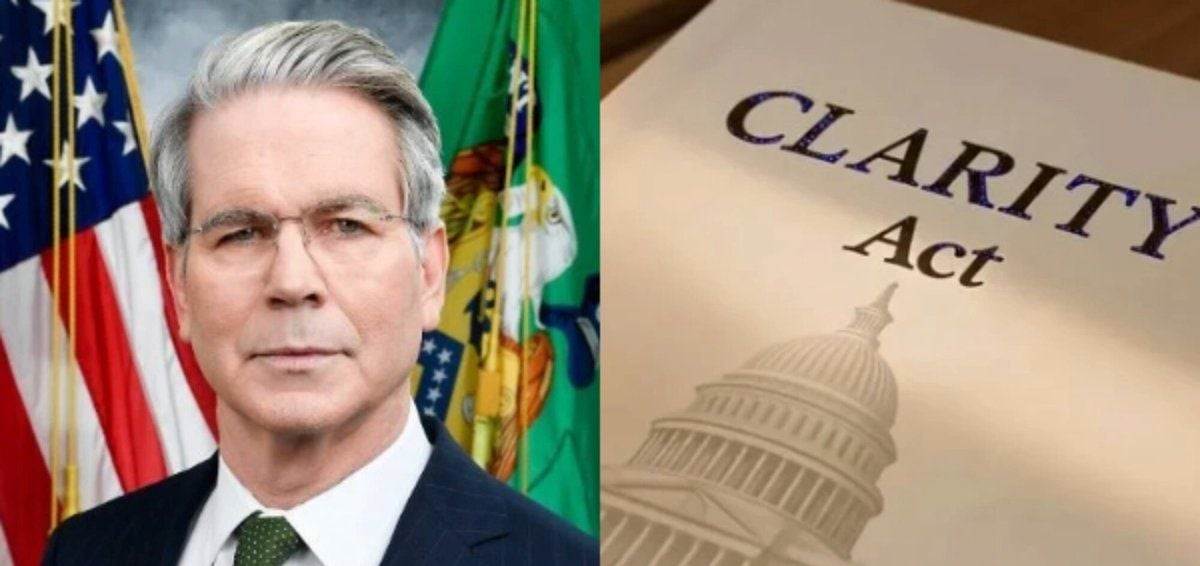
Treasury Secretary promises new powers to protect community banks, CLARITY bill faces key vote
U.S. Treasury Secretary Scott Bessent has promised to use the new intervention powers written into the CLARITY bill if the popularity of stablecoins begins to erode community bank deposits. He endorsed the bill's protections with this public promise days before a key Senate vote.
In a statement supporting the legislation, Bessent said the bill is crucial for the United States to win the global new technology race. He positioned the legislative framework as a national security issue and advocated that the United States should formulate global rules for digital assets rather than passive imports of other countries. He also pointed out that the GENIUS Act, which was passed earlier this year specifically for stablecoins, successfully retained stablecoin infrastructure within the United States.
The banking industry rebounds strongly
Besent's statement comes at a time when opposition from the traditional banking industry is intensifying. Eight U.S. banking groups have urged the Senate to tighten restrictions on stablecoin rewards in the CLARITY Act, arguing that the latest version of the text still leaves room for similar interest payments.
In particular, the banking community has questioned the proposed "circuit breaker" mechanism for deposit losses, arguing that regulators should not wait until there is a substantial loss of bank deposits before taking action. If consumers and businesses are encouraged to move funds from bank deposits into stablecoins that provide interest-like incentives, those funds will no longer support local borrowing in the same way. Much of the money supporting these stablecoins will be invested in government bonds and other reserve assets. If such a migration occurs on a large scale, it could put billions of dollars in borrowing capacity at risk, and small and rural communities will be the first to feel the consequences.
The core of the controversy is that banks are concerned about the impact of deposit losses on lending businesses, while cryptocurrency advocates believe that there is currently no evidence that stablecoin rewards will lead to deposit losses, and legislators have resolved this issue.
Closing debate votes will be held on Tuesday
The CLARITY Act aims to establish a new system of regulatory rules for cryptocurrencies and other digital assets. The bill was passed by the Senate Banking Committee in May, but voting across the house stalled after leaders failed to lock in the 60 votes needed to overcome a filibuster.
Under Senate rules, 60 votes are needed to close the debate. The Republican Party currently holds 53 seats, so even if all Republican lawmakers vote in favor, the bill will still need an additional 7 votes to pass. Two Republican senators, Josh Hawley and Jerry Moran, made clear they would oppose the bill if the text of the bill was not changed to address stablecoin rewards.
The issue of stablecoin yields adds to another major obstacle facing the CLARITY Act: the ethics clause. The terms rely on negotiations with the White House and have not yet been agreed upon. As the voting date for Tuesday's closing debate approaches, the next few days will serve as a test point of whether the administration's assurances about community bank protection are enough to persuade wavering senators to join the support camp.