Exchange Ranking
 Top Exchanges
 24h Volume Ranking
 Popularity Ranking
 Exchange BTC Balance
 Proof of Reserves
 Decentralized Exchanges
 Funding Rate
 Funding Heatmap
 Liquidation Data
 Max Pain
 Long/Short Ratio
 Whale L/S Ratio
 Binance/Okex/Huobi L/S
 Bitfinex Margin L/S
 ETF Tracker
 Solana ETF
 XRP ETF
 Hong Kong ETF
 Bitcoin Treasuries
 Crypto Reversal
 Ethereum Reserves
 HyperLiquid Wallet Analysis
 Hyperliquid Whale Watch
 Large Transactions
 On-chain Movement
 Bitcoin ROI
 Stablecoin Market Cap
 Options Analysis
 News
 Articles
 Economic Calendar
 Features
 Wallet
 Contract Calculator


 Security
 Collections
 Watchlist
 Following
 BTC
 ETH
Kalshi's short-term "non-sports" market becomes an important growth engine for platform revenue
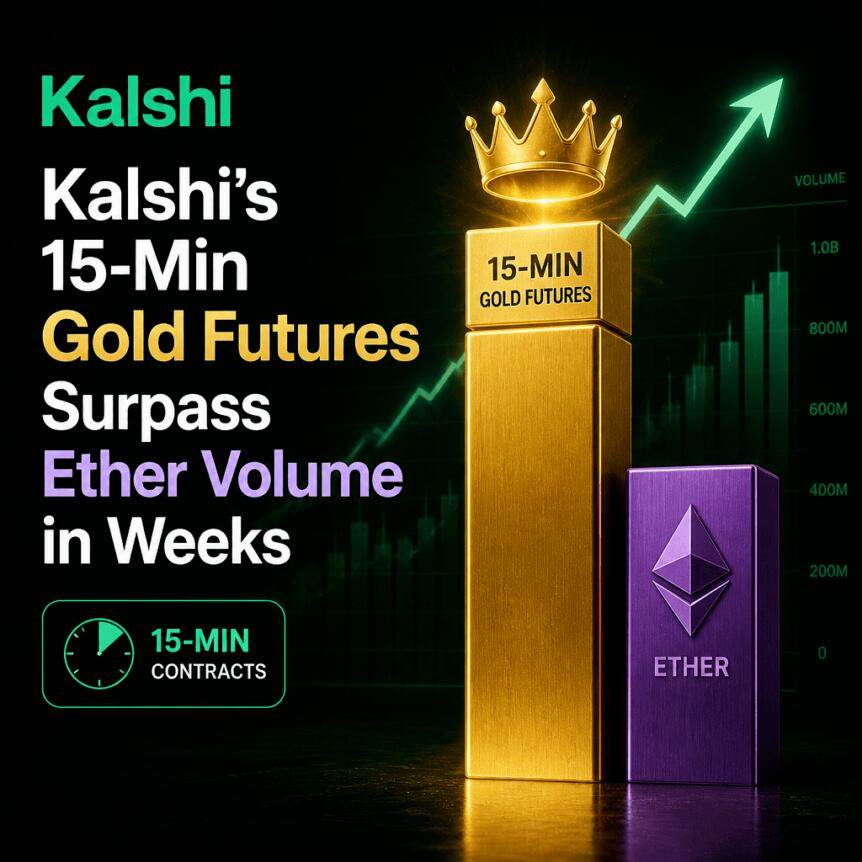
Kalshi's short-term "non-sports" market is gradually becoming an important force driving platform revenue. Its 15-minute gold contract, just weeks after its launch, generated estimated fees that were about twice those in the comparable Ether market. This data highlights the rapid trend of micro-interval trading gaining popularity on prediction platforms.
Key Points
- September Fee Performance: The 15-minute gold contract incurred approximately US$5 million in fees, which is almost double the estimated fee of US$2.6 million for the Ethereum 15-minute contract.
- Bitcoin is still far ahead: Among non-sports markets, Bitcoin ranks first with an estimated fee of US$60.4 million.
- Short-term formats expand rapidly: Gold surpassed Ethereum's 15-minute contracts in September in volume and fee performance, demonstrating the ability of Kalshi's short-term trading model to scale quickly.
InGame's analysis shows that since Kalshi's fee structure is related to contract odds, the 15-minute market's proportion of fee contributions far exceeds its proportion of volume.
Gold rises rapidly in Kalshi's 15-minute product line
The 15-minute gold contract allows traders to bet on whether gold prices will rise or fall over a 15-minute range. According to data from Predict Charts, these contracts, which were launched in August, generated estimated fees of nearly $5 million in September, almost double the amount of Ethereum's data for the same period.
This result is significant because it shows that Kalshi is not just replicating market demand associated with cryptocurrencies. Instead, short-term trading seems to be able to quickly shift to commodity instruments, reshaping the platform's fee rankings. Although Kalshi's cryptocurrency market remains a central part of the overall picture-data shows that the Bitcoin 15-minute market generated much higher fees than other series in September-gold's performance proves that non-cryptocurrency categories can also compete significantly for attention within the same short-term framework.
From launch to scale: The evolution of Ethereum and Bitcoin
Data from Predict Charts shows that after the 15-minute Bitcoin market was first launched in December, it had become Kalshi's largest market series except for cross-border betting by July. The platform's counterpart Ethereum products also grew rapidly in its early stages.
Data shows that the transaction volume of Ethereum 15-minute contracts increased from 6.1 million in January to 233 million in July. By September, Ethereum's transaction volume continued to rise to 318 million units. However, despite this huge increase, gold took a clearer lead in the September results. Predict Charts reported that gold trading volume reached 542 million in September 15 minutes, surpassing Ethereum's 318 million. This pattern suggests that in Kalshi's 15-minute ecosystem, liquidity and engagement can shift rapidly when new asset classes are introduced.
Why short-term driving expenses exceeds transaction volume
短期市场也在扩大其在Kalshi更广泛非体育活动中所占的份额。InGame在周二发布的一项分析中发现,截至10月5日的七天内,15分钟的加密货币、商品和金融市场产生了2040万美元的费用。InGame指出,这占该时期Kalshi非体育费用的80%。
同一分析还揭示了一个更为惊人的不平衡现象:InGame估计,短期市场占Kalshi交易量的13%,却占其费用的20%。换言之,在这些较短的时间间隔内,交易者似乎在每单位成交量上支付了更高的有效费用。
InGame记者Daniel O’Boyle将部分动态归因于Kalshi的费用公式,该公式取决于合约赔率。正如O’Boyle所写,与最大热门或冷门相比,价格接近50/50赔率的合约在费用占成交量的比例上更高。
对于市场参与者而言,这意味着在Kalshi上进行交易的经济效益可能因时间跨度和合约接近平衡概率的程度而异。如果短期工具自然地吸引了许多接近平均赔率的投注,即使没有主导总成交量,它们也能产生更大的费用贡献。
商品动能与Kalshi自身的增长主张相一致
随着Kalshi将其业务从早期以加密货币为主的生态系统扩展出去,黄金重新受到关注。Kalshi在九月表示,商品交易量在七个月内达到4亿美元——是其加密货币市场在同一阶段产生量的四倍多。
Kalshi also believes that the cryptocurrency market demonstrates its potential to expand new categories from tens of millions of dollars to billions of dollars per month. While the company's statements address long-term potential for scale expansion, September's fee comparisons provide early data points consistent with this argument: introducing a new class of assets that short-term transactions can quickly have a disproportionate fee impact.
Despite this, the data also highlights unknown factors that still exist. Fees in the Predict Charts dataset are "estimated" figures, while InGame's analysis focuses on specific windows for the week ending October 5. Traders should view the results as a strong signal rather than conclusive evidence of permanent structural changes in all months and market conditions.
Looking ahead, readers may want to see whether gold's fee and volume advantages persist beyond September, and whether other short-term commodity or financial markets will replicate the same pattern-especially if they attract trading activity at odds close to 50/50, where fees may be structurally higher.