Exchange Ranking
 Top Exchanges
 24h Volume Ranking
 Popularity Ranking
 Exchange BTC Balance
 Proof of Reserves
 Decentralized Exchanges
 Funding Rate
 Funding Heatmap
 Liquidation Data
 Max Pain
 Long/Short Ratio
 Whale L/S Ratio
 Binance/Okex/Huobi L/S
 Bitfinex Margin L/S
 ETF Tracker
 Solana ETF
 XRP ETF
 Hong Kong ETF
 Bitcoin Treasuries
 Crypto Reversal
 Ethereum Reserves
 HyperLiquid Wallet Analysis
 Hyperliquid Whale Watch
 Large Transactions
 On-chain Movement
 Bitcoin ROI
 Stablecoin Market Cap
 Options Analysis
 News
 Articles
 Economic Calendar
 Features
 Wallet
 Contract Calculator


 Security
 Collections
 Watchlist
 Following
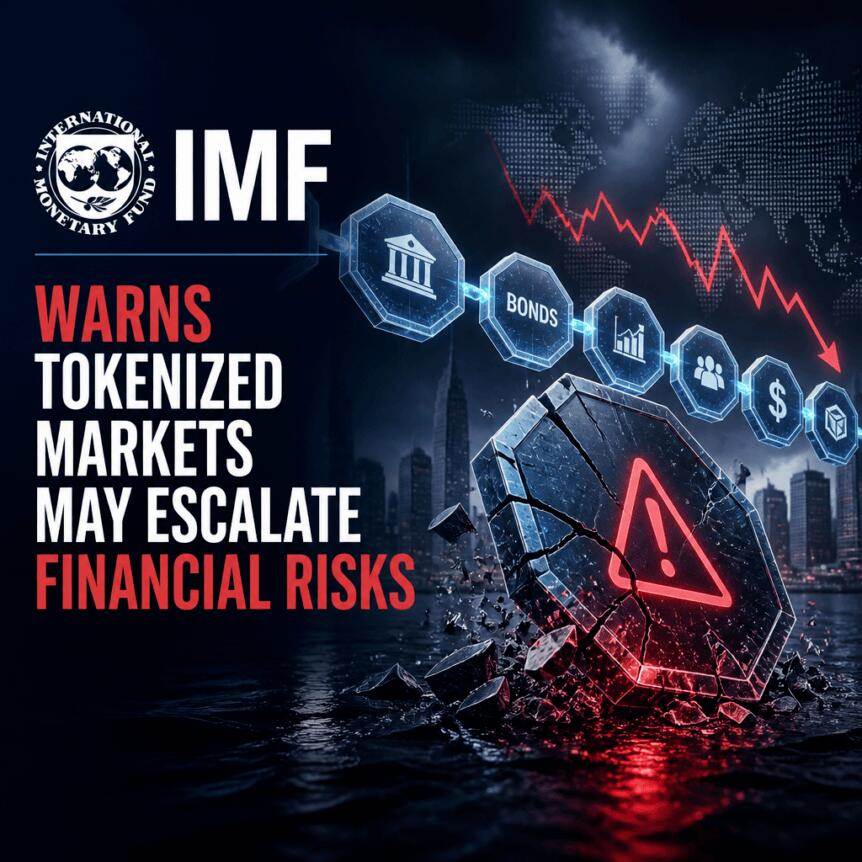
Tokenization is moving from concept to early deployment, but the International Monetary Fund warns that risks may limit its expansion.
Tokenization is rapidly moving from the concept stage to early deployment, but the latest analysis from the International Monetary Fund (IMF) points out that legal uncertainties and financial stability risks may still restrict further expansion of the tokenization market.
The IMF said in a blog post posted on Thursday that the tokenized financial market is growing rapidly from a small base. The report also highlights persistent structural obstacles-particularly poor interoperability and the lack of widely recognized clearing assets-that make the current scale of tokenization much smaller than the size of traditional capital markets.
Summary of Core Views
- The scale of tokenized transactions is much smaller than in traditional markets: The average daily transaction volume of tokenized repo agreements (Repos) is approximately US$300 billion to US$350 billion, while the average daily transaction volume of the broader U.S. repo market is approximately US$13 trillion.
- High value concentration: In addition to stablecoins, tokenized value is mainly concentrated in credit products and money market funds. As of July, tokenized real-world assets (RWAs) totaled approximately US$65 billion, accounting for only a small portion of global capital market assets.
- Liquidity and Volatility Challenges: While tokenized stocks may provide useful "after-hours" price signals, IMF reports show that tokenized stocks are less liquid and achieve higher volatility than traditional stocks.
- Systemic risk amplification effect: As the tokenized market becomes increasingly connected to the traditional financial system, leverage ratios and interdependence may amplify systemic risks. Although the risk is still controllable due to the low adoption rate, this situation may change quickly.
- Regulatory Call: The IMF urges clearer legal and regulatory frameworks, improved interoperability, and the establishment of safeguards to prevent vulnerabilities from expanding as adoption rates increase.
The scale of tokenization is still limited, but the signs of activity are thought-provoking
For investors and market participants, a core question is: Can the tokenization market grow beyond niche activities? The IMF views tokenization as a potentially transformative shift-a promise of more efficient market transactions and settlements-but also warns that the current ecosystem remains incomplete.
According to IMF data, tokenized repurchase agreements dominate tokenized trading activity. The average average daily transaction volume of tokenized repo is US$300 billion to US$350 billion. In comparison, the broader U.S. repo market has an average daily trading volume of approximately $13 trillion. This comparison highlights the gap between the momentum of tokenization and the overall size of traditional market infrastructure.
When the IMF looked beyond repo agreements and stablecoins, it found that the value of tokenized assets was concentrated in areas closely related to short-term cash management and credit exposure. As of July, the outstanding value of tokenized real-world assets (RWAs) was approximately US$65 billion. The IMF describes it as a small fraction of the world's approximately $300 trillion in capital market assets.
Of the $65 billion, the IMF cited the following composition: tokenized credit accounted for $30.4 billion, money market funds totaled $17.5 billion, and tokenized stocks accounted for about $2.3 billion. This suggests that tokenization has so far been adopted mainly where existing tools are already well suited for programmable settlements and predictable cash flows.
Tokenized stocks have attracted attention due to round-the-clock trading, but liquidity and volatility remain concerns
Although the tokenized stocks sector is relatively small in absolute size, the IMF points out that it has attracted attention because it supports round-the-clock trading and fragmented ownership.
The report found that more than half of all tokenized stock transactions occurred outside regular U.S. stock trading hours. Analysis also showed that approximately 80% of transactions involved less than one share. The data suggests that the market attracts participants seeking execution flexibility and smaller position sizes-characteristics that may not be readily satisfied in the hourly hours and stock-based trading practices of traditional exchanges.
关键在于,IMF报告称,代币化股票的隔夜价格变动在市场重新开放后不久便出现在传统股票价格中。IMF认为,这种模式表明代币化场所可能在常规交易窗口之外生成价格信号。对于交易员和市场结构分析师来说,如果代币化交易变得更加普遍,参考定价和订单流将如何演变,这提出了实际的问题。
然而,IMF在执行质量方面的态度谨慎。分析指出,代币化股票的流动性显著较低,其实现波动性约为传统对应物的1.5倍。IMF警告称,如果代币化市场继续扩张,更大的互联性和潜在的杠杆作用可能会放大传统的金融风险——如抛售潮、流动性挤兑和传染效应。
目前,IMF指出系统性风险看似有限,这在很大程度上是因为采用率仍然相对较小。但它警告称,随着更多参与者、产品和交易关系转移到代币化轨道上,风险状况可能会迅速变化。
为何监管机构聚焦于互操作性和法律清晰度
IMF认为,技术本身并不能决定代币化的轨迹。即使结算自动化在技术上可行,报告也指出,市场的增长取决于参与者是否能够依靠一致的规则、兼容的系统以及安全的结算资产。
在该分析中,两个反复出现的摩擦点尤为突出:代币化系统与传统系统之间的互操作性差,以及缺乏广泛认可的结算资产。IMF暗示,如果不解决这些问题,代币化可能会保持碎片化状态——在孤立的生态系统中更有用,而非作为广泛整合的市场基础设施。
IMF呼吁建立更清晰的法律和监管框架,改善互操作性,并针对新兴脆弱性建立保障措施。目标不仅是促进增长,还要防止监督或基础设施的漏洞在压力事件中演变为不稳定性。
这并非IMF首次涉足代币化风险领域。在2025年11月,该机构曾警告称,自动化交易和相互连接的智能合约可能会加剧市场波动性和闪崩动态。今年4月,它警告称更快的结算速度可能会加速金融压力,此前它还强调了源于平台碎片化和监管协调不足的潜在系统性风险。
欧洲监管机构对通过代币化链接产生的传染风险表示担忧
IMF的关切与非华盛顿地区的监管审查相一致。报告还引用了欧洲证券和市场管理局(ESMA)发出的警告,指出加密货币与传统金融之间日益增长的联系——包括通过代币化股票——可能会增加金融冲击跨市场传播的风险。
This regulatory stance reflects a broader tension: tokenization can make settlements faster and transactions more continuous, but these characteristics can also change how stress spreads when liquidity becomes thin or leverage builds up. If tokenized markets are closely connected to traditional trading venues, regulators may focus on how losses, margin calls and liquidity needs flow between platforms during the downturn.
The IMF authors conclude that the future of tokenization depends more on policy decisions that ensure market depth, trust and strong safeguards than on purely technical possibilities.
Conclusion
For readers who are closely following tokenization, the key question is whether the industry can move from isolated growth to standardized, interoperable market infrastructure without introducing new vulnerabilities. The IMF's warning suggests that the next phase may no longer be focused on introducing more tokenized products, but on proving that the legal framework, clearing assets and risk controls can keep pace with adoption.