Exchange Ranking
 Top Exchanges
 24h Volume Ranking
 Popularity Ranking
 Exchange BTC Balance
 Proof of Reserves
 Decentralized Exchanges
 Funding Rate
 Funding Heatmap
 Liquidation Data
 Max Pain
 Long/Short Ratio
 Whale L/S Ratio
 Binance/Okex/Huobi L/S
 Bitfinex Margin L/S
 ETF Tracker
 Solana ETF
 XRP ETF
 Hong Kong ETF
 Bitcoin Treasuries
 Crypto Reversal
 Ethereum Reserves
 HyperLiquid Wallet Analysis
 Hyperliquid Whale Watch
 Large Transactions
 On-chain Movement
 Bitcoin ROI
 Stablecoin Market Cap
 Options Analysis
 News
 Articles
 Economic Calendar
 Features
 Wallet
 Contract Calculator


 Security
 Collections
 Watchlist
 Following
 BTC
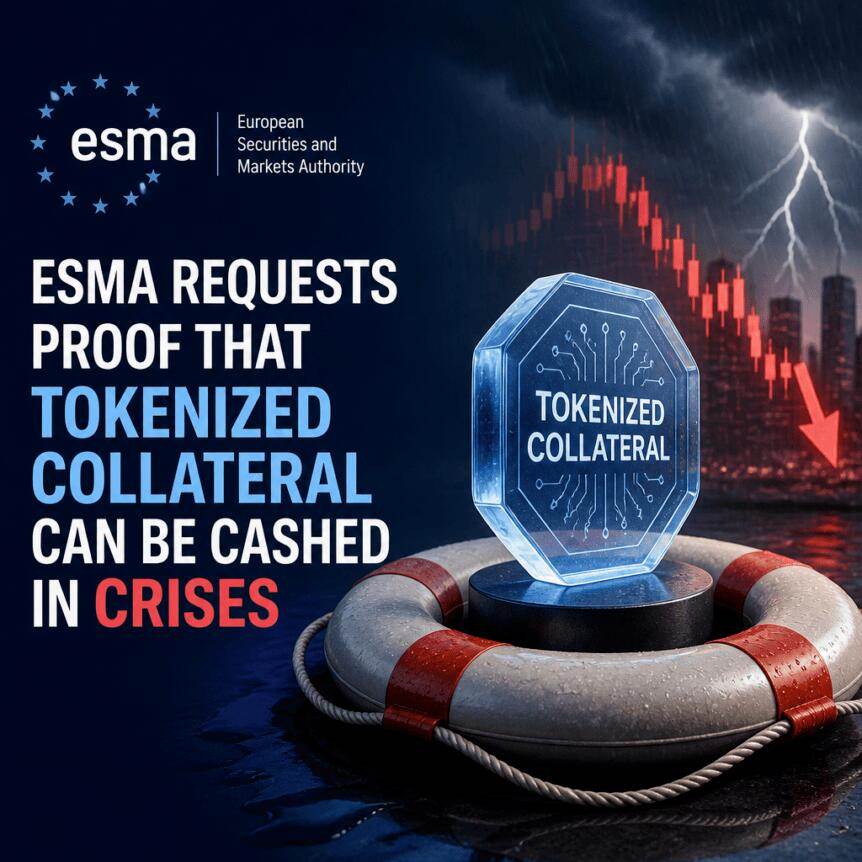
European financial market regulators require proof of whether clearing houses can quickly liquidate tokenized collateral under market pressure
The European Securities and Markets Authority (ESMA) is questioning industry participants to demonstrate that central clearing houses can access and dispose of tokenized collateral in the face of market pressure. ESMA recently released a "collection of evidence" on the use of tokenized collateral in central clearing, focusing on whether the current rule system and operating arrangements are robust enough when clearing members default.
In the initiative, ESMA Chairperson Verena Ross said the goal is to ensure that the tokenized market can operate safely and on a cross-border scale, with legal certainty, interoperability infrastructure and effective regulation. The collection of evidence released this week aims to gather practical feedback from market participants so that ESMA has a more solid basis before reaching further conclusions on how to regulate tokenized assets within the EU clearing framework.
Core Points
- Access and Liquidity: ESMA is gathering evidence to confirm whether the clearing house can access tokenized collateral and quickly convert it into cash in the event of a clearing member default.
- Coverage is extensive: This consultation covers tokenized representation forms of traditional assets, as well as assets issued directly on distributed ledger technology (DLT).
- Liquidity friction risk: ESMA指出,即使基础资产通常具有高流动性,特定的代币赎回程序或转账限制仍可能导致流动性摩擦。
- 法律与操作权属问题: 监管机构正在审视当资产以代币形式转移时,关于所有权和可执行权利的法律及操作问题。
- 与欧盟基础设施发展的关联: ESMA的审查与更广泛的欧盟基础设施建设紧密相连,包括“庞特斯”(Pontes)系统。该系统旨在利用央行数字货币实现代币化交易的结算。
为何ESMA需要“实证”而非仅靠“承诺”
随着银行和投资者寻求更快、更灵活的方式来满足保证金要求,代币化抵押品正逐渐从试点阶段迈向实际的清算操作。ESMA的证据征集聚焦于中央清算所面临的实际挑战:当市场剧烈波动且会员发生违约时,抵押品必须能够以可预测、合法合规的方式被获取并处置。
因此,ESMA的审查旨在弥合“代币化”操作能力与清算所应急要求之间的差距。现有的欧盟规则可能未能完全解决存在于分布式账本环境中的抵押品访问机制、变现时机以及法律执行力等问题——这些问题同样适用于代表其他持有资产的代币。
According to ESMA, the evidence gathering will help determine whether the existing framework can ensure that clearing houses access tokenized collateral and convert it into cash under stressful conditions.
Models and risks being examined by ESMA
This consultation goes beyond the limits of the single tokenized collateral definition. It involves not only tokenization of assets that remain in traditional financial infrastructure, but also assets issued directly on distributed ledgers. ESMA also hinted that it will consider the interactions of these structures with stablecoins, central bank digital currencies, and tokenized deposits.
Liquidity is the core theme. ESMA pointed out that assets that are liquid in traditional forms may face additional risks once tokenized. These risks include potential delays due to redemption processes or limited transfers of tokenized instruments in emergency response to margin calls or default management.
ESMA also raises a legal question with direct operational consequences: When contemporary coins are transferred, do those transfers actually confer ownership-or at least enforceable rights-on the underlying assets? For clearing houses operating under default procedures, the answer determines whether collateral can be relied on reliably and acted on quickly, rather than being questioned or stalled.
Eurex's DLT collateral service and real-time testing environment
The call comes as at least one EU clearing entity is moving towards collateral mobilization that enables distributed ledger technology (DLT). In July 2025, Eurex Clearing launched a collateral service based on distributed ledger technology, describing it as the world's first such collateral mobilization service linked to a central clearing house.
The launch also includes a real-life transaction executed for Dutch pension investor PGGM. In this transaction, securities are transferred from another custody location-which demonstrates how tokenized collateral arrangements rely on cross-custody transfer and settlement paths rather than just internal book balances.
These "real system" examples are crucial to ESMA because they raise specific questions about time, legal validity and access rights. Although tokenization simplifies certain steps, it also introduces new links. If the tokenization layer is not fully aligned with the clearing house's default process, it may cause liquidity to slow or collateral rights to become blurred.
The Pontes system and the broader drive for tokenized settlements
ESMA's consultation is also placed in the larger EU infrastructure context. Following the Eurosystem's launch in September of Pontes, which aims to use central bank digital currency to settle tokenized asset trading systems, ESMA said Pontes could support tokenized collateral arrangements by connecting blockchain-based infrastructure to existing settlement systems.
这种联系对市场参与者具有重要意义,因为央行数字货币结算通常被视为最终性和结算完整性的基准。如果基于区块链的代币化层能够与既定的央行数字货币结算轨道互操作,它可能会减少监管机构担忧的、可能破坏压力时期变现能力的部分结算和访问风险。
尽管如此,ESMA强调在会员违约期间的访问权和流动性表明,即使改善了结算基础设施,抵押品安排仍需证明清算所能够控制代币化资产,迅速将其转换为现金,并在无摩擦的情况下依靠可执行的权利。
读者应密切关注ESMA如何将证据征集的主题转化为具体的监管预期。目前的关键不确定性在于:现有法律框架是否足以涵盖代币化抵押品时的所有权和执行性问题;以及操作流程——包括赎回、转账许可和变现机制——是否能够满足中央清算的时间紧迫需求。