Exchange Ranking
 Top Exchanges
 24h Volume Ranking
 Popularity Ranking
 Exchange BTC Balance
 Proof of Reserves
 Decentralized Exchanges
 Funding Rate
 Funding Heatmap
 Liquidation Data
 Max Pain
 Long/Short Ratio
 Whale L/S Ratio
 Binance/Okex/Huobi L/S
 Bitfinex Margin L/S
 ETF Tracker
 Solana ETF
 XRP ETF
 Hong Kong ETF
 Bitcoin Treasuries
 Crypto Reversal
 Ethereum Reserves
 HyperLiquid Wallet Analysis
 Hyperliquid Whale Watch
 Large Transactions
 On-chain Movement
 Bitcoin ROI
 Stablecoin Market Cap
 Options Analysis
 News
 Articles
 Economic Calendar
 Features
 Wallet
 Contract Calculator


 Security
 Collections
 Watchlist
 Following
 XRP
Key Facts
According to a report released by Xrpl.org, a researcher reported a payment engine vulnerability through the XRPL Bug Bounty program on September 22. The vulnerability had made it possible for attackers to forge expendable XRP out of thin air.
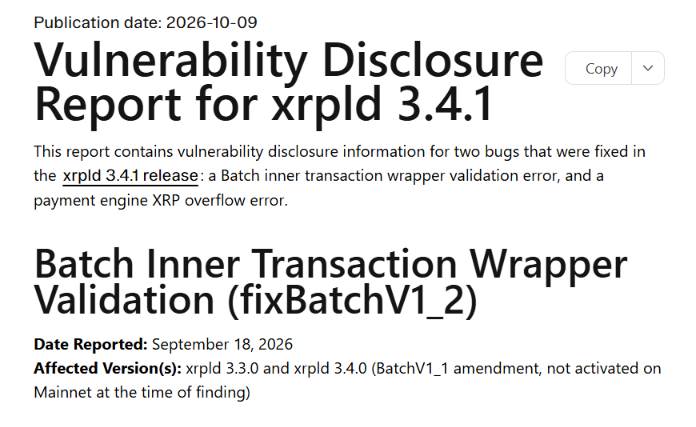
This flaw is believed to have existed in the code since the payment engine was written in 2015. The report shows that there is currently no evidence that the vulnerability has been exploited on public networks. It was discovered through the XRPL Vulnerability Bounty Program and was fixed with the release of xrpld 3.4.1 in September.
How a 64-bit overflow leads to the casting of free XRP
This vulnerability lies in the way the payment engine calculates the amount due when consuming multiple orderbook quotes at once. XRP balances are stored as 64-bit integers with a fixed upper limit, and the engine's addition operations lack overflow checking.
If a transaction is routed through enough mispriced quotes, the total may exceed the limit and wrap around to a very small number. At this point, the engine will be paid in full to each quote owner, but only the buyer will be charged this minimal sum, creating an XRP that should not exist.
The report states that two existing security measures failed to detect this issue. The ledger's own invariant check was designed to confirm that no transactions created the XRP, but it used the same unchecked arithmetic to sum the balance changes, which also occurred; while a separate check on a single account balance was not triggered because the minted XRP can be spread across hundreds of accounts.
This utilization does not require a large amount of start-up capital, only a few hundred XRP as a reserve fund (refunded after removing the relevant objects), and a small amount of transaction fees.
Why XRPL skipped its own amendment process
Normally, changes to the way XRP Ledger processes transactions will only take effect two weeks after the validator supports an amendment under the network consensus mechanism, so that all servers can switch at the same time. This fix skips this process and takes effect immediately after each server upgrade.
"We judged that given the limited risks, a short upgrade window is far safer than weeks of publicly known and open vulnerability status." The report wrote in explaining the decision to release the fix immediately rather than waiting for a vote.
RippleX Engineering recreated the vulnerability on a separate server, confirmed that the minted XRP was expendable, and raised the severity of the discovery from "significant" to "serious." As of September 25 (the day of release), more than 80% of default UNL validators have upgraded to xrpld 3.4.1.
Thereport attributed the discovery to Cayden Liao and Veria AI, and said the flaw may have gone unnoticed for about a decade because ordinary payments rarely trigger 64-bit overflows.