Exchange Ranking
 Top Exchanges
 24h Volume Ranking
 Popularity Ranking
 Exchange BTC Balance
 Proof of Reserves
 Decentralized Exchanges
 Funding Rate
 Funding Heatmap
 Liquidation Data
 Max Pain
 Long/Short Ratio
 Whale L/S Ratio
 Binance/Okex/Huobi L/S
 Bitfinex Margin L/S
 ETF Tracker
 Solana ETF
 XRP ETF
 Hong Kong ETF
 Bitcoin Treasuries
 Crypto Reversal
 Ethereum Reserves
 HyperLiquid Wallet Analysis
 Hyperliquid Whale Watch
 Large Transactions
 On-chain Movement
 Bitcoin ROI
 Stablecoin Market Cap
 Options Analysis
 News
 Articles
 Economic Calendar
 Features
 Wallet
 Contract Calculator


 Security
 Collections
 Watchlist
 Following
 XRP
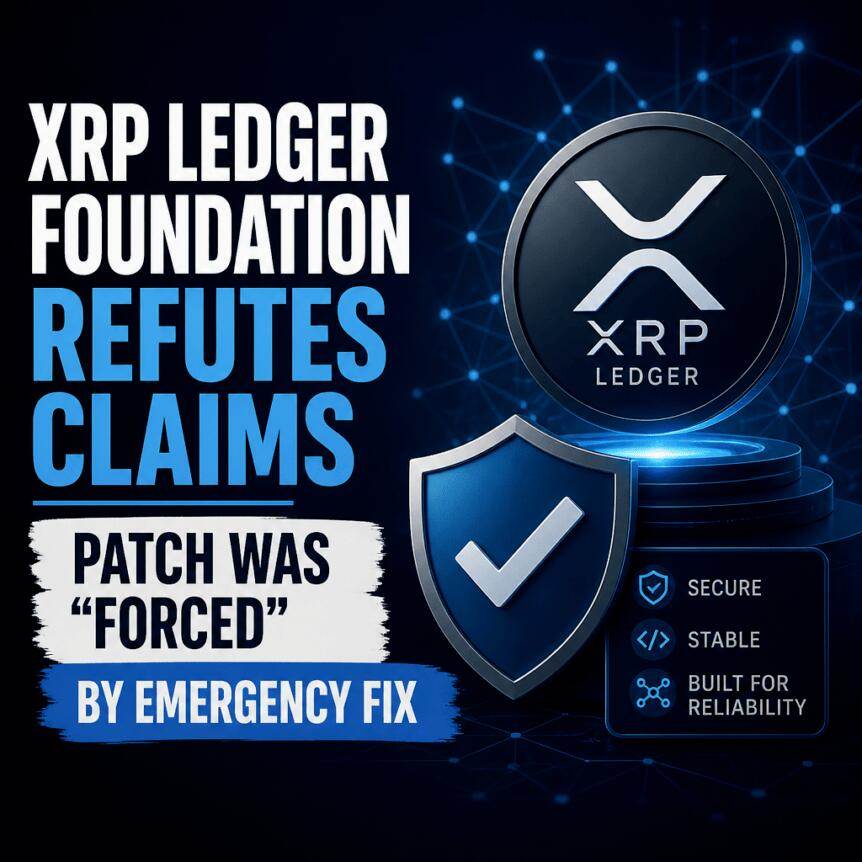
XRPL emergency security patch bypasses regular voting mechanisms and sparks decentralization controversy
XRPL developers say they are forced to deploy emergency security patches in a way that bypasses the network's usual amendment voting. The move came after the discovery of a vulnerability that could allow an attacker to forge expendable XRP in excess of the ledger's fixed supply. The fix was released on September 25 and took effect immediately on operators that installed it after the vulnerability bounty was disclosed earlier this week.
In an article posted on X (formerly Twitter) on Sunday, XRPL developers argued that waiting for the standard two-week validator vote would leave the vulnerability exposed for weeks-giving potential attackers time to test and weaponize the vulnerability. However, this acceleration approach has reignited debate about how decentralized XRPL is truly and whether operators should view collaborative upgrades as evidence of centralized control.
Core Points
- An emergency patch dated September 25 addressed an integer overflow problem in the XRPL payment engine, which, under artificial construction, could create a more expendable XRP than a fixed supply.
- XRPL developers said they skipped the normal two-week amendment vote because if standard procedures were followed, the vulnerability would become known to the public within weeks of the disclosure of public information.
- The XRPL Foundation and contributors stated that emergency decisions were made by multiple parties, while emphasizing that verifiers and node operators still can choose which software to run.
- Critics have questioned the degree of decentralization of XRPL after accelerated release; at least one independent verifier operator refuted the claim that coordination equals centralized control.
Why emergency patches skip validator votes
According to XRPL developers, the network's normal amendment process delays remediation, which is enough to significantly increase the risk. They point out that standard amendments become visible before they take effect, which means that once details are made public, attackers could use extra time to develop exploit tools.
In their X post, they described the September 25 release as deliberately bypassing the regular process of adopting protocol changes. Developers said any server that installs the fix will take effect immediately, marking the first time that the process has been deliberately circumvented since the amendment system was introduced more than a decade ago.
In response to concerns about decentralization, the XRPL Foundation explained that no single entity can unilaterally decide to rush ahead with changes. In the foundation's narrative, the decision to bypass the normal amendment path was made collectively by the foundation, RippleX, core developers and validators after assessing the severity of the vulnerability.
TheFoundation also emphasized that agreement changes still rely on the amendment mechanism. They pointed out that version 3.4.1 became required only two weeks after voting on a standard amendment that received support from more than 80% of validators, and skipping the process only applies to this emergency fix.
Decentralization debate resumes after "synergy" upgrade
This accelerated approach has attracted sharp criticism, with some arguing that XRP Ledger's governance model and the way it communicates to the public may be inconsistent with claims of decentralization.
CyberCapital founder Justin Bons said marketing XRP as a decentralized asset to retail investors constitutes "naked fraud" in part because the September 25 release reportedly provided only binaries, the source code was temporarily withheld, and operators were under pressure to upgrade.
Supporters of XRPL refute this, arguing against its implicit meaning: that coordinated action by entities within the ecosystem necessarily implies centralized control. The XRPL Foundation argues that collaboration does not mean control, reiterating that verifiers and node operators retain autonomy over their software running.
Independent verifier operator XRP Kuwait also rejected the idea that collaborative updates signal centralized control. In its statement, it argued that multiple independent operators could assess the security situation, communicate with each other, and reach a shared response without having to relinquish independence.
The core tension of the controversy is obvious: Emergency security measures may require rapid, coordinated action, but this speed may appear from the outside as centralized governance. XRPL developers and foundations seem to see this as a necessary security option, while critics say it shows decentralization in practice is more limited than in propaganda.
Analysis of vulnerability nature and exploitation methods
According to relevant reports on XRPL in the materials provided, the vulnerability disclosure report traced the error back to 2015 and characterized it as an integer overflow in the XRP Ledger payment engine.
XRPL stores the balance with the maximum value as a fixed 64-bit integer. The flaw is described as occurring when the sum exceeds this maximum value: the calculation does not fail safely, but instead wraps around to a smaller value.
The attack methods outlined in thereport rely on deliberately constructed conditions. An attacker can set up hundreds of quotations with special pricing, each requesting a large number of XRPs. After creating these quotations, the attacker will send a single payment that consumes them.
Under these artificially constructed conditions, the engine credits the full amount to each quote owner, but only charges the buyer a small amount of wrap around. The difference is then expressed as a newly created, expendable XRP.
Crucially, disclosures stated that the attack required deliberate construction of quotations and could not be triggered by ordinary trading activity. Developers involved in the remediation also said they had found no evidence that the issue had been exploited on public networks.
What should operators and users focus on next
While the immediate issue is whether XRPL's emergency response is necessary and handled properly, the longer-term issue is how to interpret future governance decisions-especially when security exigencies conflict with the standard amendment timeline. Readers should focus on further clarifications about the emergency process, including how transparency is balanced with risk and whether future fixes continue to follow a similar script.