
 Exchange Ranking
 Top Exchanges
 24h Volume Ranking
 Popularity Ranking
 Exchange BTC Balance
 Proof of Reserves
 Decentralized Exchanges
 Funding Rate
 Funding Heatmap
 Liquidation Data
 Max Pain
 Long/Short Ratio
 Whale L/S Ratio
 Binance/Okex/Huobi L/S
 Bitfinex Margin L/S
 ETF Tracker
 Solana ETF
 XRP ETF
 Hong Kong ETF
 Bitcoin Treasuries
 Crypto Reversal
 Ethereum Reserves
 HyperLiquid Wallet Analysis
 Hyperliquid Whale Watch
 Large Transactions
 On-chain Movement
 Bitcoin ROI
 Stablecoin Market Cap
 Options Analysis
 News
News Articles
 Economic Calendar
 Features
 Wallet
 Contract Calculator


 Security
 Collections
 Watchlist
 Following
 ADA
ADA  ETH
ETH  SOL
SOL Cardano ADA News: 2026 ecosystem upgrades shape ADA price structure
Cardano ADA News today reported on the latest detailed announcement of the Dijkstra upgrade, as well as a governance tool called CIP-179, which could change the way proposals are formed. Meanwhile, founder Charles Hoskinson commented on the private DeFi bridge built through Midnight. Together, the two signal a busy period for the ADA ecosystem in 2026.
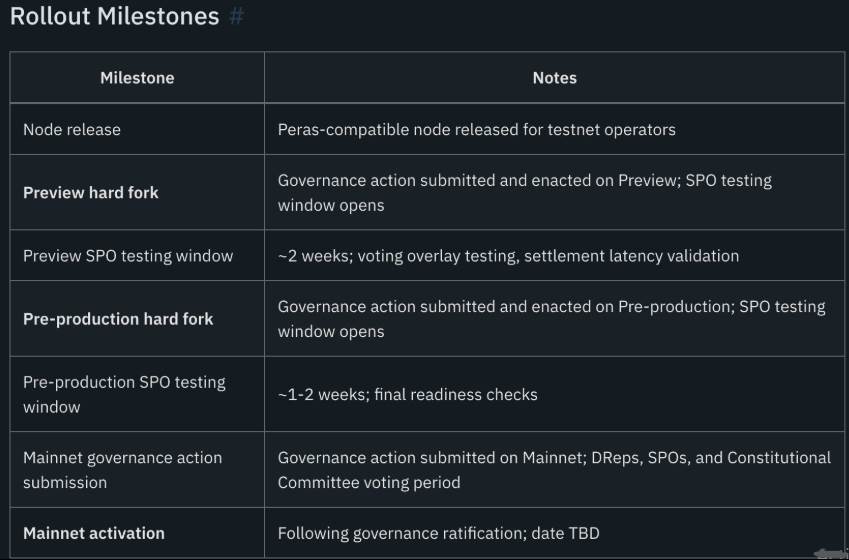
Source: Official hard fork plan
Following updates, Cardano ADA prices today are around $0.175, down 1.32% in the past 24 hours, as the network prepares for one of its biggest technological changes.
Cardano ADA News: How the Dijkstra upgrade is divided into two phases
Cardano Dijkstra upgrade will be divided into two separate phases, which are listed in Cardano's public roadmap. The goal of the first phase is to complete the code in the fourth quarter of 2026. The core is Ouroboros Linear Leios (tracking number CIP-164), which processes more transactions simultaneously by adding supplementary endorsement blocks. The first phase also bundles a number of smaller practical upgrades: CIP-118: Nested transactions, allowing applications to pay for network fees for users;CIP-112: Guardian scripts, which separate verification logic and previously required coins to run;CIP-159: Improved account addresses;CIP-181: Streamlined pledge reward withdrawal.
The second phase will be implemented in the second quarter of 2027. It introduces Ouroboros Peras (numbered CIP-140). Peras has added a pledge pool voting layer designed to speed up settlement and address the ultimate delay issue that has plagued the ADA blockchain since its early design.
Both phases follow the same deployment path before touching the main network: first, compatible nodes are released to the test network operator; then, governance voting is held on the Preview network; then, a two-week test window is held; the same steps are repeated on the Pre-production network, but the test time is shortened to one to two weeks. Afterwards, a final governance vote was held on the main website for DReps, pledge pool operators and the Constitutional Council. It can be activated after the vote is passed.
According to the 2026 Cardano Roadmap, the Preview hard fork is the first real milestone as it marks the first real-time governance test of the ADA Network 2026 upgrade cycle.
CIP-179 introduces on-chain surveys and polls for Cardano governance voting
Governance is also escalating and is directly related to all of the above. Cardano CIP-179 introduces an on-chain system for structured surveys and polls, stored under metadata tag 17. It supports ranking selection, priority allocation, numerical ranges, and parallel comparisons, rather than just a simple "yes/no" vote. DRep Will Norris explained its importance, noting that Cardano governance has long lacked a real step from idea to formal proposal. In the current setting, a concept often jumps directly from discussion to written proposal to submission for a vote without a clear understanding in advance of the true intentions of the broader community. CIP-179 fills this gap and is now online. It uses client-side counting, supports open and sealed response options, and tools such as Tessera are already in use. The idea is to serve as a coordination layer before formal governance: raise topics, collect structured preferences, refine proposals, and then conduct formal voting under the existing CIP-1694 framework.
Cardano ADA prices remain around US$0.17, upgrade news brings momentum
Today's Cardano ADA news did not talk about growth, but token prices fell instead. According to the latest data from CoinMarketCap, as of August 17, 2026, the ADA price snapshot is as follows:
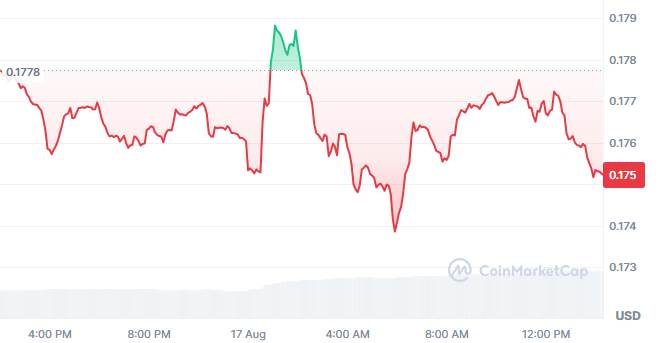
Price: US$0.175, down 1.32% in 24 hours
Market value: US$6.44 billion, down 0.03%
24-hour trading volume: US$187.5 million, up 69.79%
Fully diluted valuation: US$7.95 billion
Supply in circulation: 36.55 billion ADA, maximum supply of 45 billion
Daily trading volumes surge while prices are almost flat, often indicating that the market is laying around news rather than a clear trend direction. ADA is currently ranked 15th on CoinMarketCap by market capitalisation and has maintained this position in range swings this year.
Charles Hoskinson outlines the Cardano Privacy Layer Cross-Chain Initiative
Charles Hoskinson, founder of Cardano, presented another perspective in a recent discussion, describing a path to building private decentralized finance through Midnight, the ADA network-specific privacy sidechain. Under this model, ADA is locked in Cardano smart contracts and generates private stablecoins through Midnight. These protected assets can then be transferred to other ecosystems, including Ethereum, Solana and Hyperliquid, without exposing the original transaction trajectory. This is the clearest public description to date of how Cardano's privacy layers are connected outward rather than limited to a single chain.
This is in line with a broader view currently circulating on the Internet: stable, multi-year infrastructure work is often less eye-catching than new projects that launch new tokens, even if these underlying upgrades solve real bottlenecks.
The outlook for Cardano ADA news
A post shared by a DRep illustrates this well. Dijkstra is the first upgrade to address both speed and final issues, while also coming with a batch of CIP designed to improve the developer and user experience. A white paper for a new project can be written in just a few weeks. Updates like Leios and Peras take years to build and are difficult to reverse once online, which is one reason why testnet operations and governance approval are required before each stage. So what will happen next? The first phase of code should be completed by the end of 2026, followed by test network inspection and main network voting. The second phase (including Peras) is about six months later. During this period, CIP-179 provides DReps and pledge pool operators with a real-time way to shape a vote before it takes place, rather than react afterwards. Dijkstra was not a single event, but a series of test-net checkpoints, voting and code mergers that lasted for approximately eighteen months. The real test won't first appear on the price chart, but will be whether DReps and pledge pool operators will actually use CIP-179 to shape Peras before the official vote.
Disclaimer : This article is for information purposes only and does not constitute financial or investment advice. There are significant risks in the cryptocurrency market. Before making any investment decisions, be sure to study for yourself.
























