Exchange Ranking
 Top Exchanges
 24h Volume Ranking
 Popularity Ranking
 Exchange BTC Balance
 Proof of Reserves
 Decentralized Exchanges
 Funding Rate
 Funding Heatmap
 Liquidation Data
 Max Pain
 Long/Short Ratio
 Whale L/S Ratio
 Binance/Okex/Huobi L/S
 Bitfinex Margin L/S
 ETF Tracker
 Solana ETF
 XRP ETF
 Hong Kong ETF
 Bitcoin Treasuries
 Crypto Reversal
 Ethereum Reserves
 HyperLiquid Wallet Analysis
 Hyperliquid Whale Watch
 Large Transactions
 On-chain Movement
 Bitcoin ROI
 Stablecoin Market Cap
 Options Analysis
 News
News Articles
 Economic Calendar
 Features
 Wallet
 Contract Calculator


 Security
 Collections
 Watchlist
 Following
 USD1
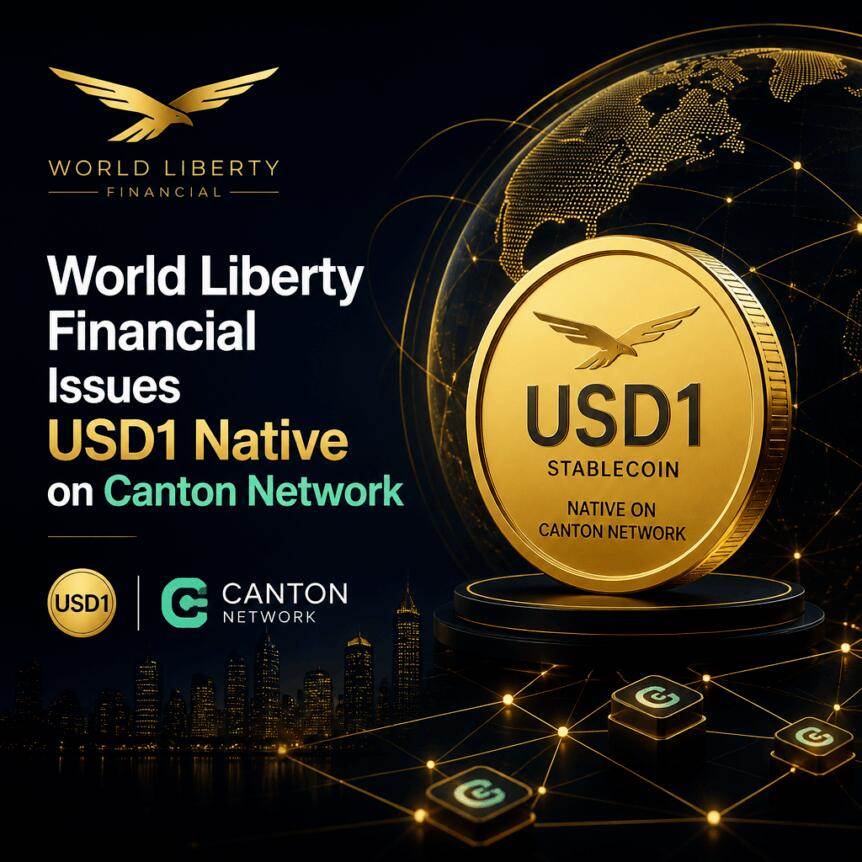
USD1 World Liberty Financial launches USD1 stablecoin on Canton Network
World Liberty Financial has launched its USD1 stablecoin on Canton Network. Canton Network is a blockchain built specifically for large financial institutions. The move presents the multibillion-dollar token, anchored in the dollar, to banks and asset management companies that use the Canton network to transfer tokenized real-world assets.
A stablecoin is a cryptocurrency designed to maintain a stable value, usually anchored at 1 dollar. World Liberty Financial stated in an announcement on August 25, 2026 that USD1 is now available on the Canton network and is natively distributed on the network.
"Native issuance" means that the token is created directly on the Canton network, rather than transferred from other chains through cross-chain bridges. This is critical because it allows institutions to use USD1 as a built-in settlement option when introducing tokenized real-world assets to the network.
This is straightforward news for cryptocurrency readers: A well-known stablecoin is expanding into a network that explicitly targets traditional finance. For a project that is already running on another chain, reaching institutional users is a bigger goal.
Why the Canton Network is Critical to USD1
The Canton Network is a blockchain designed specifically for regulated financial companies that require privacy and data control. It is used to issue and transfer tokenized assets, traditional assets such as treasury bonds that are presented in the form of digital tokens.
World Liberty said more than $9 trillion worth of tokenized assets are issued or processed on Canton each month, and more than $350 billion of on-chain U.S. Treasury bonds flow on the network every day. These numbers show the huge scale of activities that USD1 is now connected to.
Canton Networks originally announced the deployment plan on December 16, 2025, describing the same institutional application scenario before the token went online. This week's official launch turns this plan into reality.
On the Canton network, USD1 can be used to support derivatives and institutional lending, enable round-the-clock cross-border payment settlement, and fund the issuance and redemption of assets on the chain. In short, it provides large financial participants with a dollar token that allows them to transfer funds instantly on any given day.
Current Size of USD1
World Liberty said that since its launch in March 2025, USD1 has more than US$4 billion in circulation. The token is issued by BitGo Bank & Trust, the National Association, a federally chartered trust supervised by the Office of the Comptroller of the Currency.
This regulatory endorsement is crucial for stablecoins. World Liberty said that USD1 's reserve assets include short-term U.S. Treasury bonds, U.S. government money market funds, U.S. dollar deposits and other cash equivalents, so each token is backed by safe assets.
According to data from DefiLlama, the market value of USD1 is approximately US$4.046 billion, confirming claims that the stablecoin has reached billions of dollars. Public data also confirms this scale. DefiLlama shows that the total circulation of USD1 is approximately 4.048 billion pieces, providing an independent public data reference for the token supply discussed in the article.
The recent trading price of USD1 is close to its USD1 target, falling by approximately 0.05% in 24 hours. This year, World Liberty and USD1 have attracted widespread attention, including a public controversy involving Sun Yuchen and a review of his ability to reallocate funds from frozen wallets.
What this launch means for the stablecoin market
USD1 has entered a highly competitive network. On August 18, 2026, rival issuer Brale said that its USDA tokens had more than US$4 million in circulation and that before the arrival of USD1, it was the largest stablecoin on the Canton network.
The gap between the two is huge. The billions of dollars in USD1 dwarfs the USDA's meager millions of dollars. Therefore, if institutions adopt it, World Liberty is expected to quickly become the dominant U.S. dollar token on the Canton network. This is a reminder that when large players move into new areas, the rankings of stablecoins can change quickly.
For ordinary cryptocurrency holders, the practical meaning is simple. The launch is aimed at banks and asset management companies rather than ordinary users, but it shows that stablecoins are integrating more deeply into traditional finance. If you hold or use any U.S. dollar tokens, it is worthwhile to understand how they are backed by reserves and the decoupling risks that could affect even large stablecoins.