Exchange Ranking
 Top Exchanges
 24h Volume Ranking
 Popularity Ranking
 Exchange BTC Balance
 Proof of Reserves
 Decentralized Exchanges
 Funding Rate
 Funding Heatmap
 Liquidation Data
 Max Pain
 Long/Short Ratio
 Whale L/S Ratio
 Binance/Okex/Huobi L/S
 Bitfinex Margin L/S
 ETF Tracker
 Solana ETF
 XRP ETF
 Hong Kong ETF
 Bitcoin Treasuries
 Crypto Reversal
 Ethereum Reserves
 HyperLiquid Wallet Analysis
 Hyperliquid Whale Watch
 Large Transactions
 On-chain Movement
 Bitcoin ROI
 Stablecoin Market Cap
 Options Analysis
 News
News Articles
 Economic Calendar
 Features
 Wallet
 Contract Calculator


 Security
 Collections
 Watchlist
 Following
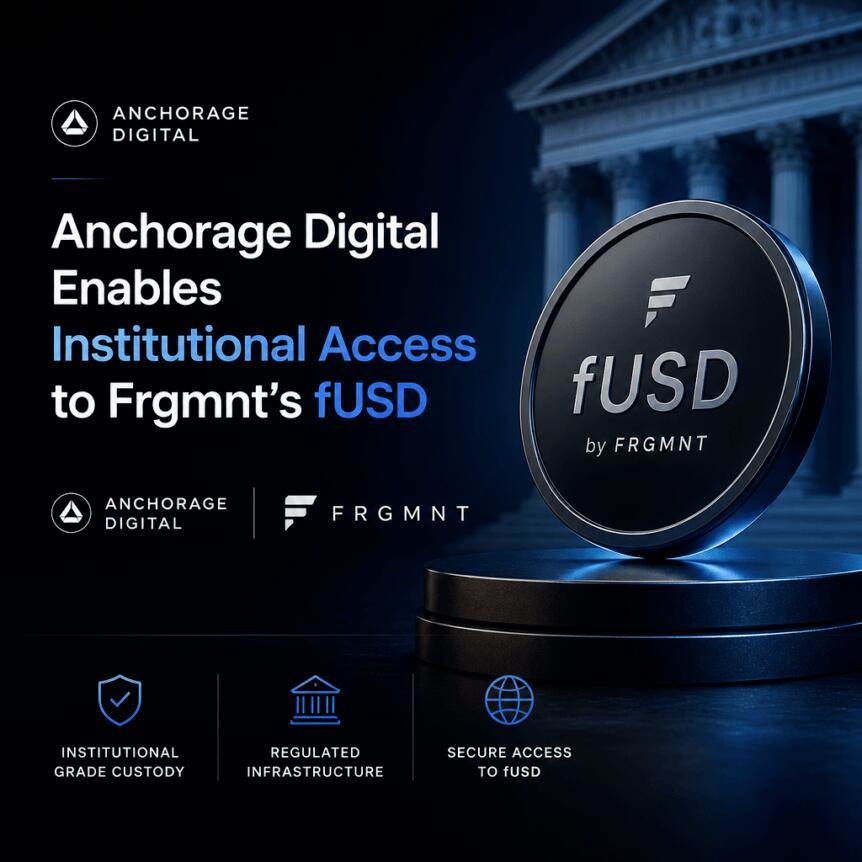
Anchorage Digital teamed up with Frgmnt to provide institutional customers with a compliant escrow channel for fUSD and sfUSD.
Anchorage Digital has entered into a partnership with the stablecoin agreement Frgmnt to open institutional customers access to Frgmnt fUSD and sfUSD tokens through Anchorage's regulated escrow platform. The arrangement is designed to allow eligible customers to directly hold, mink, redeem, pledge and unpledge fUSD on the Anchorage platform without having to establish a separate custody structure.
Core Points
- Anchorage Digital will provide institutional customers with access to fUSD and sfUSD based on escrow services, covering casting, redemption and pledge operations.
- Frgmnt issues fUSD on the Base network with USDC as collateral and links the pledge proceeds to the return in the on-chain lending market.
- Frgmnt is currently in the testing phase of the quota invitation system, but plans to open public access and increase the deposit limit on September 15.
- Frgmnt said that as of September 4, sfUSD's annual percentage return (APR) was 13.32%, while noting that yields will fluctuate with market conditions.
How Anchorage routes access to fUSD and sfUSD
This collaboration positions Anchorage as the direct entry point for institutions to participate in the Frgmnt stablecoin ecosystem. The integration plan is designed to prevent investors from transferring assets to separate custody arrangements, but instead retains all operations within the Anchorage platform, while supporting core token lifecycle functions: holding, minting, redemption and pledge-related operations.
This distinction is critical for institutions because custody arrangements often determine operating expenses, compliance controls, and the speed at which customers expand their stablecoin and on-chain revenue activities. By packaging multiple functions such as token management and pledging into one escrow workflow, the transaction reduces the frictional resistance that typically hinders the adoption of new DeFi-linked stablecoin products.
Frgmnt's stablecoin mechanism and earnings support
Frgmnt describes fUSD as a stablecoin built on the Base network and issued with USDC as collateral. The collateral for the agreement is deployed in the on-chain lending market, which means that the performance of the underlying strategy will be fed back into the rewards allocated to the pledgers.
The pledge operation converts fUSD to sfUSD, and the reward reflects the current revenue environment of the agreement. Frgmnt said in a post on the X platform that as of September 4, sfUSD's annualized yield was 13.32%. The agreement also states that yields will change as lending market conditions change, which is consistent with the behavior of typical DeFi-linked stablecoin products: stablecoin packaging may remain stable, but return characteristics are not guaranteed.
Data from DeFiLlama shows that Frgmnt has a total lock-in value (TVL) of approximately US$100,000. The same reference set also suggests that the protocol is running in a testing phase limited to invitation-based, a state that means early availability is limited compared to mature stablecoin infrastructure.
Why the September 15 public access step may be critical
The announcement links Anchorage's integration to Frgmnt's broader expansion plans. The agreement plans to open public access and increase deposit limits on September 15, moving from a limited testing phase to broader participation.
In practice, this order may affect the speed at which institutional needs translate into on-chain activities. Although Anchorage's custody access is already intended for institutional customers, Frgmnt's deposit limits during the testing period may limit the rate of new inflows. Investors and operators are likely to watch whether the September 15 increase in capacity triggers higher trading volumes or whether demand remains concentrated among early invited participants.
It is worth noting that there is an asymmetry between supervised escrow access and overall protocol participation. Anchorage's platform can simplify an agency's workflow, but the protocol's own limitations and availability rules still govern the amount of capital that enters the system at any given time.
Anchorage's in-depth deployment in regulated stablecoins and pledge services
This cooperation with Frgmnt adds Anchorage Digital's role as a regulated gateway for institutions seeking stablecoins, pledges and other on-chain financial products. Anchorage doesn't just position itself as a hosting provider; it's also venturing into a role that touches on distribution and payment-related infrastructure.
Previously, Tether chose Anchorage Digital Bank in January to issue USAT, a U.S. -focused stablecoin designed to operate under the GENIUS Act. This development has brought Anchorage to the publishing end of the market, marking a step beyond just providing managed services.
Anchorage also explores cross-border and treasury use cases. In May this year, Grupo Salinas partnered with Anchorage to support blockchain-based dollar transfers, cross-border settlements and treasury activities through its digital assets subsidiary Coinpro. In addition to stablecoins, Anchorage's institutional pledge work has expanded in terms of network and policy integration, including a policy integration with Marinade Finance's Solana pledge in April, and the subsequent addition of support for Tron TRX pledges.
Taken together, Frgmnt's collaboration strengthens a theme that Anchorage seems to be pursuing: bringing more stablecoin lifecycles and revenue stacks into the custody and control frameworks built for institutions, while allowing customers to participate in the DeFi mechanism.
Investors should pay attention to the transition from August to September-specifically, whether Frgmnt's September 15 deposit limit increase will lead to a measurable increase in participation through Anchorage, and how sfUSD's real yield trends as underlying lending conditions change. The quoted September 4 yield data provides a reference point, but the key variable will be whether those returns remain attractive after relaxing test limits.