Exchange Ranking
 Top Exchanges
 24h Volume Ranking
 Popularity Ranking
 Exchange BTC Balance
 Proof of Reserves
 Decentralized Exchanges
 Funding Rate
 Funding Heatmap
 Liquidation Data
 Max Pain
 Long/Short Ratio
 Whale L/S Ratio
 Binance/Okex/Huobi L/S
 Bitfinex Margin L/S
 ETF Tracker
 Solana ETF
 XRP ETF
 Hong Kong ETF
 Bitcoin Treasuries
 Crypto Reversal
 Ethereum Reserves
 HyperLiquid Wallet Analysis
 Hyperliquid Whale Watch
 Large Transactions
 On-chain Movement
 Bitcoin ROI
 Stablecoin Market Cap
 Options Analysis
 News
 Articles
 Economic Calendar
 Features
 Wallet
 Contract Calculator


 Security
 Collections
 Watchlist
 Following
 BTC
 ETH
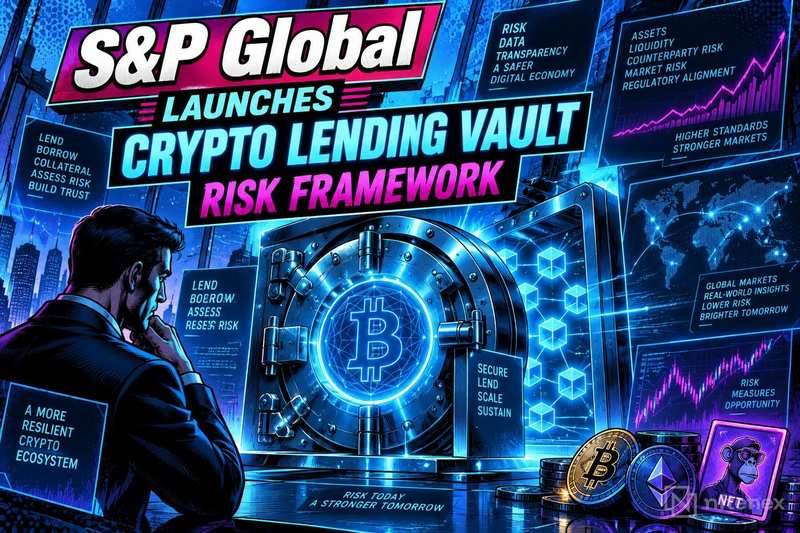
S&P Global reportedly launches a risk assessment framework for crypto lending vaults
According to unconfirmed news circulating in the digital asset field, S&P Global has launched a risk assessment framework aimed at conducting risk assessments for crypto lending vaults with a total value of more than US$10 billion. If the news is verified, the move will be one of the important milestones for major credit rating agencies to delve deeper into the decentralized finance (DeFi) infrastructure.
Details of the framework are unclear
Specific details about the framework are still limited. According to a single source, S & P's Global framework is designed to assess the risk exposure of large-scale crypto lending vaults, citing figures of more than $10 billion as an aggregate coverage threshold. As of press time, no methodology, scoring standards or specific vault operator names have been publicly disclosed.
Significance of the Standard & Poor's Global Crypto Lending Risk Framework
The risk frameworks launched by traditional credit rating agencies are essentially different from lending products. It will serve as a standardized perspective that allows institutional lenders, treasury operators and investors to compare the risk characteristics of otherwise opaque on-chain positions. This distinction is crucial: a framework means a classification system, not a security guarantee.
For a long time, the crypto lending industry has largely lacked standardized external risk benchmarks. Agreements such as MakerDAO, which operate the largest mortgage vault infrastructure on Ethereum, have relied on internal governance and community-driven risk parameters rather than third-party institutional ratings. The reported entry of S & P Global may begin to change this dynamic for large vault operators.
To understand the context of the scale involved, institutional interest in native crypto lending has gone beyond simple bitcoin mortgage arrangements. Templar Protocol's native Bitcoin lending initiative and BitGo's products such as Lightning Earn for institutional Bitcoin holders reflect the diversity of the crypto lending stack, from on-chain DeFi vaults to custody income products.
Key matters to be confirmed
Several key details have not been established in the available evidence. These details include the specific treasury or institution designated under the framework, the data inputs S & P's global use for risk scoring, any review cycles or rating update plans, and whether the framework generates publicly oriented scores or private assessments for institutional clients only.
In addition, the aggregate figure of US$10 billion also lacks original source citations. This figure may refer to the total lockdown volume (TVL) of vaults that the framework is intended to cover, or it may reflect the minimum threshold for inclusion in the standard, but there is currently no official document clarifying either interpretation.
For investors and protocol operators who are focusing on this space along with other institutional experiments with tokenized financial assets, the expansion of tokenized financial products provides further context for why they are exploring the application of traditional risk infrastructure to on-chain vaults.
Follow-up Focus
To confirm the existence of the framework, Standard & Poor's Global needs to issue a formal announcement, publish methodology or evaluation standards, or disclose participation by treasury operators. Until these events occur, the $10 billion figure and framework scope remain unproven claims and should not be regarded as a given fact.
Subsequent reporting should monitor releases by S & P's Global Investor Relations department, responses to major DeFi lending agreements, and whether any scoring output appears in loan agreements or fund disclosures and is therefore adopted by institutions. The industry-wide trend towards digital asset infrastructure that meets the requirements of the U.S. Securities and Exchange Commission (SEC) suggests that the need for standardized risk tools is real; whether S & P can provide such services on a large scale remains to be confirmed.