
 Exchange Ranking
 Top Exchanges
 24h Volume Ranking
 Popularity Ranking
 Exchange BTC Balance
 Proof of Reserves
 Decentralized Exchanges
 Funding Rate
 Funding Heatmap
 Liquidation Data
 Max Pain
 Long/Short Ratio
 Whale L/S Ratio
 Binance/Okex/Huobi L/S
 Bitfinex Margin L/S
 ETF Tracker
 Solana ETF
 XRP ETF
 Hong Kong ETF
 Bitcoin Treasuries
 Crypto Reversal
 Ethereum Reserves
 HyperLiquid Wallet Analysis
 Hyperliquid Whale Watch
 Large Transactions
 On-chain Movement
 Bitcoin ROI
 Stablecoin Market Cap
 Options Analysis
 News
News Articles
 Economic Calendar
 Features
 Wallet
 Contract Calculator


 Security
 Collections
 Watchlist
 Following
 APT
APT  AR
AR  BNB
BNB  BTC
BTC  CYBER
CYBER  LPT
LPT  TRX
TRX  WAL
WAL Key Insights
Binance News: The BNB chain plans to strengthen bridge inspections and increase block capacity through Pasteur hard fork on August 25.
Binance News shows that 16 crypto platforms are facing trading restrictions due to new U.S. and European Union sanctions.
Binance has also removed multiple spot trading pairs and plans to terminate recharge and withdrawal services on some networks.
Binance news has recently attracted attention: the BNB chain is preparing for the Pasteur hard fork on August 25, and Binance has taken action against 16 encryption platforms in accordance with new US and European sanctions, ushering in a series of new changes in the ecosystem.
Binance Smart Chain Pasteur upgrade brings higher capacity
The BNB chain plans to activate the Pasteur hard fork on the main network at 02:30 UTC on August 25. Following the test online launch on July 21, this upgrade aims to make more full use of the network speed advantages brought by previous upgrades.
The BNB chain previously achieved a 0.45-second exit time through the Fermi upgrade, while the Osaka/Mendel upgrade helped the network remain stable at this speed. Pasteur is now focusing on carrying more transactions within the same window of time while fixing weaknesses related to verifier power and network security. The upgrade includes three proposals, of which BEP-682, BEP-695 and BEP-675 are responsible for the main changes.
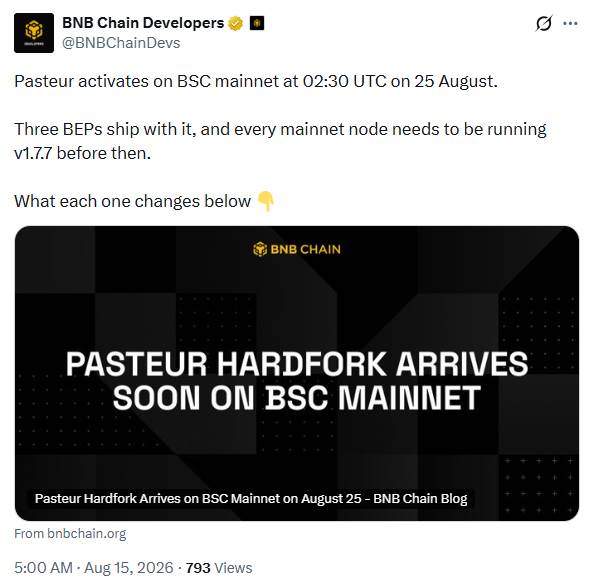 Binance Smart Chain Pasteur hard fork update
BEP-682 enhances bridge checking by preventing duplicate verifiers from being counted multiple times during signature checking. Prior to this change, validators could appear repeatedly in carefully constructed sets, with their voting rights calculated multiple times. The new rules reject such duplication.
BEP-695 handles verifier key changes. When a verifier replaces an old consensus key, the previous key should not continue to retain rights belonging to the new key. The proposal also ensures that punitive eviction mechanisms follow key rotation and prevents blacklist addresses from bypassing restrictions through signature-based governance voting.
The largest capacity change comes from BEP-675. In the current process, the builder executes the transaction before the verifier executes the transaction again, which takes up valuable time within the 450-millisecond block window. In the QANet test, the time spent on the verifier part was reduced from 125 milliseconds to 15 milliseconds. Throughput increased from 1237 TPS to 2324 TPS, and within the 100 million Gas cap, average Gas usage increased from 46.35 million to 84.15 million. These are still controlled test network data, not main-network results.
Why did Binance cut off 16 encryption platforms?
At the same time, Binance news also focused on the exchange cutting off transactions with a number of crypto platforms following new U.S. and European Union sanctions. Binance has reportedly blocked Shelbit, Aban Tether, A7 Nigeria, A7 Africa and PilotFinance. Starting August 23, the list will also include Rapira, Aifory Pro, ABCeX, WhiteBird, NoOnecrypto, Tradex, Monase, BitPapa, Exnode, HTX and EXMO Ltd.
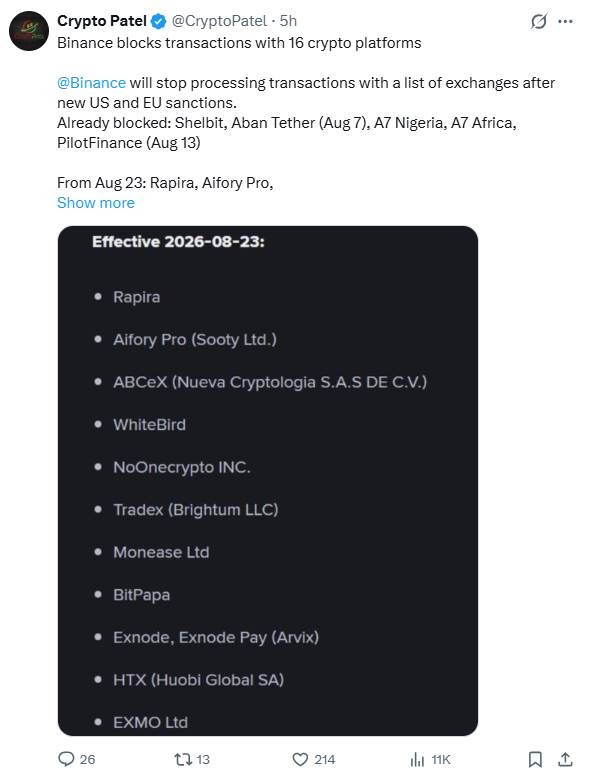 Binance blocks 16 encryption companies
The move follows regulatory action. The U.S. Treasury's Office of Foreign Assets Control (OFAC) imposed sanctions on Shelbit and Aban Tether for Iran-related financial flows, while the EU included 14 non-EU platforms in its 21st round of Russia sanctions.
Binance is complying with these regulatory measures, rather than making independent decisions on relevant platforms. For users, transfers involving affected platforms may face compliance review after the relevant date. Wallets may also be restricted during the review period, and transactions may cause problems under Binance terms.
This week's latest Binance news
In addition to the Pasteur upgrade and platform restrictions for the BNB chain, Binance also announced changes to its spot market and network support. On August 14, the exchange removed multiple spot trading pairs based on a regular review of listed markets. Affected pairs include APT/BTC, AR/BTC, A/USDC, BTTC/TRY, CYBER/USDC, LPT/BTC and WAL/FDUSD. Binance said such reviews would consider factors such as liquidity and transaction volume.
The exchange also conducted regular wallet maintenance on the Tron network on August 13. During the maintenance period, recharge and withdrawal will be suspended, and services will be restored after the maintenance is completed.
Another Binance notice stated that starting from 08:00 UTC on August 21, certain token recharges and withdrawals through selected networks will stop. More importantly, Binance warned that recharges sent through those networks after the deadline will not be credited and may result in asset losses.
























