Exchange Ranking
 Top Exchanges
 24h Volume Ranking
 Popularity Ranking
 Exchange BTC Balance
 Proof of Reserves
 Decentralized Exchanges
 Funding Rate
 Funding Heatmap
 Liquidation Data
 Max Pain
 Long/Short Ratio
 Whale L/S Ratio
 Binance/Okex/Huobi L/S
 Bitfinex Margin L/S
 ETF Tracker
 Solana ETF
 XRP ETF
 Hong Kong ETF
 Bitcoin Treasuries
 Crypto Reversal
 Ethereum Reserves
 HyperLiquid Wallet Analysis
 Hyperliquid Whale Watch
 Large Transactions
 On-chain Movement
 Bitcoin ROI
 Stablecoin Market Cap
 Options Analysis
 News
 Articles
 Economic Calendar
 Features
 Wallet
 Contract Calculator


 Security
 Collections
 Watchlist
 Following
 BTC
 ETH
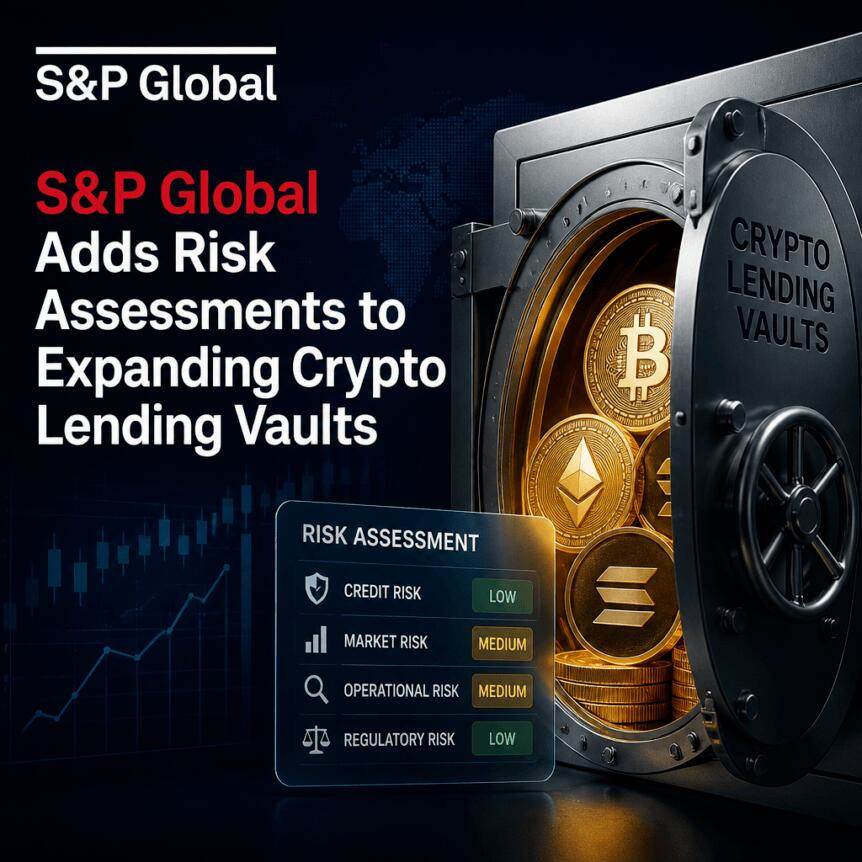
S & P Global Ratings launches digital asset lending vault risk assessment framework
As on-chain revenue products continue to attract the attention of mainstream institutions such as exchanges and wallets, S&P Global Ratings has recently introduced a new set of risk assessment frameworks, aiming to conduct a more systematic assessment of digital asset lending vaults. The framework, officially announced in an announcement released on Monday, divides treasury risk into six separate categories and aims to help market participants understand where and why investors 'losses may occur.
Standard & Poor's emphasizes that the "Vault Risk Assessment"(VRA) is not a credit rating and does not evaluate expected yields. Instead, the focus is on analyzing the vulnerability of the structure and operations of the lending vault to different types of failures such as liquidity gaps and governance flaws.
Core Points
- Six risk dimensions: Standard & Poor's treasury risk assessment framework evaluates lending treasury from six aspects: credit quality, liquidity mismatch, curator risk, blockchain risk, protocol risk, and security and governance.
- Purpose of the assessment: This assessment is intended to estimate the risk of losses faced by investors, rather than to determine credit qualifications or rate the yields generated by the treasury.
- Shortboard effect: Standard & Poor's points out that a strong score in one category cannot compensate for a significant weakness in another category, reflecting the "multiple risk/failure points" characteristics common in treasury structures.
- Rapid industry growth: Data cited by Standard & Poor's showed that deposits in lending vaults in September were approximately US$10 billion, a significant increase from US$1.5 billion two years ago.
How S & P evaluates treasury risk
In the announcement, S & P Global Ratings elaborated on the logic behind the framework and what it intends to measure. The VRA approach aims to examine the multiple levels of risks that affect the stability of digital asset lending vaults. In these vaults, funds are pooled and deployed according to predetermined strategies.
Based on the release, the framework covers the following key areas:
- Portfolio credit quality risk
- Liquidity mismatch risk
- Curator risk (Curator Risk)
- Blockchain Risk
- Protocol Risk
- Treasury Security and Governance Risk
Standard & Poor's emphasizes that these assessments are designed to measure investors 'potential loss risk rather than provide yield forecasts. The company also said the framework is not intended to treat one risk category as inherently more important than others.
In an interview, Lisa Schroeer, a global ratings analyst at S & P, highlighted a key feature of the methodology: the overall assessment can be limited by significant weaknesses of any single factor. "Significant weaknesses in any factor can limit the overall VRA score," Schroeer said."A strong score for one factor does not offset a significant weakness for another factor." She added that this approach reflects the nature of an industry with "multiple risk points of vulnerability."
Why this framework is critical to DeFi Treasury investors
Lending products package complex on-chain mechanisms into a way to allocate capital more easily understood by retail users and institutions. Depositors typically receive tokens that represent their share of assets in the vault and the corresponding return, while strategies are executed through smart contracts or in some designs, by humans or algorithmic curators.
This model, while attractive, also concentrates multiple risk vectors into a single product-risks that may not be obvious if you just compare the treasury through performance. The goal of S & P in developing the VRA framework is to increase transparency about these risk drivers so that policymakers can allocate capital based on more adequate information.
Schroeer explains this goal as: "The assessment aims to increase risk transparency and enable any entity to make smarter decisions when deciding how to allocate capital to DeFi vaults."
This is critical for investors and money allocators, as treasury performance can be affected by different failure patterns that will not be reflected solely in historical yields. Liquidity mismatches, governance controls, protocol dependencies, and security postures can all affect the possibility of withdrawals under market pressure or lead to asset damage.
DeFi Treasury growth brings closer scrutiny
S & P's move comes at a time when the digital asset lending vault is rapidly expanding beyond the pure native DeFi community. Standard & Poor's quoted data showing that deposits in the digital asset lending vault in September were approximately US$10 billion, a significant increase from approximately US$1.5 billion two years ago, showing the rapid popularity of packaged income strategies.
Across the industry, exchanges and wallet providers are increasingly introducing vause-like products that route funds to lending or income systems. Earlier this year, Wallet on Telegram introduced self-hosted BTC, ETH and USDT vaults based on Morpho, TAC and Re7 infrastructure. In May, Kraken launched the Bitcoin Revenue Vault, backed by Veda-and curated by Sentora, which reportedly attracted $30 million from 4000 wallets in the first 10 hours.
This approach has also been extended to tokenized financial products. In September, Kraken launched a revenue vault linked to tokenized versions of Nvidia, SPDR S&P 500 and Invesco QQQ ETFs, with Sentora managing the strategy and lending out underlying assets through the DeFi Marketplace.
However, as adoption increases, risks to the industry remain prominent in actual events. Previous reports have mentioned the Term Finance incident in August, where attackers used governance control of its Meta Vaults, resulting in an estimated loss of $8.5 million. Although this event is specific to a particular protocol and governance design, it illustrates the type of failure that the vault-focused risk framework is designed to highlight: governance and control weaknesses that directly translate into investor losses.
Regulatory uncertainty still shapes treasury design
即使有更好的披露工具,数字资产借贷金库在美国仍处于监管灰色地带。今年早些时候,美国证券交易委员会(SEC)委员Hester Peirce表示,取决于其结构和运作方式,某些金库和链上借贷产品可能会受到联邦证券法的约束。
Peirce的观点表明,涉及自由裁量决策的金库——例如选择资产配置、收益策略、借贷条款或清算阈值——可能会触发证券法、投资公司法规或投资顾问要求。
这种监管不确定性对投资者意义重大,因为它会影响金库运营商如何构建治理结构、决策权以及策略管理的透明度。这也意味着,如标普这样的风险框架可能成为市场参与者在评估金库在技术压力和政策审查下的韧性时,除法律合规性和运营控制之外的众多考量因素之一。
标普表示,计划在未来的公告中发布首批金库风险评估,但并未指定首先评估哪些金库。投资者应关注标普优先评估的金库类别、评估是否突出了重复出现的治理和流动性弱点,以及随着收益产品竞争的加剧,市场参与者如何应对VRA披露信息。